


Why Does My Team Still Treat Me Like a Peer After the Promotion?
Role changes fail when the system keeps rewarding the old relationship.
You were promoted into authority, but the system is still operating from the old map.
Leadership friction after a promotion from within is rarely about confidence or capability. It happens because authority changes faster than the system that supports it. When roles, decision rights, and boundaries aren't explicitly re-mapped, the organization continues to operate on the old peer structure. Authority exists on paper, but the work still routes through informal relationships.
This is where the Authority Paradox lives. When you're promoted from within, responsibility changes faster than relationships do. Without a new social contract, authority feels fragile and trust feels conditional.
This map helps you identify where the transition stalled so you can stabilize authority through structure, not over-accommodation.
I need relief now
I want to understand the pattern

Start with your map.
When leading former peers feels awkward, the issue is rarely just authority. It often reflects a deeper leadership pattern: how you hold belonging, how you set distance, how you define fairness, and what you default to when the role changes.
The Source Assessment helps you identify that pattern so you can understand why this transition feels difficult and what kind of support will help you lead without overcorrecting.
Ten minutes. Free. Your result arrives by email.
Is this your terrain?
If two or more of these are true, this is your terrain.
- You hesitate to set direction with people who still see you as "one of us."
- Directness feels like it might damage relationships that used to feel easy.
- You over-explain decisions to soften their impact.
- Team members test boundaries in small ways rather than directly.
- You feel caught between being fair and being liked.
- Old peer dynamics resurface in meetings or side conversations.
- Authority feels fragile instead of steady.
- You're accountable for outcomes without feeling fully authorized to lead.
- You sense a shift in belonging but can't name what changed.
- You wonder whether asserting authority will cost you trust.
If this is your terrain, you don't need more effort. You need a clearer map. Start with the framework that makes the peer-to-leader transition navigable.
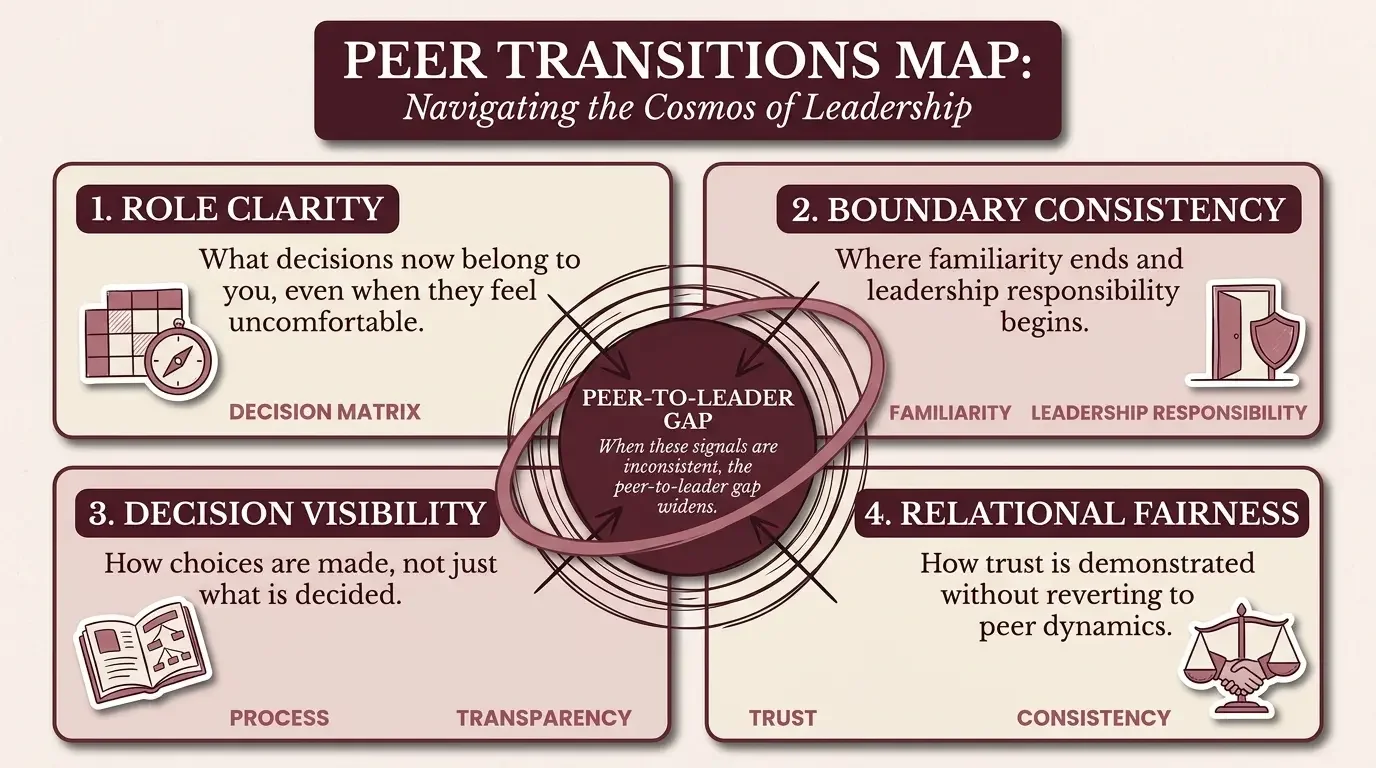
The 4 Pillars of Authority Stabilization
Authority doesn't stabilize through confidence or distance alone. It stabilizes when the team can reliably read how leadership now works.
When these signals are inconsistent, the peer-to-leader gap widens.
Role Clarity
What decisions now belong to you, even when they feel uncomfortable.
Boundary Consistency
Where familiarity ends and leadership responsibility begins.
Decision Visibility
How choices are made, not just what is decided.
Relational Fairness
How trust is demonstrated without reverting to peer dynamics.
"Hey, can we push the deadline back a week? I know you get it — we're slammed."
You feel caught between being understanding (the peer response) and holding accountability (the leader response).
- Role Clarity: "I need to hold the deadline because it impacts three other teams. Let's look at what can flex."
- Boundary Consistency: "I hear you're slammed. As your manager, my job is to help you prioritize, not extend timelines."
- Decision Visibility: "Here's why this deadline can't move: client commitment, dependencies, resource allocation."
- Relational Fairness: "I'm not saying no because I don't trust you. I'm saying no because the system needs this boundary to work."
Former peer texts you directly about a team decision instead of bringing it to the 1:1.
- Role Clarity: "Let's talk about this in our 1:1 tomorrow — these conversations need structure now."
- Boundary Consistency: "I know we used to handle this over text. Now that I'm your manager, let's use our scheduled time."
- Decision Visibility: "When decisions happen in side channels, the rest of the team doesn't see the reasoning."
- Relational Fairness: "This isn't about trusting you less. It's about creating fairness for everyone."
The first approach leaves the relationship ambiguous and authority unstable. The second clarifies the new map without damaging trust.

What this sounds like in practice
When boundaries get tested
Old peer dynamics resurface in real-time decisions
When they reference the old relationship
They invoke familiarity to soften your authority
When your role requires clarity
You need to hold structure without apologizing
Choose your route
There is no single right move here. It depends on what you need first.
Start Here If You Need Traction This Week
Use this route if you need to stabilize authority and reduce friction this week.
This route helps you create clear role boundaries without overcorrecting, step out of old peer dynamics that keep resurfacing, and lead with steadiness instead of hesitation. Start with a structure that clarifies expectations without forcing distance.
- Create clear role boundaries without overcorrecting
- Step out of old peer dynamics that keep resurfacing
- Lead with steadiness instead of hesitation

Being promoted over your peers creates role confusion fast. One day you are in the group chat; the next, you are responsible for their performance. If you feel "outside the circle," it isn't because you've done something wrong—it's because the terrain has changed and you need a new map.
This 30-60-90 day transition plan helps you navigate the shift from "one of the team" to "leader of the team" without losing trust or over-explaining your decisions.
What is included:
- The 30-60-90 Day Roadmap: A phase-by-phase guide to building authority while maintaining relationships.
- Role Clarity Framework: Tools to define new boundaries and set clear standards immediately.
- The "First 1:1" Script: A steady way to address the elephant in the room with former peers.
- Decision-Making Guide: How to close decisions cleanly so your team knows where they stand.
Why these tools work:
This plan is built on the Leadership Cartography™ method. We believe systems are a form of care. Instead of relying on your "personality" to manage former friends, this toolkit gives you a professional infrastructure. It turns the friction of role confusion into clear signals, helping you stay emotionally steady as you find your new footing.
Details:
- Comprehensive fillable and printable PDF.
- Direct, neutral language that avoids corporate fluff and marketing hype.
- Designed for immediate use during your first 90 days.
- Instant digital download.
This file is for individual use only. No redistribution or resale.

Build Fluency Before Choosing a Tool
Use this route if you want to understand the pattern before acting.
This route helps you see why authority feels fragile after internal promotion, understand why old dynamics persist even when the role changes, and learn what actually stabilizes trust during this transition. Build orientation before committing to a tool.
- See why authority feels fragile after internal promotion
- Understand why old dynamics persist even when the role changes
- Learn what actually stabilizes trust during this transition
What is actually happening
The peer-to-leader transition breaks down when system governance hasn't been reset. Your role gained new responsibilities, but the team's operating rules — how decisions are made, who owns what, how boundaries work — were never recalibrated. Everyone keeps using the old map even though the terrain changed.
Authority Without a New Contract
Decision rights shifted structurally, but governance boundaries weren't reset. The system holds you accountable while the team still relates through peer dynamics.
Trust Anchored to the Old Relationship
Peer trust was built on equality. Leadership trust requires clarity, fairness, and consistent coordination. The old relational contract can't support the new governance requirements.
Boundary Drift
Without clear direction on what changed and why, old dynamics leak forward. Authority feels fragile because you're navigating without structural boundaries.
Once you identify which governance breakdown is active, your next move becomes clear. But first, you need to recognize the signal accurately.
When you're navigating the peer-to-leader transition, your internal story is often reasonable. It's just incomplete. Here's how to read what the system is actually telling you.
When this terrain keeps repeating
If this keeps showing up across different situations, you might not need another tactic. You might need orientation. Your leadership Pathway shapes what you notice, what you prioritize, and what you misread under pressure.
You will get your Pathway orientation and next steps there.
Your interpretation. The likely signal.
| You think: | The system signal may be: |
|---|---|
| They do not trust me. | They are adjusting to new authority signals that have not stabilized yet. |
| If it matters, they will ask. | They assume you now decide what needs to be surfaced. |
| I should not have to spell this out. | Your decision rights changed faster than shared expectations did. |
| I am losing the closeness we had. | The relationship is reorganizing around responsibility, not rejection. |
| Saying "no" will damage the relationship. | They need you to name the tradeoff and hold the boundary. |
When this pattern repeats, it is not personal. It is structural.

Read The Manager's Compass to understand the structural forces shaping modern leadership roles.
These frameworks help you name the terrain friction and interpret the signals you're receiving through structured Terrain Surveys, so you can see what's happening before deciding what to do.
This is where you go when you want clarity before choosing a response.

Read The Manager's Mind to learn how these patterns surface in real leadership moments. Each post traces a lived situation so you can recognize yourself in the signal, not just understand it intellectually. This is where the framework meets reality.

Read The History of Work to understand how these dynamics formed and why they persist.
This lens connects modern managing-up friction to older systems of authority, professionalism, and control.
This is where personal frustration turns into systemic understanding.


Toolkits
These toolkits are not meant to be used all at once. Each one addresses a different pressure that shows up when you are leading through the peer to manager gap.
Start with the friction you feel most this week.
If the role changed but expectations never did
Use this when you need to reset authority, boundaries, and decision rights after being promoted from within.
If avoidance is creeping in because the stakes feel personal
Use this when you need to address tension, misalignment, or performance without damaging trust or retreating into peer dynamics.
If decisions feel heavier now and second-guessing is slowing you down
Use this to anchor authority through clear, consistent decision logic rather than personality or persuasion.
Being promoted over your peers creates role confusion fast. One day you are in the group chat; the next, you are responsible for their performance. If you feel "outside the circle," it isn't because you've done something wrong—it's because the terrain has changed and you need a new map.
This 30-60-90 day transition plan helps you navigate the shift from "one of the team" to "leader of the team" without losing trust or over-explaining your decisions.
What is included:
- The 30-60-90 Day Roadmap: A phase-by-phase guide to building authority while maintaining relationships.
- Role Clarity Framework: Tools to define new boundaries and set clear standards immediately.
- The "First 1:1" Script: A steady way to address the elephant in the room with former peers.
- Decision-Making Guide: How to close decisions cleanly so your team knows where they stand.
Why these tools work:
This plan is built on the Leadership Cartography™ method. We believe systems are a form of care. Instead of relying on your "personality" to manage former friends, this toolkit gives you a professional infrastructure. It turns the friction of role confusion into clear signals, helping you stay emotionally steady as you find your new footing.
Details:
- Comprehensive fillable and printable PDF.
- Direct, neutral language that avoids corporate fluff and marketing hype.
- Designed for immediate use during your first 90 days.
- Instant digital download.
This file is for individual use only. No redistribution or resale.
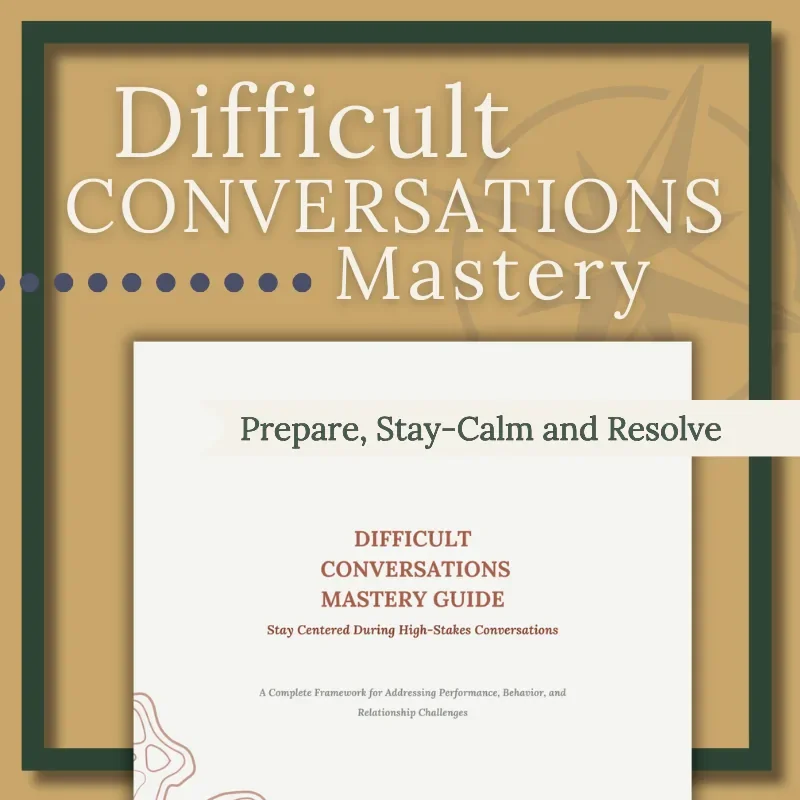
Difficult conversations don’t require a stronger personality. They require a steadier structure. This fillable guide gives you a calm, repeatable framework to prepare, open the conversation clearly, address the real issue without escalation, and close with concrete next steps. Use it for performance issues, behavior concerns, or relationship breakdowns—especially when informal feedback hasn’t worked. You’ll also get language support for common reactions (defensiveness, shutdown, tears, anger) and a follow-up plan so the conversation actually leads to change.
What’s inside (7 bullets)
Prep worksheet (facts vs. assumptions, intent, desired outcome)
Opening + closing structure
SBI (Situation–Behavior–Impact) discussion guide
Curiosity questions to reduce defensiveness
Handling reactions prompts (defensiveness/anger/tears/shutdown)
24-hour recap email template
30–60 day follow-up plan
Format line
Instant download • Fillable + printable PDF • 18 pages
FAQ (3)
Is this a script? Not word-for-word—structure + adaptable language.
Will it work for performance and behavior? Yes—both, plus interpersonal tension.
Does it include follow-up? Yes—recap email + follow-up cadence.
What This Tool Is
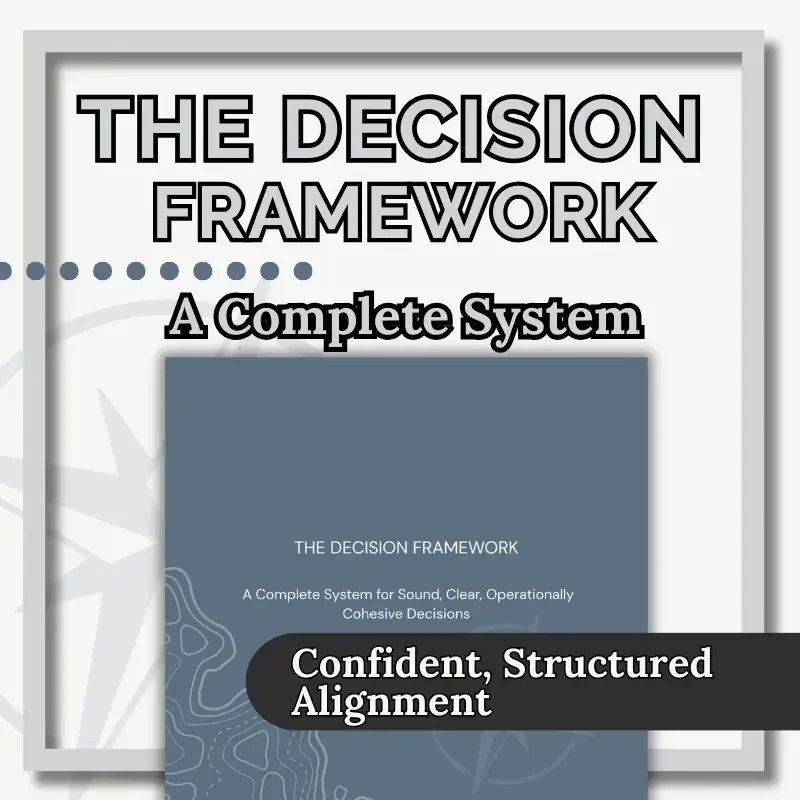
THE DECISION FRAMEWORK is your end-to-end system for making strong, defensible decisions—especially under pressure, incomplete information, or competing priorities.
This Pro Edition gives you the full workflow: how to define the decision, evaluate options, test alignment, anticipate risks, consult stakeholders, communicate clearly, and review outcomes. It’s the same structure executive leaders use to ensure decisions hold across teams, timelines, and operational realities.
If the stakes are real, this is the system you use.
Who This Is For
This toolkit is designed for managers who:
• Lead cross-functional work
• Need decisions that scale beyond one team
• Navigate urgency, ambiguity, or missing information
• Carry operational responsibility
• Want decisions that can be explained, defended, and revisited with clarity
What You’ll Be Able to Do
With this system in place, you’ll be able to:
• Separate urgency from importance
• Clarify success before choosing an option
• Evaluate choices using a weighted scoring model
• Identify and mitigate risks early
• Align decisions with values, strategy, and capacity
• Communicate decisions cleanly and consistently
• Reduce rework and avoid pressure-driven mistakes
• Build a repeatable decision culture on your team
What’s Inside
A complete 15-part decision-making system, including:
• Decision definition and urgency assessment
• Information analysis
• Success criteria
• Option development
• Criteria weighting + scoring model
• Risk analysis + mitigation planning
• Values alignment check
• Stakeholder input workflow
• Implementation roadmap
• Communication plan
• 30–90 day review framework
• Plan B readiness checklist
You get the entire structure—not just templates.
This is a full operational decision architecture.
Why It Works
Most decision-making tools focus on speed or consensus.
This one focuses on soundness, clarity, and operational cohesion.
It brings order to pressure, structure to uncertainty, and strategic steadiness to your leadership practice.
This framework teaches you how to think, not just what to do.
Format
• PDF
• Designed for printing or digital completion
• Includes all tables, grids, scoring models, and planning templates
• Metadata embedded per MMMCo standards
How It Fits Into Leadership Cartography™
This tool expands the Precision and Purpose pathways by strengthening:
• Decision literacy
• Systemic awareness
• Risk interpretation
• Structural clarity
• Values-integrated judgment
It becomes a cornerstone tool in any manager’s “operational architecture.”
Continue Your Development
Pair this with:
• The Urgency Filter Map (free weekly Trail Map)
• The Manager’s Map Drawer (monthly rotating tools)
• Discovery Toolkits for deeper pathway development
Every leader needs a map.
This one ensures your decisions are built on clarity—not pressure.
Related terrains you may be navigating
When you are promoted from within, authority shifts faster than expectations and relationships. That transition often activates adjacent terrains at the same time.
Feedback Pattern Map
When feedback starts landing awkwardly, inconsistently, or feels harder to interpret than it used to.
Delegation Block Map
When handing work off suddenly feels relationally risky, even when it is necessary.
Overwhelm Type Map
When responsibility expands faster than capacity and everything begins to feel urgent.
Managing Up Map
When you are accountable for outcomes but the expectations above you remain implicit or unspoken.
Team Dynamics Map
When peer relationships shift and group behavior changes after your role changes.
Time Management Map
When priority churn increases because decision authority is still stabilizing.
Leadership Identity Map
When you feel friction between who you were as a peer and who the role now requires you to be.
Former Peer Transition Map
Before you choose a next move, here are four clarifying answers managers tend to need in this terrain.
Why does leadership feel harder after a promotion from within?
Because authority changes faster than relationships. The system still routes expectations, decisions, and trust through the old peer map even though your role has shifted.
Is resistance from former peers a respect issue?
No. It's usually a role clarity issue. When decision rights, boundaries, and escalation paths aren't reset, people default to prior relational patterns.
Why do I feel stuck between being "one of the team" and being the leader?
Because the system hasn't fully transitioned authority. Without explicit re-mapping of roles and expectations, leaders are forced to negotiate authority informally.
What does this page help me do differently?
It helps you identify where the authority transition stalled, so you can reset structure and expectations instead of managing relationships through over-accommodation.

When authority changes inside an existing relationship, the org chart moves faster than the relationship can. Here is how to protect the work, the role, and the relationship at the same time.