
How to Assert Leadership When Your Team Still Sees You as “One of Us”

If your team still treats you like “one of us” after you get promoted, asserting leadership can feel like risking the relationship. That is normal. It is not a confidence issue. It is a role transition that never became operational. The fix is not to get harsher. The fix is to make the new agreements visible. In this article you will use a simple Role Reset Map to name the shift, clarify decision lanes, and reinforce the new pattern in real time so you can hold the line without losing trust or belonging.
Quick Map (60 seconds):
Name the shift.
Clarify decision lanes.
Reinforce the new map in real time.
This is also called the peer-to-manager transition, or managing former peers after a promotion.
You’ll leave with a sentence to name the shift, a way to divide decision lanes, and three phrases to reinforce the new pattern this week.
🎙️Prefer to listen?
I remember the extreme sense of belonging I felt right after I got promoted.
I was still working alongside my peers. I was still inside the same jokes, the same rhythm, the same “we’re in this together” energy.
And for a moment, it felt like nothing had changed.
Except everything had.
Because I was their manager now. I needed them to respond to the role, not just to me. I needed follow-through. I needed a different standard. I needed the work to land.
They still wanted the old arrangement.
That is the moment most new managers get stuck. They think asserting leadership means becoming colder or tougher.
It does not.
It means making the role shift clear, then holding to it consistently so you are not negotiating authority through friendship.
This is not a personality problem. It is a role transition without new agreements.
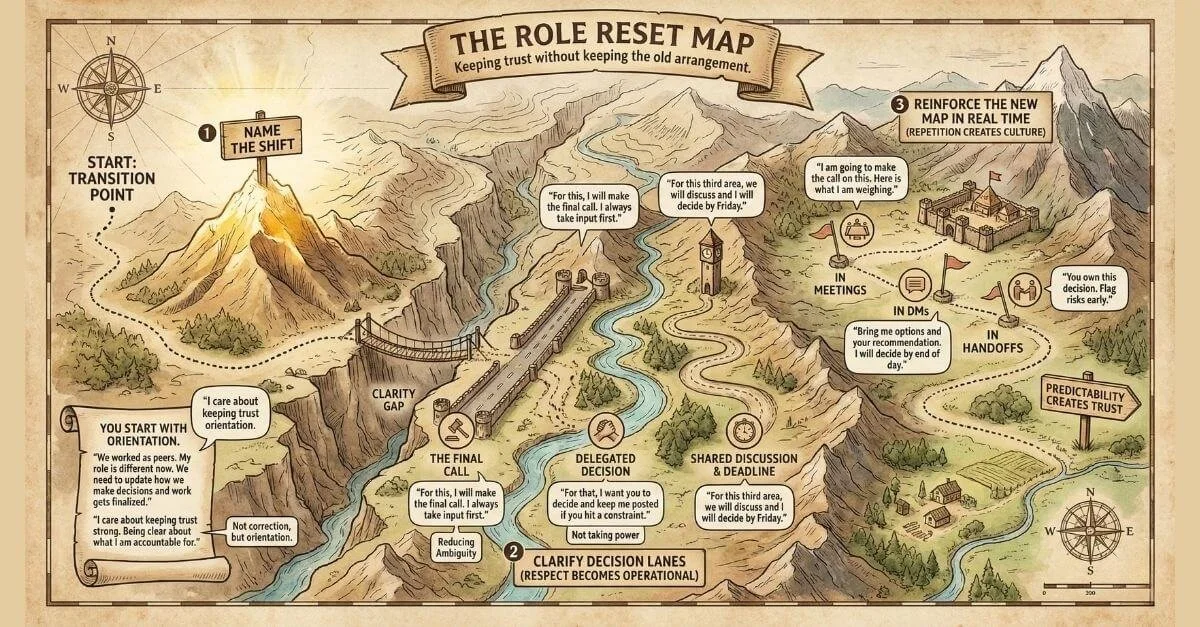
The Role Reset Map
If you are in this transition, here is the mini-map that helps you keep trust without keeping the old arrangement.
1️⃣ Name the shift
You do not start with correction. You start with orientation.
“We worked as peers for a long time. My role is different now, and we need to update how we make decisions and how work gets finalized.”
“I care about keeping trust strong. Part of that is being clear about what I am accountable for.”
2️⃣ Clarify decision lanes
This is where respect becomes operational.
“For this, I will make the final call. I will always take input first.”
“For that, I want you to decide and keep me posted if you hit a constraint.”
“For this third area, we will discuss and I will decide by Friday.”
You are not taking power. You are reducing ambiguity.
3️⃣ Reinforce the new map in real time
One conversation does not reset a culture. Repetition does.
In meetings: “I am going to make the call on this. Here is what I am weighing.”
In DMs: “Bring me options and your recommendation. I will decide by end of day.”
In handoffs: “You own this decision. Flag risks early.”
Predictability creates trust.
If you need scripts for this
If you want language you can use immediately, especially when you are trying to hold the line without sounding harsh, use The Boundary-Setting Scripts
Why asserting leadership can feel like betrayal
One thing I want to name is what happened inside me when my feelings got hurt.
It was not just disappointment. It was a real sense of betrayal.
That part was brutal, because betrayal is not a small emotion. Betrayal reaches straight for trust. It takes one moment and turns it into a dramatic, painful story:
They do not care about me.
They are not loyal.
I cannot trust them.
And once trust or betrayal gets placed in front of the friendship, it becomes very hard to continue. Even if nothing was intentional. Even if, intellectually, you can see they were not trying to harm you.
Their intention might have been, “We want things to stay the same.”
But my body heard, “You are alone in this now.”
If you are in this moment, I want you to hear this clearly.
This is not a personality failure. This is what happens when belonging gets threatened and the system has not updated to match your new role.
The real problem is still the same: the lanes never became explicit
When you become the manager of people who used to be your peers, three things often remain unspoken:
Decision rights: Who decides what, and when.
Boundaries: What access and assumptions are no longer appropriate.
Operating rhythm: How work moves now that you are accountable for outcomes.
When those are not talked about up front, people fill the gap with what they remember. That is not malicious. It is default behavior.
So you keep trying to assert authority, but you are doing it inside a system that still thinks you are a teammate, not the manager.
And as a result, every moment starts to feel personal.
What I wanted versus what I had to do
Here is the cleanest way I can say it.
What I wanted was equal respect for the role I held.
But what I had to do was different.
I had to step back and decide whether I wanted to stay in peer friendships, or fully step into being their manager.
When I fully stepped into the role, everything changed.
I held the line.
I held everyone accountable.
I stopped treating pushback as an attack on our friendship.
That changed everything.
Because you cannot lead a team if you are constantly trying to protect a social arrangement that no longer fits the role.
What I wish I had been aware of sooner
This is what I would say to my past self, if given the opportunity.
I should have named what was happening in me, not to me. The belonging trigger was real, and I needed to be aware of it so I could respond with clarity instead of emotion.
Yes, I should have known all this. But I did not. It was out of my awareness.
So I suffered needlessly.
That is why I am writing this. So you do not have to suffer the way I did. So you can recognize the belonging trigger early, name the role transition clearly, and move through it with steadiness instead of self-doubt..
What not to do, even if you are tempted
Do not wait until you are angry to set boundaries. Anger makes boundaries sound punitive.
Do not over-explain your authority. Over-explaining teaches people your role is negotiable.
Do not keep paying for belonging with ambiguity. It will cost you later.
The closing truth
You can keep trust.
But you cannot keep the old arrangement.
This is not betrayal. This is role transition without new agreements.
And once you make the new agreements clear, you stop fighting for belonging and you start leading with steadiness.

Choose Your Next Steps:
Need words today → Boundary-Setting Scripts
Need a 30–60–90 structure → Peer to Leader Transition Plan
Need orientation on your default under pressure → Leadership Style Quiz