
Managing Former Peers: How to Rebuild Authority Without Losing Trust

To rebuild authority with former peers, you don’t need a personality change. You need the role shift to land through concrete expectations, clean decision closure, and early boundary reinforcement. When the system becomes predictable, trust forms and testing drops.
You didn’t lose authority. The shift just never landed.
🎙️ Prefer to Listen

When you start managing former peers, authority usually breaks down for one simple reason: the team is still operating from the old map. If expectations, decision rights, and boundaries were never reset in the system, your employees keep treating you like a peer—even if they respect you.
This isn’t a confidence problem. It’s an alignment problem.
If you’re managing former peers after a promotion, the hardest part is making the authority shift real without damaging trust. This is the peer-to-manager transition—especially hard when you’re managing former friends.
By the end of this, you’ll know which of the three shift-landing levers you need most this week, and the first sentence to use when you set it
To rebuild authority with former peers, you don’t need a personality change. You need the role shift to land through concrete expectations, clean decision closure, and early boundary reinforcement. When the system becomes predictable, trust forms and testing drops.
If you’re overthinking your tone, getting pulled into side conversations, or watching decisions get treated like suggestions, you’re in the transition gap:
decisions treated like suggestions
bypassing to your manager
constant “just this once” exceptions
side-channel venting
undermining jokes framed as “just kidding”
The Two-Front Transition
When you step into management from inside the team, most of the struggle isn’t skill.
It’s two transitions happening at the same time—and most new managers only prepare for one.
Front one: managing former friends
A lot of new managers try to be a boss and a friend at the same time.
Not because they’re immature. Because the relationship contract hasn’t been updated yet.
If you don’t set a new standard early, your employees keep operating off the old map:
casual access
informal exceptions
side conversations that used to be harmless
boundaries that feel “flexible” until they aren’t
Then the tests start showing up in real time—small oversteps, little negotiations, quiet bypassing—and if you don’t reinforce boundaries in the moment, the system learns something fast:
the new role is optional.
Front two: earning trust and respect in the new role
A title changes responsibilities.
It does not automatically change how your employees relate to you.
Many new managers expect the org chart to do the relational work for them. But your employees are watching for something else:
Do you follow through?
Are you consistent?
Are you fair when it’s uncomfortable?
Can you hold the line without turning cold?
That’s what builds trust. That’s what becomes respect.
And when you’re younger than some people on the team, this becomes even more important—not because age determines competence, but because it can intensify legitimacy testing. If boundaries and decision rights aren’t clear, your employees will keep checking where the edges are.
This is why it can feel like you “lost authority.”
You didn’t.
The shift just never landed.
The Authority Paradox
Here’s the paradox that makes this transition so emotionally charged:
Trust is built through connection.
Authority is built through direction and follow-through.
If you protect connection by avoiding direction, your authority erodes.
If you protect authority by dropping connection, trust erodes.
Most new managers swing between two extremes:
Over-accommodating: staying “one of the team,” softening decisions, avoiding hard moments
Over-correcting: getting distant, rigid, overly formal, sharper than you intend
Neither creates stability, because neither tells the truth of what changed.
The shift doesn’t land through vibes.
It lands through shared language.
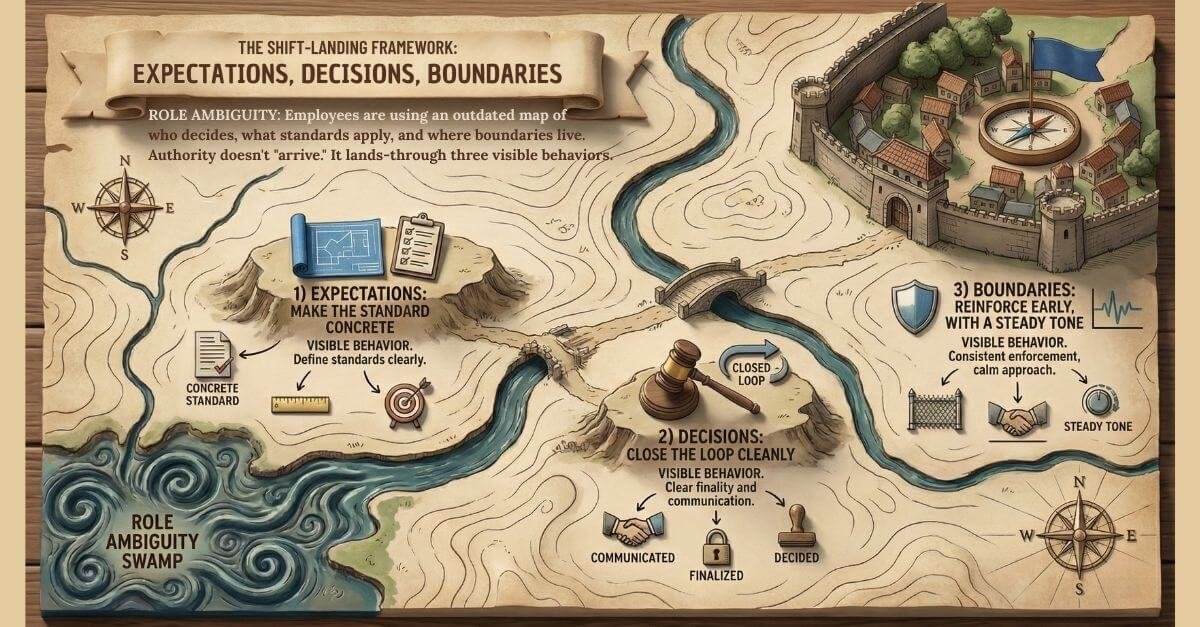
The Shift-Landing Framework: Expectations, Decisions, Boundaries
This is role ambiguity: your employees are using an outdated map of who decides, what standards apply, and where boundaries live.
When you manage former peers, authority doesn’t “arrive.” It lands—through three visible behaviors your employees can feel immediately.
1) Expectations: make the standard concrete
Most former-peer tension is not disrespect. It’s unspoken expectations colliding.
How it shows up:
You assume deadlines are firm now; your employees assume “we’ll figure it out like we always have.”
You assume meeting attendance matters; they assume it’s optional because it used to be.
You assume work quality has a new standard; they assume “good enough” still counts because it always did.
What changes things: pick the 2–3 standards that matter most right now and repeat them consistently—so people stop guessing what you want.
2) Decisions: close the loop cleanly
Authority friction often gets labeled as “my team won’t listen,” when the real issue is:
no one knows who decides what anymore.
How it shows up:
A former peer keeps “workshopping” your decision in Slack like you’re still equals.
Disagreements escalate late—after people have already lobbied others.
Someone claims “we already agreed” when nothing was actually decided.
What changes things: make decision points visible—input window → decision → next step—so decisions stop lingering as open negotiations.
3) Boundaries: reinforce early, with a steady tone
Boundaries are where the promotion becomes believable—especially when you’re managing former friends.
How it shows up:
“Just this once” exceptions
side-channel venting about leadership
undermining jokes framed as “just kidding”
pulling you into private side chats instead of addressing things openly
What changes things: you don’t let the small oversteps become normal. You redirect early and calmly so your employees learn the new edges.
How Your Employees Test the New Role
Even after you reset the system, your employees will test the new role. Not to undermine you—because they’re checking what’s real now.
The “optional decision” test
You make a call and it keeps getting debated after the fact.
Your move: close the loop—decision + owner + next step—then stop re-litigating without new information.
The bypass test
Someone goes around you to your manager to get a different answer.
Your move: treat it as a process defect, rebuild the escalation path, and align with your manager so bypassing stops getting rewarded.
The exception request
“Just this once” keeps appearing, especially from former friends.
Your move: require tradeoffs and make exceptions visible. Exceptions without costs teach entitlement.
The undermining joke
A comment positions you as equal again in front of others.
Your move: interrupt lightly and keep moving. You’re not correcting a person—you’re correcting a dynamic.
The “you’ve changed” test
Someone expresses grief or annoyance that you’re different now.
Your move: confirm the reality without apologizing for the role, and invite specifics so you aren’t trapped in vague tension.
Pattern underneath all tests: your employees are asking one question:
Are your boundaries real, or are they negotiable if we apply pressure?
“Pick your lever for this week”
If expectations are the problem, start with the Peer to Leader Transition Plan. It gives you the structure to reset standards without making it a big, awkward announcement.
If people keep debating after closure →Decisions
If standards feel fuzzy → Expectations
If side channels and jokes are rising → Boundaries
You Didn’t Lose Authority — The Shift Just Never Landed.
If you’re managing former peers and it feels like your leadership isn’t working, don’t jump to “What’s wrong with me?”
Most of the time, nothing is wrong with you.
What’s wrong is the map your employees are still using.
They’re still relating to you through the old contract: same access, same negotiation, same informal exceptions, same side-channel dynamics. And you’re trying to lead through a new contract: clear standards, clear decisions, clear accountability.
That mismatch is what creates the friction.
So the fix isn’t to become colder.
It isn’t to become louder.
It isn’t to prove you deserve the title.
It’s to make the shift land:
make expectations concrete
close decisions cleanly
reinforce boundaries early, with a steady tone
When your employees experience you as predictable, they stop testing.
When they stop testing, trust can actually form.
You didn’t lose authority.
The shift just never landed.
Stop Guessing Where the Lines Are
If you need words for the moment → Difficult Conversations Guide
If you need structure for the next 30–90 days → Peer to Leader Transition Plan
If you’re unsure what you default to under pressure