
How to Master the Former Peer Transition
The former peer transition is often misread as a relationship problem when it's actually an authority calibration problem. New managers misinterpret role awkwardness as personal failure, when it more accurately signals that the system hasn't given you permission structures to hold your new ground. Without translation tools for the shift from peer to leader, managers default to vagueness or over-correction. Both of these approaches erode trust faster than clear, calm boundary-setting ever could.
You're standing in the same conference room where you used to complain about managers who didn't understand what it was like to do your job.
Now you're the manager.
The person sitting across from you—the one avoiding eye contact—was the person you vented to three months ago. You used to split appetizers. You traded weekend coverage. You knew each other's work rhythms without needing to ask.
Now you're supposed to give feedback. Set expectations. Hold the line when they push back.
And you don't know how to do any of it without feeling like you're betraying something.
Why Most Former Peer Transitions Fail
Most new manager training focuses on skills: delegation, feedback, performance management. But none of that lands if you haven't first stabilized the relational ground beneath your authority.
Here's what makes the former peer transition uniquely difficult:
You're operating in two time zones at once. Your team still sees you through the lens of who you were. You're trying to embody who you need to become. The gap between those two versions creates friction in every interaction.
The old social contract is gone, but the new one isn't clear yet. You used to share information freely. Now some things are confidential. You used to commiserate about leadership decisions. Now you're the one making them. The rules shifted, but nobody told you which ones or how to name the change.
Your former peers are watching to see if you've changed. They're measuring your tone, your decisions, your availability. Some are rooting for you. Some are waiting to see if you'll favor certain people. Some are grieving the loss of the peer relationship you used to have.
You're afraid that setting boundaries means you've become "one of them." The managers you used to criticize. The ones who stopped listening. The ones who forgot what it was like. You don't want to be that person, so you stay too close, too available, too apologetic about your new role.
The cost of not addressing this terrain clearly: your team stays confused about your authority, you stay exhausted trying to manage everyone's feelings about the transition, and the relationships you're trying to protect erode anyway.
But here's what matters: the specific friction point you're standing on determines which tool you need first.

Stampeders hike up the Golden Stairs from Scales tent city on the Chilkoot Trail, ca. 1898
David Sundman, Smithsonian National Postal Museum
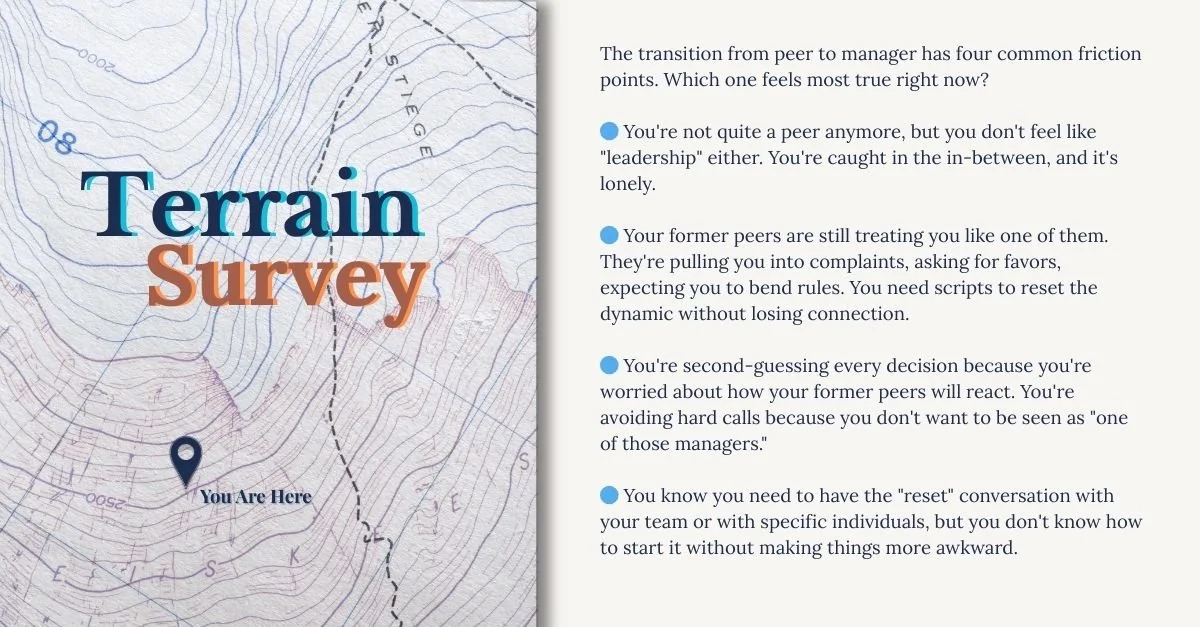
The Peer-to-Leader Pass: Where Are You on the Former Peer Map?
The Former Peer Transition Map: Your 4-Phase System
Once you know which friction point you're standing on, here's how the full transition system works.
This isn't about "earning respect" or "establishing authority" through force. It's about naming the shift, holding your ground, and rebuilding trust on new terms.
Name the Transition (Week 1)
Purpose: Acknowledge the shift before your team fills the silence with their own interpretation.
The key move: Hold a short team meeting in your first week. Name the change directly, state your commitment, and acknowledge the adjustment period. The exact language matters, which is why having a transition script helps you stay grounded in the moment.
What shifts: Your team stops guessing what you're thinking. You establish that it's okay to talk about the change. You create psychological permission for the transition to be real.
Reset Boundaries Without Apology (Weeks 2-4)
Purpose: Establish your new ground before small boundary violations become patterns.
The key move: Identify one or two behaviors that need to shift (being pulled into complaints, being asked to bend rules, being treated as the "inside source"). Script the reset conversation. Deliver it as information, not negotiation. Hold the line for 30 days.
What shifts: Your team learns where the new boundaries are. You stop carrying the emotional weight of trying to be everyone's peer and their manager at the same time.
Rebuild Trust Through Consistency (Months 2-3)
Purpose: Earn credibility in your new role through reliable follow-through, not through performing authority.
The key move: Keep commitments. Be predictable. Explain decisions when appropriate. Show up the same way in every interaction. No favorites, no exceptions.
What shifts: Your team stops testing boundaries. They start bringing problems to you before they escalate. Resistance decreases. Questions become operational instead of emotional.
Address Lingering Dynamics (Month 4+)
Purpose: Surface and resolve the specific relational patterns that haven't self-corrected.
The key move: Identify who is still operating as if you're peers (undermining in meetings, bypassing you, making jokes that erode authority). Schedule a direct conversation. Name the pattern clearly. State the impact. Clarify the path forward.
What shifts: The last pockets of resistance dissolve. Your authority stabilizes. You can focus on leading instead of constantly re-establishing your role.
Do / Don't
✅ Do:
Do name the transition out loud in your first week. Silence creates more anxiety than acknowledgment ever could.
Do set boundaries calmly and clearly. Your team needs to know where the new lines are.
Do hold everyone to the same standard. No exceptions for the people you were closest to.
Do give yourself permission to be learning. You don't need to have all the answers on day one.
Do rebuild trust through follow-through. Reliability matters more than likability.
Do make your decision-making process visible. When people understand your reasoning, they trust you more.
❌ Don't:
Don't apologize for being promoted. Your role isn't something to feel guilty about.
Don't try to maintain the old friendship dynamic. The relationship has to evolve, not stay frozen.
Don't avoid hard conversations hoping things will smooth out on their own. They won't.
Don't over-correct by becoming distant or cold. You can be warm and clear at the same time.
Don't make exceptions to prove you're "not like other managers." Inconsistency damages trust faster than boundaries ever could.
Don't keep secrets about organizational decisions to maintain the "peer" feeling. You now hold confidential information, and that's appropriate.

Why This Matters
Leadership Cartography™ approaches the former peer transition as a relational terrain shift, not a character test. You're not failing if the transition feels hard. You're navigating legitimately difficult ground.
The system gave you a promotion without giving you the translation tools to name the change. Your job isn't to pretend the shift isn't happening. Your job is to name it clearly, hold your new ground steadily, and rebuild trust on terms that fit your actual role.
The transition isn't about becoming someone else. It's about holding the same values with a different scope of responsibility.
Your Next Steps
This week:
If you're in your first 90 days: schedule your "naming the transition" team conversation
If you're past 90 days and still feeling the friction: identify one boundary that needs resetting and script the conversation
If a specific former peer dynamic is stuck: schedule a private conversation using the pattern-naming script
This month:
Map your consistency gaps. Where are you still being pulled into peer-level behaviors that don't fit your role?
Build your boundaries as systems, not personality traits
Track trust signals: when do people start bringing problems to you first?
The former peer transition isn't a problem to solve. It's terrain to navigate with clarity, steadiness, and a map.
Build Your Full System
The former peer transition requires more than one conversation—it requires a complete first 90 days system.
If the former-peer transition still feels unstable, it is usually because the work stopped at the conversation.
The Leadership Crossing: Your First 90 Days is not advice. It is a structure.
This map breaks the first 90 days into three distinct phases so you can:
establish authority without becoming rigid,
build systems that reduce friction instead of increasing it,
and move out of constant self-monitoring and into steady leadership.
It is designed for managers who want clarity without bravado and structure without losing themselves.
This is not about proving you belong.
It is about building the ground so the role can actually hold.
Use it when you are done explaining the shift and ready to stabilize it.