
Manager Identity: Stop Being a Doer and Start Leading
Manager identity confusion is not a confidence problem. It is a role-definition problem.
Most managers are promoted for visible execution, but leadership responsibility becomes invisible once they step into the role. When systems continue to reward doing while expecting leading, managers stay stuck in the doer trap. The tension they feel is not personal failure. It is a signal that authority has shifted without being clearly relocated.
Leadership begins to stabilize when managers stop measuring their value by output and start locating what the system is actually asking them to hold.
You are still doing the work you used to do.
People still come to you when something breaks. You still fix, solve, and deliver. You just do it now with “Manager” in your title and a calendar that is somehow fuller than it was before.
When someone asks what your job is, you start listing tasks. You talk about projects, tickets, deliverables, problems handled. You do not describe what you are building. You do not describe what you are responsible for holding.
At some point, a quieter question shows up and does not leave:
If you are not doing the work, what exactly are you here to do?
The Orientation
Manager identity confusion is often treated as a confidence issue.
It is more accurately a role-definition issue.
Most organizations promote high-performing contributors because the system can already measure their value. They ship work. They solve problems. They are reliable. Then the promotion happens and the system quietly changes what it expects, without translating what leadership actually is.
When the new role stays undefined, managers remain positioned inside the work they were rewarded for, even while being held responsible for outcomes that require a different kind of authority.
The result is not incompetence.
It is exhaustion, stalled teams, and a persistent sense of failing at a job that has never been clearly named.
Why the Doer Trap Persists
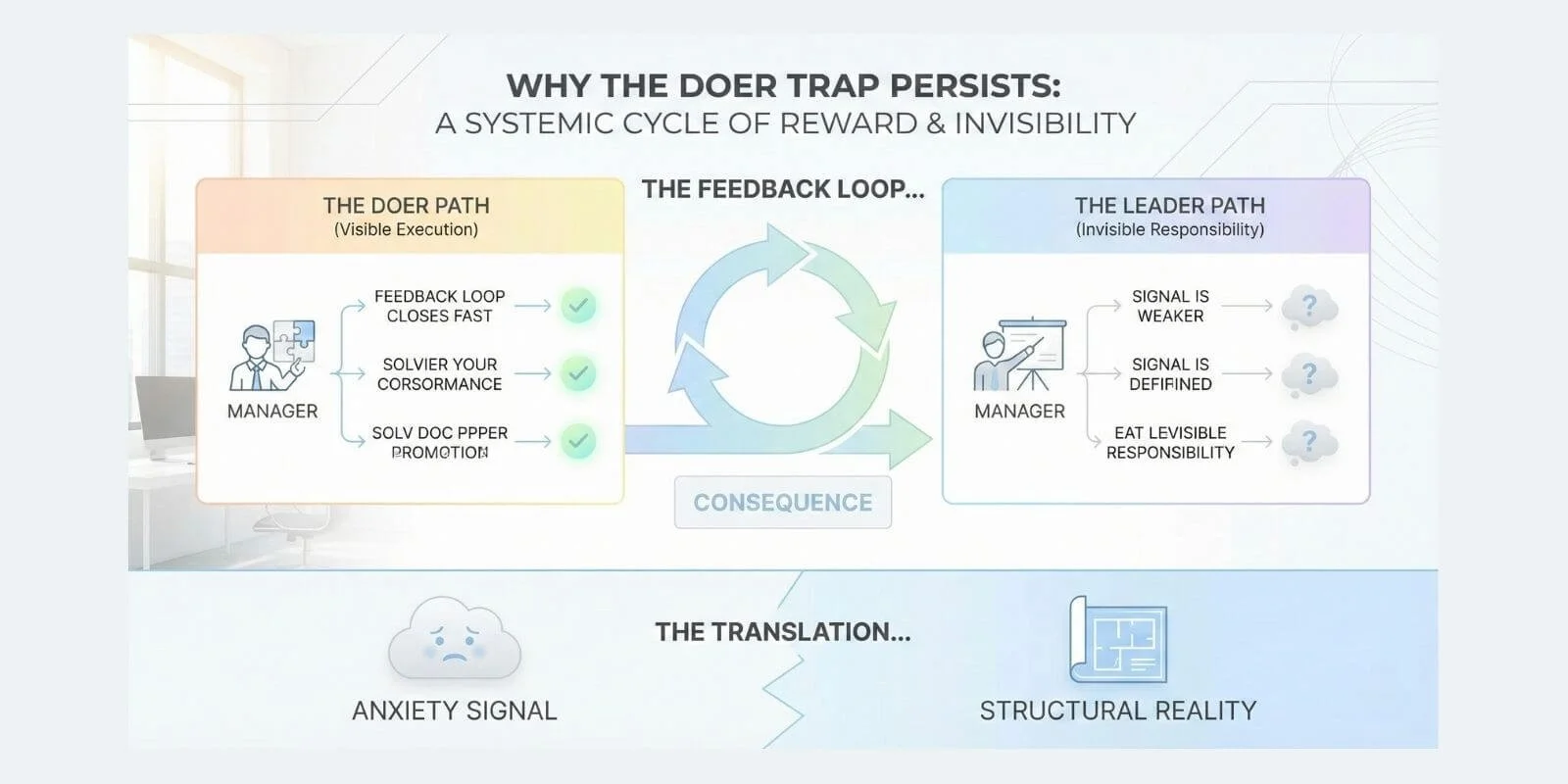
This pattern tends to appear when systems continue to reward visible execution after formally assigning invisible leadership responsibility.
When a manager steps in and solves the problem personally, the feedback loop closes fast. Work moves. Friction drops. Appreciation appears. The contribution is legible.
When a manager slows the system down to build capability, coach judgment, or create conditions for ownership, the signal is weaker. The outcome takes longer. The recognition often never comes.
Over time, the system trains managers to stay close to execution even while holding leadership titles. The doer identity remains readable. The leadership identity stays abstract.
The Translation
When stepping back from the work creates anxiety, it stops being a personal confidence problem.
It becomes a signal that authority has not been structurally relocated.
Without clear boundaries around what leadership is responsible for creating, the system keeps pulling managers back into the work they already know how to do. Not because they are avoiding leadership, but because the terrain where leadership lives has not been made visible yet.
A Different Lens on “Manager Identity”
Leadership Cartography is a framework developed by Your Leadership Map that treats manager identity as a positioning problem, not a personality problem.
From this lens, “stop being a doer” is not advice. It is a description of a structural transition the system is asking for but often fails to support. Identity friction is read as a signal about incentives, authority, and legibility. The question becomes less “What is wrong with me?” and more “What is the system currently reading as leadership here?”
That shift matters because it reduces self-blame. It also makes the role easier to see.
Where Identity Gets Stuck
The doer identity persists for predictable reasons:
The old identity had clear measures. The new one does not.
The system still provides faster feedback for doing than for leading.
Teams often prefer speed over development in the short term.
Authority is frequently implied rather than explicitly repositioned.
None of these are moral failures. They are structural conditions. When they stay unnamed, managers internalize the friction as self-doubt.
The Identity Pass: Where Are You on the Self Map?

Leadership identity friction tends to surface in familiar places. Which one feels closest right now?
You are delivering, but you still feel like you could be exposed at any moment.
You are performing leadership instead of inhabiting it, and the performance is draining.
You are copying what you have seen because you do not yet have language for your own style.
You keep measuring yourself against other managers and coming up short.
Sometimes the most useful move is not choosing a tool. It is choosing an entrance.
Choose the route that fits your nervous system today:
The Shift That Is Not a Shift
Leadership identity does not usually change through replacement.
It changes through relocation.
When authority is no longer anchored to personal output, other forms of leadership become visible. Some leaders stabilize systems. Some create clarity. Some hold emotional weather. Some design structures that others can move inside.
None of these are better. They are different sightlines.
Much of the exhaustion managers feel comes from trying to lead against their natural orientation instead of from it.
In Practice
A manager promoted from a senior technical role stayed deeply embedded in daily execution months after the transition. From the system’s perspective, nothing was broken. Work shipped. Problems were handled.
From her perspective, leadership felt unreal. She was busy and invisible at the same time.
Once her role was reframed around what only she could hold—direction, decision authority, and development pathways—the system began to redistribute the work. Execution did not stop. It moved.
Her identity did not change.
Her position did.
Why This Matters
This moment matters because it is usually where managers turn on themselves.
They call it impostor syndrome. They call it self-doubt. They call it a confidence problem. But what is actually happening is quieter and more structural than that.
The system changed the rules without naming them.
When expectations remain implicit, managers keep measuring themselves by the last rules they were given. Output. Speed. Personal reliability. Over time, this creates a private tension. You are working constantly, yet you are no longer sure what success looks like.
That uncertainty is not a signal that you are failing.
It is a signal that your position has shifted and the terrain has not yet been mapped.
What to Notice Next
Nothing needs to be decided immediately.
If you do nothing after reading this, something still changes. You may notice when you step into the work because it feels grounding. You may notice when leadership feels performative rather than natural. You may notice which moments drain you and which ones quietly steady the room.
Those observations are not preparation.
They are the work.
Closing
Leadership identity does not arrive through effort. It settles when the terrain becomes visible enough to stand on.
Manager identity is not something you earn by letting go of the work.
It forms when the system finally learns how to read the leadership you are already practicing.
Seeing the terrain is enough to begin.