


Time Management Map
Restore the rhythm of your work before you try to fix your productivity.
Your calendar is a system signal. When coordination breaks down, the friction you feel is not a failure of discipline. It is a sign that your map is out of date.
We do not manage time. We manage the energy and coordination required to move through the terrain. The Time Management Map helps you identify where the rhythm has stalled so you can steady the footing for your entire team.
I need relief now
I want to understand the pattern

Start with your map.
When time keeps getting away from you, the issue is rarely just discipline. It often reflects a deeper leadership pattern: what you prioritize first, what you keep saying yes to, and what you default to when everything feels important.
The Source Assessment helps you identify that pattern so you can see why your time keeps fragmenting and what kind of structure will help you regain control.
Ten minutes. Free. Your result arrives by email.
Is this your terrain?
If two or more of these are true, this is your terrain:
- Your days are full, but your most important work keeps getting pushed forward.
- Planning happens, but it does not seem to hold once the week begins.
- Meetings take up most of your time, yet decisions still feel unfinished.
- You are constantly context-switching between tasks that require different levels of focus.
- Your calendar reflects other people’s priorities more than your own responsibilities.
- You spend time preparing, revising, or re-explaining work instead of moving it forward.
- Every week feels urgent, even when nothing is truly new.
- You end most days tired, but unsure what actually moved.
If this is your terrain, you don't need more effort. You need a clearer map. Start with the framework that makes time pressure navigable.
The Four Pillars of Time Stability
When time feels unstable, it is rarely a planning problem.
It is usually a breakdown in how the system directs, governs, interprets, and coordinates work.
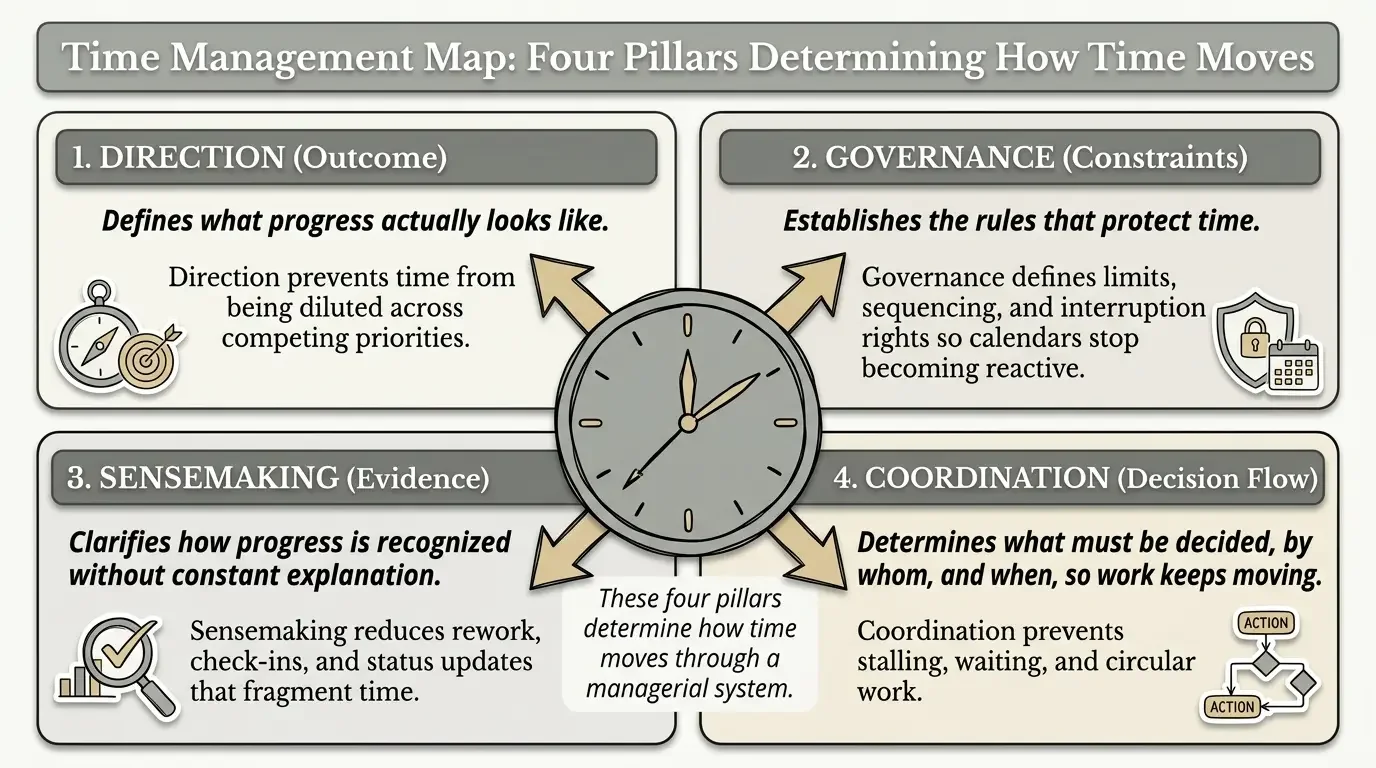
These four pillars determine how time moves through a managerial system.
Direction
Outcome
Defines what progress actually looks like. Direction prevents time from being diluted across competing priorities.
Governance
Constraints
Establishes the rules that protect time. Governance defines limits, sequencing, and interruption rights so calendars stop becoming reactive.
Sensemaking
Evidence
Clarifies how progress is recognized without constant explanation. Sensemaking reduces rework, check-ins, and status updates that fragment time.
Coordination
Decision Flow
Determines what must be decided, by whom, and when, so work keeps moving. Coordination prevents stalling, waiting, and circular work.
When these pillars are present, time stabilizes and planning can hold.
When they break down, no tool can compensate for the instability.
See it in practice
Your calendar is full. Three urgent requests land. Everything feels equally important and you are already behind.
- Priority Sequencing "I can take on one of these this week. Which aligns with our Q1 goal: revenue growth or operational stability?"
- Boundary Protection "My focus blocks are full. If this is urgent, what should I deprioritize or delegate?"
- Rhythm Disruption "This would fragment my deep work time. Can it wait until my admin block at 2pm?"
- Demand Filter "We are absorbing requests faster than we are completing work. What should stop to make room for this?"
You are working evenings and weekends but still feel behind. The calendar says you are productive but you are exhausted.
- Priority Sequencing "I am spending 60% of my time on low-impact work. Let me realign my calendar to the actual priorities."
- Boundary Protection "Meetings are bleeding into focus time. I am blocking 9-11am daily for uninterrupted work."
- Rhythm Disruption "I am context-switching 15 times a day. Let me batch similar work into dedicated blocks."
- Demand Filter "I am saying yes to everything. What criteria should determine what gets my time?"
The difference: The first approach treats time as a personal resource to optimize. The second approach identifies which system pressure is distorting time and addresses the structure.
Now choose how you want to move forward: Use this framework with structured tools, or understand why the pattern exists before committing to a solution.

Competing Priorities
Everything feels urgent but nothing is clearly most important
Unprotected Boundaries
Calendar blocks exist but get overridden constantly
Energy Mismatch
Schedule ignores natural rhythms and recovery needs
What is actually happening
Time breakdowns are rarely about effort or discipline. They happen when the system no longer protects rhythm.
When time is pulled equally toward coordination, decision-making, and execution, nothing gets the continuity it needs to complete. Planning exists, but it cannot hold. Focus fractures. Urgency replaces progress.
Most of the time, three predictable frictions are at play.
These frictions do not mean you are managing time poorly. They mean the system is misusing time.
Competing Time Claims
Your time is being claimed by multiple systems at once. Meetings, updates, requests, and follow-ups all draw from the same limited pool of hours. Without clear prioritization or boundaries, coordination work expands until it consumes execution time. This is not a calendar problem. It is a demand-management problem.
Rhythm Collapse
Days, weeks, and months are not designed to work together. Daily tasks reset without reference to weekly priorities. Weekly plans shift without regard for monthly goals. Nothing compounds. Everything restarts. When rhythm collapses, planning becomes reactive instead of stabilizing.
Interruption Without Recovery
Time is treated as endlessly interruptible. Context-switching becomes constant. Focus is fragmented. There is no protected space for thinking, finishing, or recalibrating. Without recovery built into the system, time feels scarce even when hours are full.
The next section helps you decide how to respond.
Once you identify which time pressure pattern is active, your next move becomes clear. But first, you need to recognize the signal accurately. When you're navigating time management friction, your internal story is often reasonable. It's just incomplete. Here's how to read what the system's actually telling you.
When this terrain keeps repeating
If this keeps showing up across different situations, you might not need another tactic. You might need orientation. Your leadership Pathway shapes what you notice, what you prioritize, and what you misread under pressure.
You will get your Pathway orientation and next steps there.
Choose your route
There is no single right move here. It depends on what you need first.
Quick Relief
Use this route if your days feel full but won't hold together.
Start with tools that stabilize your days and weeks so time stops improvising itself.
- Anchor daily and weekly priorities so planning holds.
- Reduce cognitive load and constant context-switching.
- Create immediate steadiness in how your time is structured.
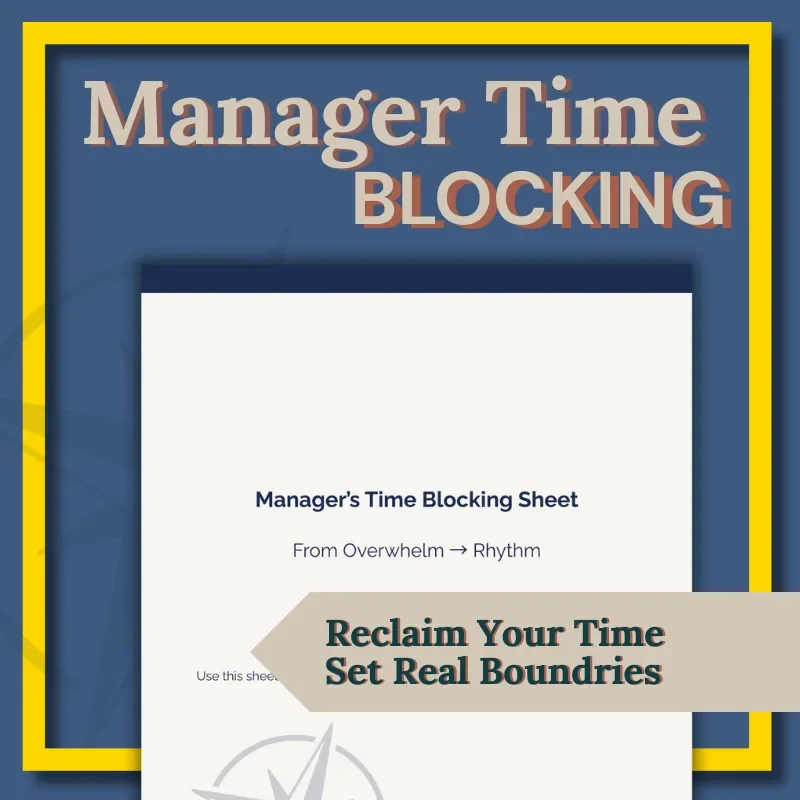
A printable, fillable time-blocking sheet for managers who want their calendar back—protect focus time, balance meetings and recovery, and set realistic daily boundaries.
When a manager’s calendar fills itself, your day stops being yours. The Manager’s Time Blocking Sheet is a printable, fillable planning tool that helps you intentionally block time, protect focus, and set realistic boundaries—so your schedule isn’t dictated entirely by meetings, interruptions, or other people’s priorities.
This isn’t “be more productive.” It’s a practical structure for real manager days: back-to-back meetings, shifting asks, team support, and the work that still needs quiet time to get done. Use this sheet to map your day into clear blocks—meetings, focus work, admin, team support, and breaks—so you can see overload early and make adjustments before the week turns into constant urgency.
What this tool helps you do
Plan your day with intention instead of reacting to meetings
Protect focus time and personal boundaries
See where your time is actually going (at a glance)
Balance meetings, deep work, and recovery
Build a sustainable daily rhythm you can repeat
What’s inside
Time-blocking layout for a full workday
Space to plan meetings, focus blocks, and breaks
Visual structure to spot overload quickly
Printable + fillable PDF
Best for
Managers whose calendars feel out of control, meeting-heavy days, boundary-setting around time and energy, and leaders working toward more sustainable schedules.
Result: clearer daily structure, protected focus, and a calendar that supports your leadership instead of draining it.
Explore the Terrain
Use this route if the pressure keeps returning, even when you plan.
Start here if you want to understand the pattern before deciding what support you need.
- See how coordination, meetings, and interruptions are consuming time.
- Understand why familiar planning approaches stop working.
- Rebuild rhythm across daily, weekly, and monthly cycles.

Your interpretation. The likely signal.
| Your interpretation. | The likely signal. |
|---|---|
| I am bad at time management. | The system has no clear direction, so time is being spread across competing priorities. |
| I cannot stay focused. | The system does not protect continuity, so interruption is treated as normal. |
| Planning does not work for me. | Governance is missing. Demand keeps entering without limits, sequencing, or tradeoffs. |
| Meetings are stealing all my time. | Coordination and decision flow are unclear, so meetings expand to compensate. |
| I just need better habits. | Habits cannot hold when the system keeps overriding the structure they depend on. |
When this pattern repeats, the signal is structural, not individual.

Read The Manager’s Compass
to diagnose what kind of time problem you are actually facing.
These frameworks help you: Identify which friction is destabilizing time. Distinguish overload from misalignment. * Interpret time pressure as a system signal, not a personal failure. This is where you go when you want clarity before choosing a tool.

Read The Manager's Mind to hear how time instability plays out in real leadership moments.
Each post traces a lived situation so you can recognize:
How coordination expands.
How rhythm collapses.
How planning stops holding under pressure.
This is where the framework meets reality.


Read The History of Work to understand how these dynamics formed and why they persist.
This lens connects modern managing-up friction to older systems of authority, professionalism, and control.
This is where personal frustration turns into systemic understanding.



Toolkits
These tools are not meant to be used all at once. Each one stabilizes a different breakdown in time.
Start with the friction you feel most this week.
Use the weekly planner when direction has collapsed.
This tool helps you:
- Re-anchor your week around a small number of outcomes.
- Separate urgency from importance.
- Prevent priorities from shifting mid-week.
Use this when everything feels important and nothing is holding.
Use time blocking when governance is missing.
This tool helps you:
- Protect focus time.
- Reduce interruption and context switching.
- Establish limits around availability.
Use this when your calendar reacts faster than you can plan.
Use the pre-flight when rhythm has broken down.
This tool helps you:
- Rebuild cadence across weeks and months.
- Surface capacity limits before burnout.
- Align planning with sustainable pace.
Use this when the pressure keeps returning, even after you plan.
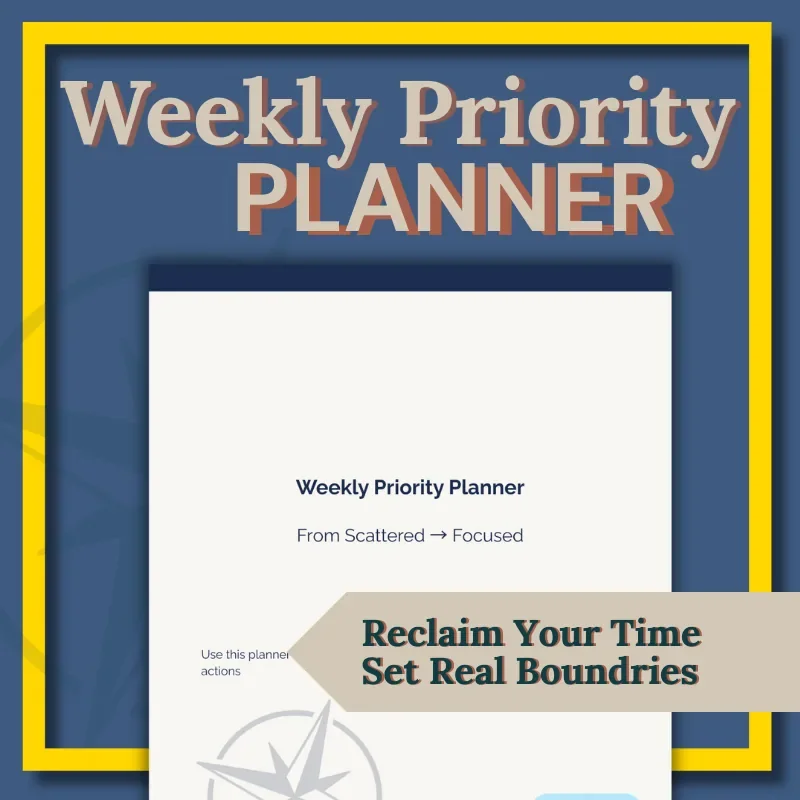
A printable, fillable weekly priority planner template for managers to reset focus, choose what matters, and reduce overload before the week takes over.
When a manager’s week feels scattered, reactive, or overloaded, the issue isn’t effort—it’s a lack of weekly reset structure. The Weekly Priority Planner is a printable, fillable planning tool that helps you step back, clarify priorities, and reset focus so you can plan your week with intention instead of constantly responding to urgency.
Use it at the start of the week (or anytime the week starts drifting) to name what matters most, organize tasks and commitments without over planning, and reduce overwhelm caused by competing demands. The result is a calmer, clearer weekly rhythm—built on direction, not pressure.
What this tool helps you do
Clarify your top priorities for the week ahead
Organize tasks and commitments without complex systems
Reduce overwhelm from competing demands and shifting requests
Regain a sense of control and direction
Build a steadier, more intentional weekly rhythm
What’s inside
Weekly priority planning page
Focus + intention-setting section
Space to track key actions and commitments
Reflection prompts to adjust and refocus
Printable + fillable PDF
Best for
Managers pulled in too many directions, weekly planning/reset routines, leadership roles with shifting priorities, and anyone who wants clarity without overengineering.
Result: a weekly plan that protects what matters and reduces mental fatigue.
A printable, fillable time-blocking sheet for managers who want their calendar back—protect focus time, balance meetings and recovery, and set realistic daily boundaries.
When a manager’s calendar fills itself, your day stops being yours. The Manager’s Time Blocking Sheet is a printable, fillable planning tool that helps you intentionally block time, protect focus, and set realistic boundaries—so your schedule isn’t dictated entirely by meetings, interruptions, or other people’s priorities.
This isn’t “be more productive.” It’s a practical structure for real manager days: back-to-back meetings, shifting asks, team support, and the work that still needs quiet time to get done. Use this sheet to map your day into clear blocks—meetings, focus work, admin, team support, and breaks—so you can see overload early and make adjustments before the week turns into constant urgency.
What this tool helps you do
Plan your day with intention instead of reacting to meetings
Protect focus time and personal boundaries
See where your time is actually going (at a glance)
Balance meetings, deep work, and recovery
Build a sustainable daily rhythm you can repeat
What’s inside
Time-blocking layout for a full workday
Space to plan meetings, focus blocks, and breaks
Visual structure to spot overload quickly
Printable + fillable PDF
Best for
Managers whose calendars feel out of control, meeting-heavy days, boundary-setting around time and energy, and leaders working toward more sustainable schedules.
Result: clearer daily structure, protected focus, and a calendar that supports your leadership instead of draining it.

✨ Overview
Lead your team through the year-end crunch — with calm, not chaos.
Most managers treat the final quarter like a sprint and burn out their teams in the process.
The Quarterly Pre-Flight Kit (Premium Edition) helps you manage Q4 like a seasoned navigator: with structure, foresight, and rhythm.
This isn’t another report template. It’s a leadership framework designed to bring clarity and steadiness when everything feels urgent.
🧭 What’s Inside
• Complete Pre-Flight Meeting Framework — run a 15-minute session that replaces weeks of confusion.
• Resistance Handler Scripts — four ready responses when your team pushes back.
• Email Templates — pre-meeting, post-meeting, weekly check-ins, and course corrections.
• Risk Assessment Matrix — identify and mitigate early bottlenecks.
• Three Real-World Examples — filled-in worksheets across common scenarios.
• Manager Self-Reflection Prompts — recognize your leadership pattern under pressure.
• Post-Quarter Debrief Template — close the year with clarity, not exhaustion.
• One-Page Q4 Survival Checklist — the final mile, made manageable.
💡 Use This When
• Deadlines tighten and capacity dips.
• Your team feels stretched thin or reactive.
• You need to refocus energy around what truly matters.
Fifteen minutes of clarity saves weeks of rework. This kit gives you the structure and calm to finish strong.
🧾 Product Details
• Format: Fillable PDF (print or use digitally)
• Length: 12 pages
• Skill Level: Ideal for new or mid-level managers
• Theme: Q4 / Year-End Leadership
🌐 Related Tools
Leadership Pathway Quiz — discover your leadership style
>> Add to Cart << to finish the year with clarity, capacity, and confidence.
Leading from the middle rarely travels alone.
Time pressure rarely shows up by itself. It often intersects with other terrain frictions that compound the strain.
Feedback Pattern Map
When time pressure increases because delivering hard truths requires preparation, framing, or follow-up.
Overwhelm Type Map
When demands exceed capacity and time scarcity is a symptom, not the root issue.
Delegation Block Map
When work stays with you longer than it should and time pressure is created by unclear handoff, trust, or role boundaries.
Former Peer Transition Map
When authority is still forming and time is spent managing relationships instead of execution.
Time Management Map
Before you choose a next move, here are four clarifying answers managers tend to need in this terrain.
Why do time management systems stop working over time?
Because the problem is rarely the tool. When work rhythms change faster than decision clarity, systems overload and calendars become reactive instead of directional.
Is this a productivity problem or a workload problem?
It is usually a coordination problem. When priorities, recovery space, or decision timing are misaligned, time pressure increases even without more work.
Should I try to optimize my schedule first?
No. Optimization without rhythm clarity often makes saturation worse. This map helps you identify where time is being structurally consumed before making changes.
What does this page help me do differently?
It helps you read what the system is asking of your time so you can restore pace, boundaries, and recovery without relying on constant self-management.

Most managers who can't stop reacting aren't disorganized. They're operating without a prioritization structure that matches the actual demands of their role.