
Why Too Many Meetings Destroy Manager Focus
Why do managers end up with too many meetings?
Too many meetings usually signal a system problem, not poor time management. When decisions lack clear ownership and direction is weak, coordination expands to compensate. Meetings become the place where unresolved work waits because the system has not created a stronger structure for decisions to land.

When I entered the C-suite, I was suddenly invited to every meeting.
I was running operations, and I had a reputation for getting things done. That combination made me useful. Once you are useful at the executive level, people start pulling you into everything.
There was no strategy behind most of these requests. There was no shared intention. There was a steady stream of projects that “needed” my presence because the work was stuck, urgent, or politically delicate.
Meeting after meeting, something became impossible to ignore. The company was disjointed. Each department head launched initiatives meant to help employees or customers in isolation. The work did not connect. The work did not resolve into a larger direction.
We technically had a guiding idea. At one point, the organization said it was focused on “regional vitality.” The phrase could absorb anything. Every project, no matter how narrow or self-protective, could be labeled as serving regional vitality.
That is when it clicked.
The meetings were a symptom.
🎙️ Prefer to Listen?
Why Meetings Multiply When Direction Is Weak
The missing piece was a shared center strong enough to hold decisions in place. Without that center, coordination expanded. The calendar became the place where the system hid its lack of clarity.
Too many meetings on your calendar rarely indicate a time management problem. They signal that decisions lack clear ownership and that strategic direction is weak. When authority is unclear, coordination expands because it is the only available method for keeping work moving.
Why Back-to-Back Meetings Feel Confusing, Not Just Busy
Back-to-back meetings eventually stop feeling like a scheduling inconvenience. They start to feel confusing. Managers often describe it the same way. Meetings feel like they exist for their own sake. The same people show up.
The same topics circulate. Nothing resolves. Another meeting gets scheduled to “see where things land.”
The person calling the meeting is often searching too.
The Hidden System Pattern Behind Endless Coordination
When no one orchestrates direction across projects, decisions do not land. Accountability fragments. Progress becomes difficult to measure. People keep meeting because the next step never feels legitimate enough to commit to.
That gap turns meetings into a signal flare. The facilitator hopes someone will crack the code. Someone will push the work into a clear lane. Someone will name a direction strongly enough that action can happen, a result can return, and the team can measure what it learned.
This is the bind many thoughtful managers face. You see the horizon. You can articulate direction. But you do not control whether the organization commits to it. So you keep showing up to meetings, hoping clarity will arrive—when what is actually needed is someone willing to drive the work toward a decision.
You start doubting whether you are the problem. Too rigid. Too linear. Not collaborative enough. The system tells you to “align more” and “build consensus.” What is missing is commitment.
When that moment never arrives, the meeting ends with more discussion. Another meeting gets scheduled so the group can keep searching for a path forward that feels justifiable.
This is how meetings multiply without intent. The system has not given anyone the authority to define what success looks like, so the work has nowhere solid to land.
What Managers Can Do When Strategy Lives Above Their Role
Managers operating inside this terrain often have limited visibility into strategy. That creates a bind. You are expected to move work forward while the direction stays blurry.
Your job in this situation is to prevent ambiguity from becoming endless coordination by making sure work has somewhere real to land.
The shift required is to operate as if you are the driver. Driving means you keep the meeting moving toward something the team can do next, and you do not let the group confuse conversation with progress.
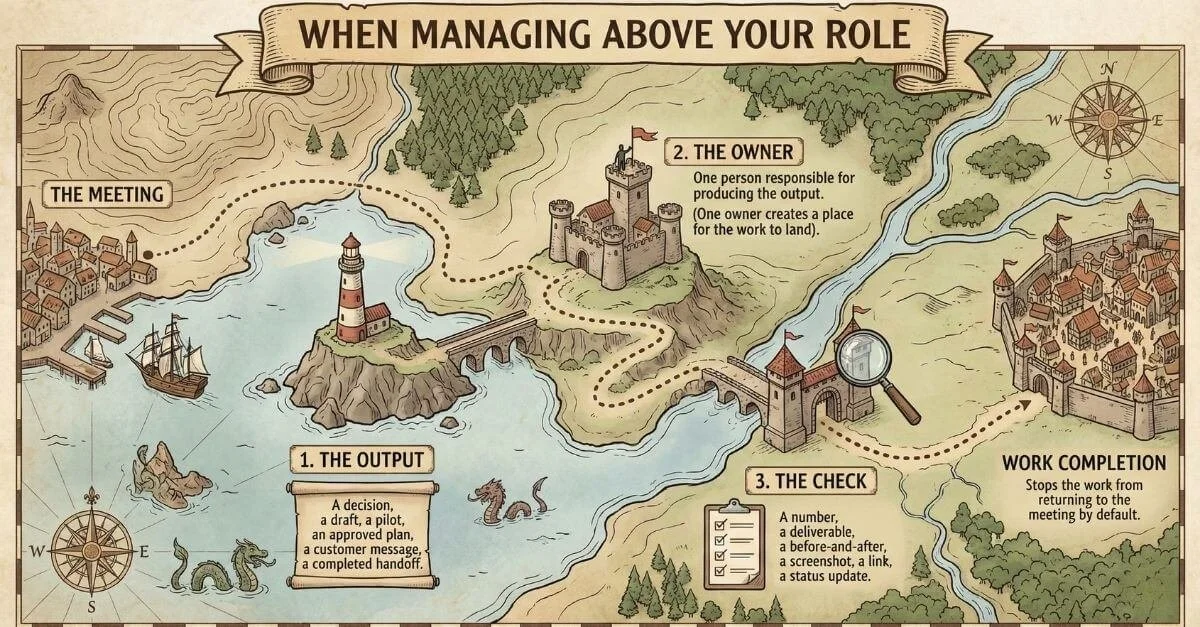
You do that by making three things explicit before the meeting ends.
First, the output. Name what will exist after the call. A decision, a draft, a pilot, an approved plan, a customer message, a completed handoff. Something that can be pointed to.
Second, the owner. Name one person responsible for producing the output. One owner creates a place for the work to land.
Third, the check. Name how progress will be verified. A number, a deliverable, a before-and-after, a screenshot, a link, a status update with specific fields. A check is what stops the work from returning to the meeting by default.
Watching for Drift Inside Meetings
This is also where teams get misled by language. Certain phrases sound productive while postponing accountability.
When you hear language like “we should align,” “let’s keep this moving,” “we’ll take this offline,” or “circle back next week,” treat it as a signal that the meeting is drifting.
Driving the meeting means translating those phrases into something that lands.
A meeting can end with alignment and still produce nothing. A result that only exists as a statement at the end of the meeting remains a plan. A real result exists in the world. Someone can point to it. Someone can verify it.
A simple Result Test helps.
A result is real when it is observable, owned, and verifiable.
Observable means something will exist or change outside the meeting.
Owned means one person is responsible for producing it.
Verifiable means someone else could confirm it happened without scheduling another meeting.
When a group cannot name what will exist after the meeting, ownership stays diffuse. Measurement stays vague. The work returns to the meeting because it has nowhere else to go.
And here is what most managers do not realize. This is not a collaboration problem. It is a clarity problem. When you cannot name the output, the owner, and the check, you have not run a meeting. You have held space for the system to avoid accountability.
Coordination is not care when it substitutes for direction.
A Practical Way to Make Meetings Land
When meetings keep looping, the problem is not conversation quality. It is that the work has nowhere concrete to land.
The 30-Minute Meeting Blueprint for Managers was designed for exactly this terrain.
It is a structured, outcome-focused meeting template that helps managers interrupt endless coordination by anchoring every meeting to three things:
An output
An owner
A measurable check
This is not a facilitation script or a productivity hack. It is a decision-landing structure for moments when direction is weak but work still needs to move forward.
When Coordination Substitutes for Direction
When you start seeing meetings this way, the problem shifts. It is no longer about identifying what is wrong. It is about knowing how to intervene without overreaching—especially in cases where the strategy lives above your role.
That is the gap most managers get stuck in. You can see the pattern. You just do not have a structure for interrupting it in real time.
I have seen this pattern repeat across fast-growing organizations, distributed teams, and executive rooms where the pressure to coordinate quietly replaces the authority to decide.
In my C-suite season, the invitations never stopped. People wanted my input because movement felt possible when I was in the room. What I learned is that meetings expand fastest in organizations that cannot hold direction firmly enough to make decisions stick.
That is why endless meetings start to feel pointless. They are not built to finish the work. They are built to give the system the appearance of doing.
When strategy is missing or too broad to guide tradeoffs, meetings take the place of commitment. Conversation produces motion and coordination. Measurable progress stays scarce. The system stays busy because it is bracing for what is next. Winter is always coming.
Focus returns when work finally lands.
One action.
One owner.
One result that exists after the call ends.
Not sure why your calendar stays full while your to-do list stays empty? Take the Leadership Style Quiz to see how your map is currently drawn.