
Manager Overwhelm: Why Busywork Leads to Burnout
Manager overwhelm is often misdiagnosed as a time management problem. In reality, it is a system signal caused by competing stakeholder demands that cannot be satisfied simultaneously. When managers are required to absorb conflicting expectations without naming trade-offs, busywork takes over because it feels safer than making visible decisions. The solution is not better prioritization, but clearer optimization choices and explicit trade-off communication.

I walked into the supply chain role on a Tuesday morning in September, and by lunch I knew I was standing in the middle of a battlefield.
There was no structure. No process. No competitive bidding. Just a filing cabinet full of inflated contracts negotiated over golf games and supplier dinners. Prices were not grounded in data. They were grounded in relationships.
So I did what any supply chain professional would do. I built specifications. I ran competitive bids. I went out for quotes. I found savings. Real savings. On lettuce alone, I identified $250,000 in annual cost reductions.
And that is when the pitchforks came out.
Leadership was furious. I was disrupting supplier relationships. The distributor went straight to leadership, arguing that I was forcing them to manage low-margin items. General Managers wanted even more savings, faster.
Every direction I turned, someone was dissatisfied.
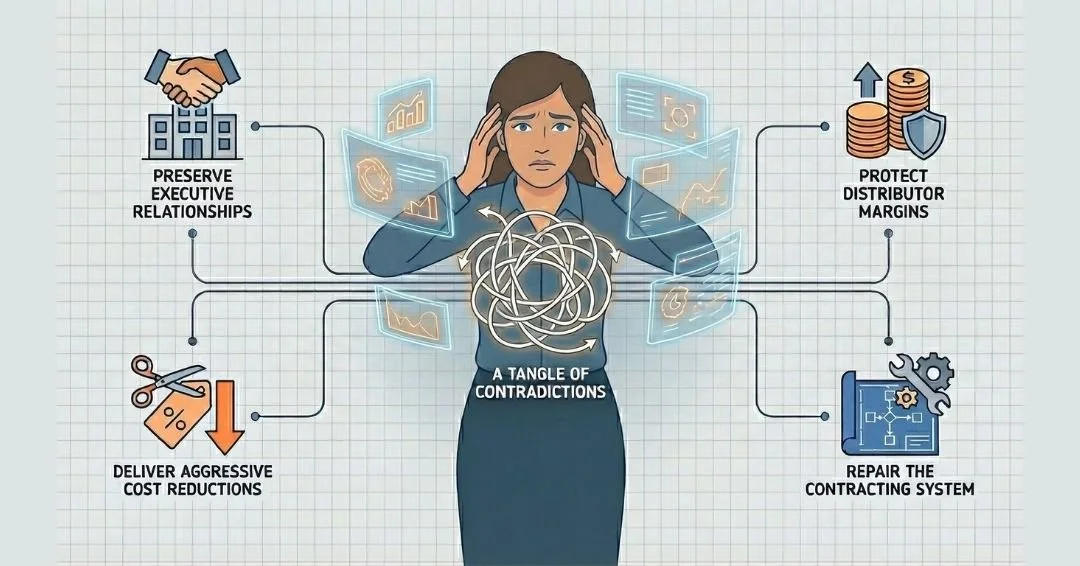
I was expected to:
Preserve executive relationships
Protect distributor margins
Deliver aggressive cost reductions
Fix a broken supply chain system
All at the same time.
That is not task overload.
That is middle manager reality.
🎙️ Prefer to listen?

What This Aricle Covers
In this article, we explore why capable managers feel constantly busy but rarely effective, and how busywork becomes the default response inside systems that refuse to make trade-offs.
We look at:
Why overwhelm persists even when managers are disciplined and organized
How conflicting stakeholder demands quietly consume managerial bandwidth
Why responsiveness feels productive but blocks real progress
A simple daily focus practice that restores clarity without increasing workload
The Pattern Under the Problem: You’re Managing Stakeholders, Not Tasks
Most managers believe overwhelm comes from having too much to do.
Sometimes that is true.
More often, it is incomplete.
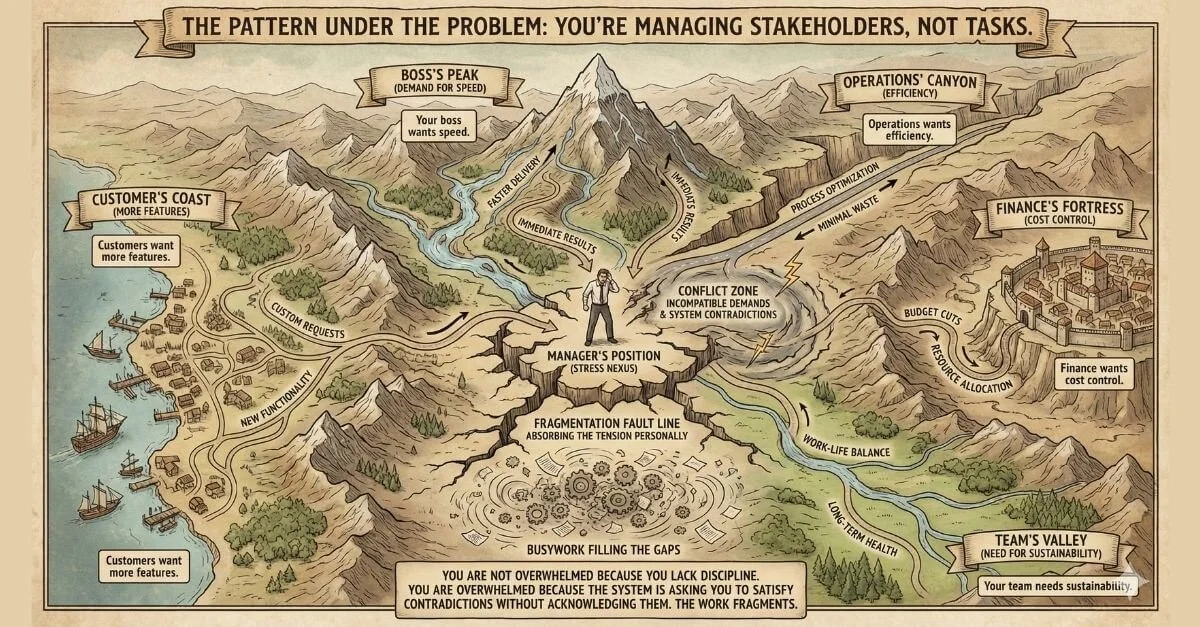
The deeper issue is that managers sit at the intersection of incompatible demands.
Your boss wants speed.
Your team needs sustainability.
Finance wants cost control.
Customers want more features.
Operations wants efficiency.
You are not overwhelmed because you lack discipline. You are overwhelmed because the system is asking you to satisfy contradictions without acknowledging them.
When expectations cannot be reconciled, managers absorb the tension personally. The work does not slow down. It fragments.
Busywork begins to fill the gaps.
What the System Is Doing
When systems refuse to tolerate visible trade-offs, they reward responsiveness instead.
Quick replies.
Status updates.
Meetings.
Small fixes.
Constant availability.
None of this resolves the underlying conflict. It only reduces friction temporarily.
Over time, the manager’s role shifts. Instead of directing outcomes, they become the buffer that prevents conflict from surfacing. Their calendar fills. Their thinking time disappears. Their workday becomes reactive by design.
Busywork does not appear because managers are unfocused.
It appears because the system avoids decision clarity.
The Lens We’re Using
Leadership Cartography treats overwhelm as a form of data. Instead of assuming you are the problem, it asks what the system is asking you to absorb and what trade-offs it refuses to name. The goal is not to become a different kind of leader. The goal is to get oriented so your response matches the terrain.
Through this lens, overwhelm is not a flaw. It is information.
The Daily Focus Framework: A Practical Orientation
When every day feels chaotic, relief does not come from doing more. It comes from deciding what you are optimizing for and protecting that choice.
1️⃣ Name the Non-Negotiable- Each day, identify the single outcome that must move forward for the system to progress. Not the full list. One anchor.
2️⃣ Make the Conflicts Visible- Write down who wants what from you today. Look for where expectations clash. You cannot work your way out of a contradiction.
3️⃣ Choose the Optimization and State the Trade-Off- Decide what you are optimizing for today. Team capacity. Client trust. System stability. Deadline protection.
Then communicate the trade-off clearly.
Not as an apology.
As a decision.
This is how leadership replaces reactivity.
If this pattern is showing up for you, the Daily Focus Tracker for Managers was designed to support this exact moment. It helps you identify your daily non-negotiable, map competing stakeholder demands, and document the trade-offs you communicated so your decisions do not disappear into the noise. This tool supports clarity without requiring you to change who you are to use it.
You can usually recognize this pattern when:
Your calendar fills but nothing feels complete
You are constantly responding but rarely advancing
Everyone thinks their request is urgent
You feel responsible for holding competing pressures together
These are not personal shortcomings. They are structural conditions.

If You Only Remember One Thing
The problem is not that you cannot manage your time.
The problem is that the system is asking you to absorb incompatible demands without naming the trade-offs.
This matters most when you are capable, conscientious, and deeply invested in doing your role well. In those conditions, it is easy to mistake constant activity for leadership.
The question is not whether you can handle more.
The question is whether the system allows you to decide clearly.
Leadership begins when trade-offs are named instead of silently carried.
The Route Through the Bandwidth Trap
The weight you feel is a logical contradiction, not a lack of effort. When you absorb the tension of incompatible demands, you stop leading outcomes and start managing requests. Real growth happens when you stop trying to do it all and start making the trade-offs visible so the work can finally move.
Not sure why your attempts to prioritize leave you feeling more drained?
Take the Leadership Style Quiz to see how your map is currently drawn.