


You’re Working Harder. Nothing Is Moving.
You’re getting more done than ever.
And still ending the day behind.
You’re reprioritizing constantly. You leave meetings with more on your plate than you walked in with. You’re doing the work and managing the people.
And somehow, it still isn’t enough.
Most overwhelm isn’t a discipline problem. It’s a system saturation signal.
It shows up when demand exceeds your ability to sequence work, set limits, and protect recovery. In saturation, effort increases while coordination breaks down.
This map helps you identify which overload pattern you’re in so you can see what the system is asking for next.
I need relief now
I want to understand the pattern

Start with your map.
When overwhelm keeps returning, the issue is rarely just workload. It often reflects a deeper leadership pattern: what you absorb, what you delay, what you protect, and what you believe you are responsible for holding.
The Source Assessment helps you identify that pattern so you can see why the load keeps building and what kind of support will actually relieve pressure..
Ten minutes. Free. Your result arrives by email.
If two or more of these are true, your system is saturated.
Work expands to fill every available container. These are the signals that the container has already broken down.
- Work expands even when assigned tasks are complete.
- Urgency is constant but importance is rare.
- Decision weight and coordination lack clear ownership.
- Progress depends on your personal memory or reminders.
- The calendar is full while important work slips.
- Small interruptions disrupt the entire day.
- Handoffs across people and tools are messy.
- The week ends with uncertainty about being behind or overloaded.
If this is your terrain, you don't need more effort. You need a clearer map. Start with the framework that makes overwhelm patterns navigable.
The Overwhelm Map: Where the System Breaks Down
Direction
- Too many priorities. No stable focus.
- Work enters the system without clear trade-offs.
- Everything feels important, so nothing is sequenced.
- Effort increases, but progress fragments.
Governance
- No limits on work entering the system.
- Decisions about scope, timing, and ownership are missing or implicit.
- Requests pile up because there are no clear rules for what gets said no to, delayed, or stopped.
Sensemaking
- Signals arrive faster than they can be interpreted.
- Information, requests, and changes come in continuously.
- There's no pause to assess what matters now versus later, so urgency replaces judgment.
Coordination
- Work moves through people instead of systems.
- Progress depends on you to connect tasks, people, tools, and timelines.
- Handoffs are informal, and work stalls when you're not actively managing it.
Overwhelm shows up when one or more core management functions are under strain. These four signals help you identify where the load is coming from, not what to fix yet.
Your calendar is full. Three "urgent" requests land in Slack. You're behind on your own deliverables. Everything feels equally important.
- Direction"I can take on one of these. Which aligns most with our Q1 priority: revenue growth or operational stability?"
- Governance"We can't absorb three new requests without dropping something. What should we delay or stop?"
- Sensemaking"Let me take 10 minutes to assess: Is this truly urgent, or is it just arriving fast?"
- Coordination"This needs a workflow, not my memory. Let me document the handoff so it doesn't stall when I'm unavailable."
Team member says: "Can you review this by EOD? It's urgent."
- Direction"What's the deadline driven by? Let's make sure 'urgent' aligns with actual impact."
- Governance"I have capacity for one urgent review today. Is this the highest priority, or should I focus on [other task]?"
- Sensemaking"Urgent compared to what? Help me understand the trade-off so I can prioritize accurately."
- Coordination"Can someone else review this, or does it require my specific input? Let's map the decision path."
The first approach treats every pressure as equal. The second approach identifies which system function is saturated and adjusts accordingly.
Use this framework with structured tools, or understand why the pattern exists before committing to a solution.

What this sounds like in practice
Pick the scenario closest to what you're navigating this week. You don't need all of them right now.
The pattern: Distinguish urgent from important, set explicit limits, move coordination from memory to systems.
When everything feels urgent
No pause to assess what actually matters
When you can't say no
No limits on what enters your system
Coordination bottleneck
Everything routes through your memory
Choose your route
There is no single right move here. It depends on what you need first.
Quick Relief
If everything feels urgent and you need traction now, start here.
The Weekly Priority Planner helps you slow the decision pile-up, clarify today's true priorities, and regain a sense of forward motion without reorganizing your entire system.
- Separates what feels urgent from what actually moves work forward.
- Reduces decision fatigue for the day.
- Creates a visible "done" line.
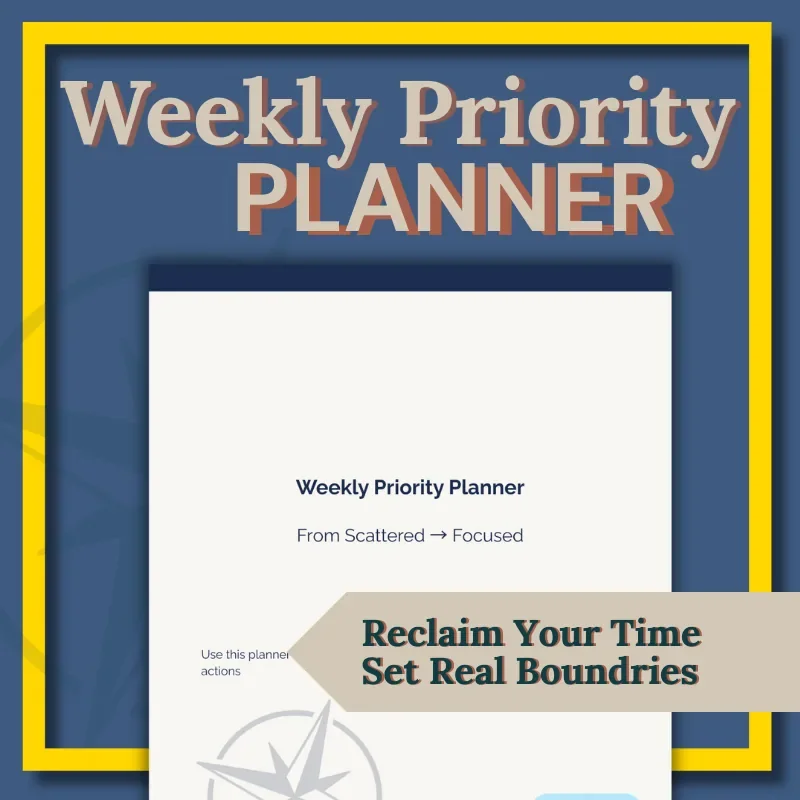
A printable, fillable weekly priority planner template for managers to reset focus, choose what matters, and reduce overload before the week takes over.
When a manager’s week feels scattered, reactive, or overloaded, the issue isn’t effort—it’s a lack of weekly reset structure. The Weekly Priority Planner is a printable, fillable planning tool that helps you step back, clarify priorities, and reset focus so you can plan your week with intention instead of constantly responding to urgency.
Use it at the start of the week (or anytime the week starts drifting) to name what matters most, organize tasks and commitments without over planning, and reduce overwhelm caused by competing demands. The result is a calmer, clearer weekly rhythm—built on direction, not pressure.
What this tool helps you do
Clarify your top priorities for the week ahead
Organize tasks and commitments without complex systems
Reduce overwhelm from competing demands and shifting requests
Regain a sense of control and direction
Build a steadier, more intentional weekly rhythm
What’s inside
Weekly priority planning page
Focus + intention-setting section
Space to track key actions and commitments
Reflection prompts to adjust and refocus
Printable + fillable PDF
Best for
Managers pulled in too many directions, weekly planning/reset routines, leadership roles with shifting priorities, and anyone who wants clarity without overengineering.
Result: a weekly plan that protects what matters and reduces mental fatigue.
Explore the Terrain
If you want to understand why overwhelm keeps recurring, go here.
This route maps the structural forces loading your system so you can change the pattern, not just survive the week.

What is actually happening
Overwhelm emerges when demand exceeds the system's ability to coordinate work. This is not about effort or motivation.
It is about how work is loaded, sequenced, and handed off. Most of the time, three predictable frictions are at play.
This is not a performance problem. It's a coordination problem.
Load Accumulation
Work enters the system faster than it exits. Tasks, decisions, and follow-ups stack without clear limits. Completion does not reduce pressure because new work arrives without removing old work. The system never resets.
Decision Saturation
You are holding too many decisions at once, many of which should be resolved by role, rule, or process. When decisions stay unresolved, work stalls. When you compensate by deciding everything yourself, cognitive load spikes and focus collapses.
Coordination Strain
Work depends on you to connect people, tools, and timelines. Handoffs are informal, ownership is unclear, and progress relies on memory. Instead of moving through the system, work gets carried by you.
Once you identify which overwhelm pattern is active, your next move becomes clear. But first, you need to recognize the signal accurately.
When you're navigating overwhelm, your internal story is often reasonable. It's just incomplete. Here's how to read what the system is actually telling you.
When this terrain keeps repeating
If this keeps showing up across different situations, you might not need another tactic. You might need orientation. Your leadership Pathway shapes what you notice, what you prioritize, and what you misread under pressure.
You will get your Pathway orientation and next steps there.
Your interpretation. The likely signal.
When you are navigating overwhelm, your internal story is often reasonable. It is just incomplete.
| You Think: | The System Signal May Be: |
|---|---|
| I just need to work harder or be more efficient. | The volume of work entering the system exceeds its capacity. |
| Everything feels urgent, so I can't slow down. | Priorities have not been sequenced or constrained. |
| I'm bad at focus lately. | You are carrying too many unresolved decisions at once. |
| I can't get ahead no matter how much I do. | Work keeps re-entering the system without a clear "done." |
| If I stop pushing, things will fall apart. | The system relies on you to coordinate what should be handled structurally. |
When this pattern repeats, the signal is structural, not individual.
Read The Manager’s Compass to diagnose the exact overload pattern you are experiencing.
These frameworks help you identify which system function is under strain and interpret the signals your workload is producing through structured Terrain Surveys.
This is where you go when you want clarity before deciding what to change.


Read to The Manager’s Mind to hear how overload patterns surface in real leadership moments.
Each post traces a lived situation so you can recognize yourself in the signal, not just understand it intellectually.
This is where the framework meets reality.


Read The History of Work to understand why overload has become the default condition of modern management.
These essays trace how roles, expectations, and coordination demands evolved so you can see how today’s overwhelm was structurally produced, not individually caused.
This is where the pattern gets historical context.



Toolkits
These toolkits are not meant to be used all at once. Each one addresses a different overload signal that shows up when the system is carrying more than it can coordinate.
Start with the pressure you are feeling most clearly right now. That signal tells you which system function needs attention first.
Weekly Priority Planner
When everything feels important, direction has collapsed. This planner helps you surface what actually matters now, separate urgency from consequence, and establish a visible "done line" for the week.
- Separate urgency from consequence.
- Surface what actually matters this week.
- Establish a visible "done" line.
Use this when your workload is expanding faster than your priorities can be named.
Leadership Rhythm Builder
When work never settles, the system has no rhythm. This tool helps you reintroduce a sustainable cadence for decisions, recovery, and focus so overload does not compound week after week.
- Rebuild cadence across daily, weekly, and monthly cycles.
- Surface capacity limits before they become burnout.
- Align planning with a sustainable pace.
Use this when you are busy but never caught up, even when you work harder.
Manager Time Blocking
When your time is constantly overridden, coordination has failed. This sheet helps you make capacity visible, protect decision space, and manage dependencies without constant renegotiation.
- Make capacity visible before it disappears.
- Protect decision space from reactive demand.
- Manage dependencies without constant renegotiation.
Use this when other people's urgency is dictating your day.
A printable, fillable weekly priority planner template for managers to reset focus, choose what matters, and reduce overload before the week takes over.
When a manager’s week feels scattered, reactive, or overloaded, the issue isn’t effort—it’s a lack of weekly reset structure. The Weekly Priority Planner is a printable, fillable planning tool that helps you step back, clarify priorities, and reset focus so you can plan your week with intention instead of constantly responding to urgency.
Use it at the start of the week (or anytime the week starts drifting) to name what matters most, organize tasks and commitments without over planning, and reduce overwhelm caused by competing demands. The result is a calmer, clearer weekly rhythm—built on direction, not pressure.
What this tool helps you do
Clarify your top priorities for the week ahead
Organize tasks and commitments without complex systems
Reduce overwhelm from competing demands and shifting requests
Regain a sense of control and direction
Build a steadier, more intentional weekly rhythm
What’s inside
Weekly priority planning page
Focus + intention-setting section
Space to track key actions and commitments
Reflection prompts to adjust and refocus
Printable + fillable PDF
Best for
Managers pulled in too many directions, weekly planning/reset routines, leadership roles with shifting priorities, and anyone who wants clarity without overengineering.
Result: a weekly plan that protects what matters and reduces mental fatigue.
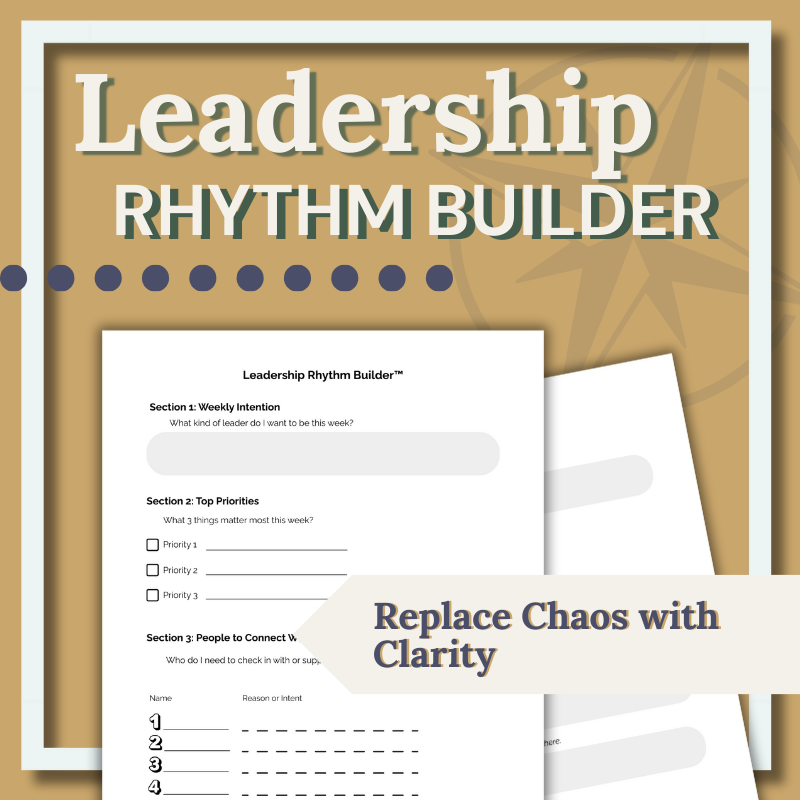
When a manager’s week is full of shifting demands, most plans break by Tuesday. The Leadership Rhythm Builder™ is a printable, fillable weekly clarity system that creates a repeatable operating rhythm—so you lead with steadier structure instead of reaction mode.
This tool helps you set a clear leadership intention for the week, define your top priorities before chaos takes over, and choose which relationships need attention. It also gives you a simple way to track follow-ups, commitments, and unfinished work—so your calendar and your leadership stay aligned.
What this helps you do
Set a clear leadership intention for the week
Identify your top priorities before the week fills itself
Focus on the relationships and communication that need attention
Track follow-ups, commitments, and open loops
Build a steady weekly rhythm you can rely on (even in high-change weeks)
What’s inside
Leadership Rhythm Builder™ (multi-page PDF)
Weekly intention + priority-setting structure
Relationship + communication focus section
Follow-ups + commitments tracker
Printable + fillable PDF
Best for
New managers, team leads, and managers navigating overwhelm, scattered priorities, meeting-heavy weeks, or constant context switching—especially if you want a calmer weekly reset that’s practical, not performative.
Result: a grounded weekly rhythm that replaces chaos with clarity.
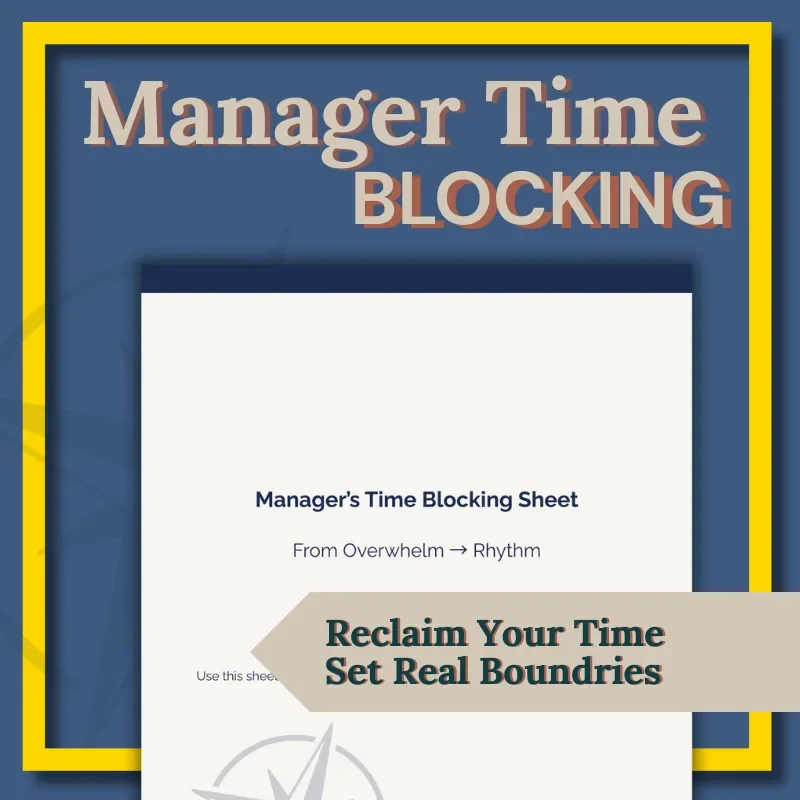
A printable, fillable time-blocking sheet for managers who want their calendar back—protect focus time, balance meetings and recovery, and set realistic daily boundaries.
When a manager’s calendar fills itself, your day stops being yours. The Manager’s Time Blocking Sheet is a printable, fillable planning tool that helps you intentionally block time, protect focus, and set realistic boundaries—so your schedule isn’t dictated entirely by meetings, interruptions, or other people’s priorities.
This isn’t “be more productive.” It’s a practical structure for real manager days: back-to-back meetings, shifting asks, team support, and the work that still needs quiet time to get done. Use this sheet to map your day into clear blocks—meetings, focus work, admin, team support, and breaks—so you can see overload early and make adjustments before the week turns into constant urgency.
What this tool helps you do
Plan your day with intention instead of reacting to meetings
Protect focus time and personal boundaries
See where your time is actually going (at a glance)
Balance meetings, deep work, and recovery
Build a sustainable daily rhythm you can repeat
What’s inside
Time-blocking layout for a full workday
Space to plan meetings, focus blocks, and breaks
Visual structure to spot overload quickly
Printable + fillable PDF
Best for
Managers whose calendars feel out of control, meeting-heavy days, boundary-setting around time and energy, and leaders working toward more sustainable schedules.
Result: clearer daily structure, protected focus, and a calendar that supports your leadership instead of draining it.
Overwhelm Type Map
Before you choose a next move, here are four clarifying answers managers tend to need in this terrain.
Why does overwhelm feel constant even when I am working hard?
Because the system is carrying more work than it can metabolize. When demand exceeds capacity, effort increases but relief does not arrive.
Is overwhelm a time management problem or a personal resilience problem?
It is usually a system-load problem. When work intake, priorities, and recovery are misaligned, overwhelm persists regardless of discipline or skill.
Should I try to push through this season until it settles?
Not without understanding the pattern. Pushing through without diagnosing the type of overload often deepens saturation and delays recovery.
What does this page help me do differently?
It helps you identify what kind of overload you are experiencing, so you can choose the right intervention instead of applying generic productivity fixes.

When a team loses capacity and leadership still expects the same output, the manager ends up carrying more than extra work. They carry the prioritization, the translation, and the pressure of making an unstable structure look sustainable. This article names that condition clearly and shows what upward leadership requires before the strain gets mislabeled as a people problem.