
Night Shifts and the End of Natural Rest
How the lightbulb destroyed the boundary between work and sleep
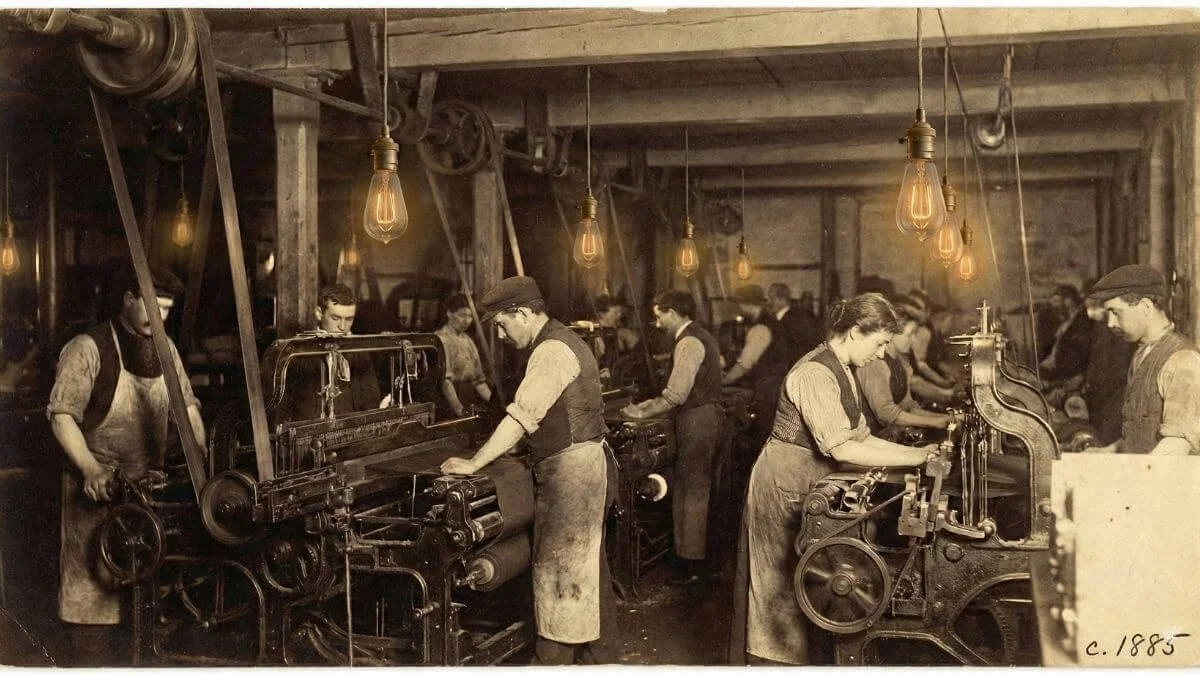
The Night Shift Foreman
Before 1879, work stopped when the sun went down. This was not a humane policy decision. It was a biological fact.
Candles and gas lamps were expensive, dangerous, and insufficient for operating machinery at scale. When Thomas Edison perfected the incandescent bulb and electrified the Pearl Street Station in Lower Manhattan in 1882, he did not simply improve visibility. He removed the natural stop signal that had governed human labor for thousands of years.
The lightbulb made the night shift economically viable. Within a decade, factories across America and Europe began operating twenty-four hours a day.
The Job That Appeared Overnight
Before electric light, the foreman worked daylight hours. After it, a new role emerged: the Night Shift Foreman.
This person managed a skeleton crew of workers who were biologically wired to be asleep. Night crews were often staffed by people who could not secure day shifts. New immigrants. Workers desperate enough to trade their circadian rhythm for slightly higher wages.
The Night Shift Foreman had to maintain output with exhausted people operating dangerous equipment under artificial light that mimicked day but did not replicate it.
They were not managing a team.
They were managing a disrupted biological system.
Workers on night rotations experienced what we now recognize as chronic sleep deprivation. Injury rates spiked. Errors multiplied. Fatigue became structural. The foreman’s job was to extract productivity from bodies that were signaling collapse.
They became the human buffer between the company’s demand for continuous output and the workers’ diminishing capacity to deliver it.
This role required a specific kind of steadiness. Not empathy exactly, but acceptance. The system had declared war on sleep, and the foreman was expected to win.
The Inheritance We Rarely Name
Most managers today do not oversee literal night shifts. But we have inherited the same structural expectation that was born in 1882.
Work is no longer bound by daylight.
Messages arrive at eleven at night.
Emails queue overnight.
Global teams mean someone is always working, which quietly implies that someone should always be available.
In Leadership Cartography™, this pressure lives in the Support™ pathway.
Managers who lead with Support absorb the disrupted rhythms of their teams. You stay online late to cover another time zone. You wake early to respond before your team starts their day. You stretch yourself across the clock until rest feels irresponsible.
You become the Night Shift Foreman of a system that no longer has formal shifts.
We still treat constant availability as dedication rather than what it actually is: a design flaw. The lightbulb gave us the technical ability to work around the clock. It did not give us the biological capacity to sustain it.
Support-led managers are especially vulnerable to this inheritance. You tell yourself that being there for your team means being reachable whenever they need you. What you are actually doing is reinforcing an 1880s factory logic inside a 2026 knowledge economy.
The system has not adapted.
It has simply electrified the exploitation.
If you find yourself checking messages after hours or feeling guilty for going offline, you are not failing at leadership. You are succeeding at being a Night Shift Foreman in a role that was never supposed to require one.
The lightbulb did not just extend the workday.
It erased the boundary between work and rest.
And we have spent the last 140 years pretending that boundary was optional.
If we would never ask factory workers to run dangerous machinery while sleep-deprived under flickering gaslight, why do we expect modern teams to do cognitive labor indefinitely under artificial urgency?

If this pattern feels familiar, the Leadership Style Quiz can help you see whether Support™ is the pathway absorbing the load.