
The Suggestion Box and the Theater of Listening
When companies invented "employee voice" without giving workers any power
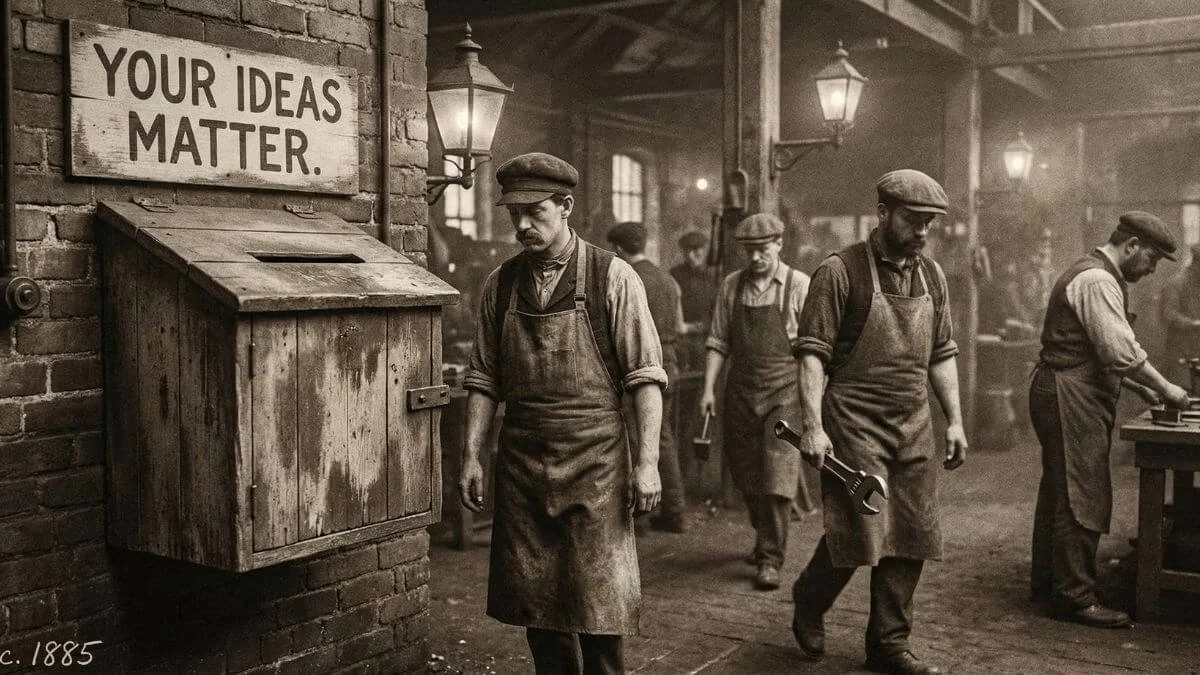
In 1880, American factories faced a labor organizing problem. Workers were forming unions, demanding shorter hours, and threatening strikes. Factory owners needed a way to defuse this collective energy without actually sharing power. The solution was elegant. Install a wooden box on the wall, add a slot on top, and call it a Suggestion Box. Workers could now "have a voice" without having a vote. They could submit ideas, complaints, and requests for better conditions. And management could perform the act of listening without the obligation of responding or changing anything.
The Job: The Suggestion Box Clerk
The Suggestion Box created a new administrative role. The Suggestion Box Clerk. This person's job was to unlock the box once a week, sort through the slips of paper, and categorize them. Complaints about unsafe machinery went into one pile. Requests for shorter shifts into another. Suggestions for efficiency improvements into a third. The Clerk would then summarize the contents in a report to management. That report almost always ended the same way. "Noted."
The Suggestion Box Clerk wasn't hired to implement ideas. They were hired to absorb them. To create a bureaucratic buffer between worker frustration and management decision-making. Workers could feel heard because someone physically retrieved their note. But the Clerk had no authority to act on the feedback. No budget to fix the problems. No mandate to bring the suggestions to anyone with actual power. Their job was to perform the collection of feedback, not to facilitate change. The box gave workers the illusion of participation in a system that had already decided they would never be participants.
The Modern Correlation
Today, we don't have wooden boxes on the wall. We have anonymous employee surveys, town hall Q&A sessions, and managers who say "my door is always open." If you lead Together™ in the Leadership Cartography™ system, you've been taught that listening is leadership. That creating space for feedback is how you build collaboration. And you mean it. You genuinely want to hear from your team. But here's what the 1880s factory owners understood that you might not. Listening without the power to act is not collaboration. It is theater.
You hold feedback sessions where your team shares their frustrations. You take notes. You nod. You thank them for their honesty. And then you go back to your own manager, who tells you the budget is locked, the timeline is fixed, and the policy is non-negotiable. You return to your team and deliver some version of "I escalated your concerns." They hear "noted." The Feedback_Pattern_Map pain point isn't that you're bad at listening. It's that you're trapped in a role designed in 1880 to perform listening without granting decision rights.
We still treat feedback collection as the end goal rather than the starting point. We measure "employee engagement" by how often we ask for input, not by how often that input changes the system. Together™ pathway leaders are especially vulnerable to this inherited belief. You think your job is to create the conditions for collective voice. But if that voice has no power to alter decisions, you're not building collaboration. You're just maintaining a very sophisticated Suggestion Box, and your team knows it.
If your team keeps giving you the same feedback and nothing ever changes, are you leading with Together™, or are you just the Suggestion Box Clerk for a system that decided their ideas don't matter?

Identify Your Terrain: Are you a Together™ pathway leader who collects feedback that goes nowhere? Take the Leadership Style Quiz to see if your collaborative instincts are being exploited by a system designed to perform listening without sharing power.
Lower the Pressure: If your team has stopped giving you real feedback because they've learned it disappears into the void, you're experiencing a Feedback Credibility pain point. Explore the Feedback_Pattern_Map to see how the 1880s Suggestion Box Clerk role shows up in your modern leadership and learn to distinguish between feedback that performs participation and feedback that actually shifts decisions.