
The Safety First Sign and the Performance of Care
How US Steel turned workplace death into a time management problem
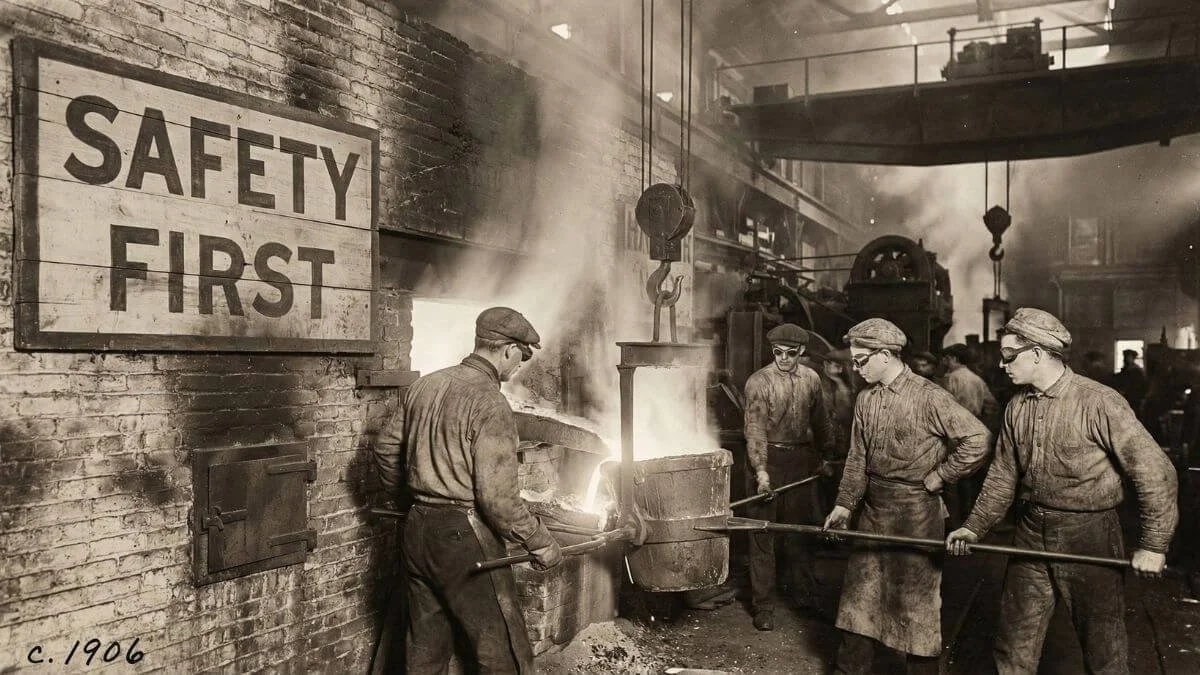
In the early 1900s, industrial work was lethally unsafe. One of the earliest systematic surveys of workplace fatalities tracked Allegheny County, Pennsylvania from July 1906 through June 1907. In that single year, 526 workers died in work accidents. 195 of them were steelworkers.
Under that kind of public scrutiny, U.S. Steel began formalizing safety efforts. In 1906, U.S. Steel began coordinating safety efforts. By 1908, “Safety First” had become an explicit corporate program.
The Job: The Safety Inspector
The Safety First campaign created a new role. The Safety Inspector. This person didn't work the furnaces or pour the steel. They walked the factory floor with a clipboard, documenting hazards and lecturing workers on "safe practices." Their job was to be visible. To demonstrate that the company "cared." But the Safety Inspector had no authority to stop production, no budget to install guards on machinery, and no power to shorten the 12-hour shifts that made workers too exhausted to avoid accidents.
In practice, the Safety Inspector could function as theater: highly visible attention to safety without the decision rights to change the conditions creating risk. They were hired to perform care without altering the conditions that caused the injuries. Their real job was time management. Every accident stopped the line. Every death triggered an investigation. Every lawsuit consumed resources. The Safety Inspector's task was to reduce the time cost of worker injury by creating the illusion of prevention. They held mandatory safety meetings before shifts, adding 15 minutes to the workday. They required workers to sign acknowledgment forms, creating paper trails that shifted liability from the company to the individual. They posted signs. Lots of signs. "Safety First" became the most visible phrase in American factories, even as the machinery stayed just as dangerous.
The Modern Correlation
Today, most managers aren't trying to prevent literal death. But if you lead with Lead with Heart™ in the Leadership Cartography™ system, you've inherited the Safety Inspector's calendar problem. You spend hours each week on emotional safety rounds. Pre-meeting check-ins to ensure no one feels blindsided. Post-meeting debriefs to make sure no one left feeling hurt. One-on-ones that start with "How are you really doing?" and consume 30 minutes before you even discuss the work. You've been taught that this is what good leadership looks like. That care requires constant monitoring.
Most of the "safety" work on your calendar isn't preventing harm. It's performing care in a system that hasn't actually changed the conditions causing the harm. You can't fix a toxic senior leader by having more empathy conversations with your team. You can't repair a broken promotion process by doing extra emotional labor in your one-on-ones. You can't make unrealistic deadlines safe by checking in more frequently. What you can do is spend so much time on safety theater that you have no time left to do the structural work that would actually reduce the harm.
The Safety Inspector role was designed to absorb time so the company didn't have to spend money on machine guards. Your role as the emotional Safety Inspector absorbs your time so the organization doesn't have to fix its systems. The Time Management Map pain point isn't about your personal efficiency. It's about a job description that was built in 1906 to look like care while preserving danger. And you've been handed the clipboard.
If your calendar is full of emotional safety work but your team still feels unsafe, are you leading with Heart™, or are you just the highest-paid Safety Inspector in a system that hasn't installed the guards?

Identify Your Terrain: Are you a Heart™ pathway leader whose calendar is consumed by emotional safety rounds? Take the Leadership Style Quiz to see if your natural care orientation is being weaponized by a system that hasn't changed.
Lower the Pressure: If you're drowning in check-ins and safety meetings while nothing actually gets safer, you're experiencing a Time Allocation pain point. Explore the Time Management Map to see how the 1906 Safety Inspector role shows up in your modern calendar and learn to distinguish between care that changes conditions and care that just performs concern.
Sources
Historical sources are included to ground the events and timelines referenced in this piece. Interpretations reflect a systems-level analysis of how early safety programs functioned within industrial organizations.
Centers for Disease Control and Prevention (CDC)
Early workplace fatality data documenting industrial deaths, including steelworker fatalities in Allegheny County, Pennsylvania (1906–1907).
https://www.cdc.gov/mmwr/preview/mmwrhtml/mm4822a1.htm
U.S. Department of Labor – History of Occupational Safety Regulation
Historical overview of U.S. Steel’s early safety organization, including the start of annual safety officials’ meetings in 1906 and the creation of the Central Committee of Safety in 1908.
https://www.dol.gov/general/aboutdol/history/mono-regsafepart05
U.S. Steel – Safety and Health History
Company history noting the emergence of “Safety First” as a formal safety philosophy in the early 20th century.
https://www.ussteel.com/2023-sustainability-report/empowering-people/safety-and-health