
Stop being the only one holding the room together.
Restore direction without losing the connection you have built.You do not need to stop including people. You need a structure that turns shared voice into shared movement. The Together Repair Kit helps you restore direction, clarify ownership, and keep the room connected without letting the work spread into fog.
Get the Repair Kit
You think in we before you think in me.
Most leadership models are built around the person at the front of the room. Together leaders build the room itself. You notice who is not speaking. You make space before anyone has to ask for it. You know the best plan is rarely the one person thought of alone.
That wiring is real. It is also undervalued by systems that reward speed over alignment, individual credit over collective momentum, and quick decisions over durable buy-in.
But when the terrain gets tense, Together can start carrying too much of the room. Inclusion becomes delay. Consensus becomes drift. The conversation keeps widening while direction gets softer. You may keep holding space long after the work needs ownership, decision, and movement.
The next step is not to stop including people. The next step is to build a structure strong enough to turn connection into coordinated action.
What Together does under pressure
Your strength is still the room.
But pressure changes what it costs to hold it.
Together is most useful when it builds a room people can move inside. Under pressure, that same strength can start carrying too much. The goal is not to stop including people. The goal is to notice when connection is becoming the only thing holding the room together.
Healthy Together
Healthy Together creates a room people can actually move inside. It draws out the quiet signal, makes room for dissent before it turns into resistance, and helps people see themselves in the work without making every decision belong to everyone.
When Together is clear, collaboration does not slow the work down. It strengthens commitment, surfaces risk earlier, and turns separate perspectives into shared direction.
Distorted Together
Under pressure, Together can start protecting the room more than the movement. The conversation stays open too long. Feedback keeps circulating. Decisions soften. Everyone feels included, but no one is quite sure what has landed.
The repair is not to become less collaborative. The repair is to build clearer agreements about who decides, who contributes, who is consulted, and when the group has enough signal to move.
Three repair moves
The connection can stay.
The structure needs to change.
Repair Move 01
Separate the connection from the drift.
Not every stall is a connection problem. Sometimes the decision rights are unclear, the threshold for moving was never set, or the group mistook being heard for reaching a decision. Repair starts by naming what is actually missing, which is usually direction, not more inclusion.
Repair Move 02
Name who decides before you open the room.
A conversation can be fully inclusive and still leave no one holding the decision. Together repair sets the roles before the discussion, so the group knows who contributes, who is consulted, and who owns the call once the talking ends.
Repair Move 03
Set the threshold for enough.
When Together is overextended, the conversation stays open because no one defined what enough looks like. The repair is to name the signal that means the group can move, so inclusion ends in a decision instead of widening into drift.
Together does not need to include less. It needs to make inclusion end in a decision the group can move on.
The work is not to become less collaborative. It is to build a structure where voice, ownership, and direction hold without requiring you to be the only one holding the room together.
The tension this repair holds
Inclusion matters. But inclusion cannot replace the decision the group is avoiding.
Consensus matters. But consensus has to produce movement, not just agreement that nothing is wrong.
Connection matters. But connection holds better when who decides, who contributes, and who is consulted are clear before the conversation opens.

Go deeper into
your Together terrain.
Together works the same way. The issue you are noticing may not be isolated. Team dynamics, feedback patterns, delegation, managing up, and remote coordination often share the same root system.
The Full Terrain Report helps you see how your Together pathway moves through the whole terrain, not just the pressure point in front of you.
Get the Full Terrain Report
Where this pathway is most tested.
Leadership rarely breaks along one line. When Together is active, friction tends to appear where coordination falters, norms fragment, or shared understanding erodes.
You don't need to work on all of these. Noticing which one is active is often enough to change how this week unfolds.
- Team Dynamics Map When collaboration exists, but trust or norms have fractured.
- Feedback Pattern Map When feedback circulates, but shared meaning does not form.
- Delegation Block Map When work is assigned, but ownership is unclear across the team.
- Managing Up Map When alignment breaks between leadership layers.
- Remote Leadership Map When distance disrupts coordination and shared context.
Free Tools
Free Tools for Together Leaders
Two tools to help the room move without losing the room.
Free Reflection Tool
The Feedback Truth Map
A free reflection tool to help you trace where feedback breaks down inside a team — before it becomes a pattern that's harder to name.
Get the Free ToolFree Script Tool
Decision Framework Scripts
A free script tool to help your team make decisions together without stalling, deferring, or defaulting to whoever speaks loudest.
Get the Free Scripts
Not sure this is your pathway? Start with the assessment.
This page assumes Together is already your result. If you are not sure, take the Source Assessment first. It will show you the leadership pathway you default to under pressure, so you are not trying to repair the wrong terrain.
Ten minutes. Free. Your result arrives by email.
New to management?
Start with the room you are already leading.
The Discovery Toolkit is the first step for Together leaders who are still learning how their pattern shows up in real management moments.
Use it to map the collaboration agreements your team is currently operating without, notice where shared ownership is unclear, and build language for the way you lead before pressure turns connection into drift.
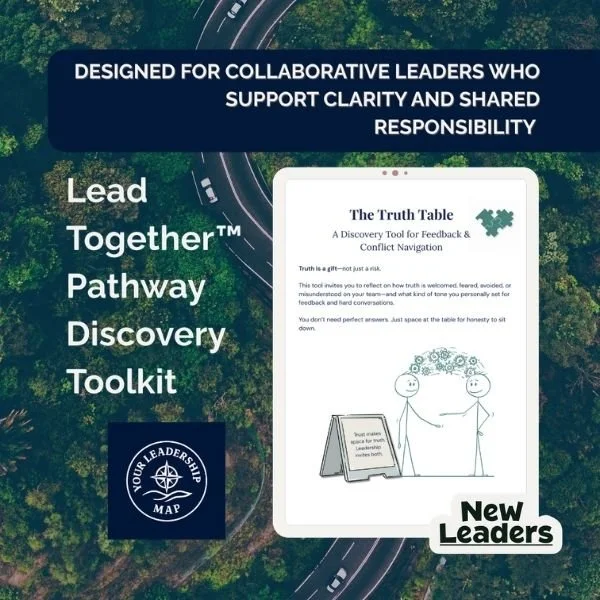
Lead Together™ helps collaborative managers build trust, navigate consensus traps, and create momentum through shared ownership.
What you’ll get:
A guided discovery sequence to map your natural collaboration style
Fillable tools for team decision-making and role clarity
Reflection prompts for balancing inclusion with direction
A one-page map to anchor agreements and next steps
Format: Fillable PDF (instant download)
Ideal for: Collaborative leaders, facilitators, and new managers who want to create buy-in without losing pace
Common Questions
```This page is for managers whose Source Assessment result is Lead Together™, or for managers who recognize that their leadership pressure often shows up around collaboration, shared ownership, group trust, decision drift, or coordination across people.
Start with The Source Assessment. It will show you the leadership pathway you tend to default to under pressure, so you are not trying to repair the wrong terrain.
The Together Repair Kit is for the moment when collaboration has started to turn into drift. Use it when everyone has been included, but ownership is still unclear, decisions are not landing, or the room keeps widening while the work loses direction.
Start with the Lead Together™ Pathway Discovery Toolkit. It gives you seven fillable tools to map collaboration agreements, meeting structure, voice, shared commitments, decisions, team pulse patterns, and weekly review rhythms one step at a time.
Use one of the pressure-point maps. For Together leaders, the most common pressure points are team dynamics, feedback patterns, delegation blocks, managing up, and remote leadership. You do not need to work on all of them. Start with the terrain that is most active right now.
The Full Terrain Report is the deeper pathway reading. It helps you see how your Together pattern moves through the whole system, not just the pressure point in front of you. Use it when the visible issue feels connected to several things at once: trust, ownership, feedback, decisions, team norms, or coordination.
Leadership Cartography™ is the mapped approach behind all MMMCo™ tools. It reads your leadership in three territories: Identity, the pathway you lead from under pressure; Terrain, the patterns that pathway produces; and Navigation, the next steady move from where you actually stand.
A personality type describes who you are as a fixed category. A pathway maps how you tend to lead under pressure and what that produces in the team around you. For the longer answer, read why personality tests fail managers.
Because these are digital products, purchases are non-refundable. Personal use license only. Facilitator or team licenses are available upon request.