


When the Map is Blurry at the Top, Staying Silent Hides the Cliff
Direction is clear.
The cost to the team is invisible.
A request comes down from your boss. Timeline set. Expectations clear. What isn’t clear is exactly what this new work is landing on top of.
You see the trade-offs immediately. You know what will slip and what will be absorbed. But in the legacy "shock absorber" model of management, you were taught that loyalty means absorbing the friction. You fear that speaking up looks like a solo agenda or a lack of devotion.
The Reality: Absorbing the chaos doesn't solve it. It only hides the gaps in the map.
Staying silent isn't being a "team player"—it's participating in a system of silence. This map provides the Signal Table you need to make capacity visible. It is a shared language for upward negotiation that protects your team and provides your leader with the high-fidelity data they need to make better decisions.
You aren't being resistant. You are being precise.
I need the gear now.
I want to understand the system

Start with your map.
When managing up feels unclear, the issue is rarely just confidence or communication. It often reflects a deeper leadership pattern: how you read authority, how much context you think you need, and what you default to when the person above you is hard to reach.
The Source Assessment helps you identify that pattern so you can understand why upward communication feels difficult and what kind of structure will help you move with more clarity.
Ten minutes. Free. Your result arrives by email.
If two or more of these are true, you're in it.
The gap isn't in your performance. It's in how your work is reaching the people who decide.
- You're doing the work, but they only see the fires.
- You're waiting for a decision that never comes.
- Your 1:1s feel like status updates, not strategy.
- The goals keep shifting, but the deadline doesn't.
- You're not sure how to tell the truth about how behind you are.
- You don't know how to decline executive requests without damaging the relationship.
- You spend more time managing perceptions than managing outcomes.
- You're trying to influence stakeholders who have power but no direct line to your work.
If that's where you are, you don't need more effort. You need a clearer map. Start with the framework that makes your work legible to the people who decide.
The 4-Signal Map: Make Your Work Legible
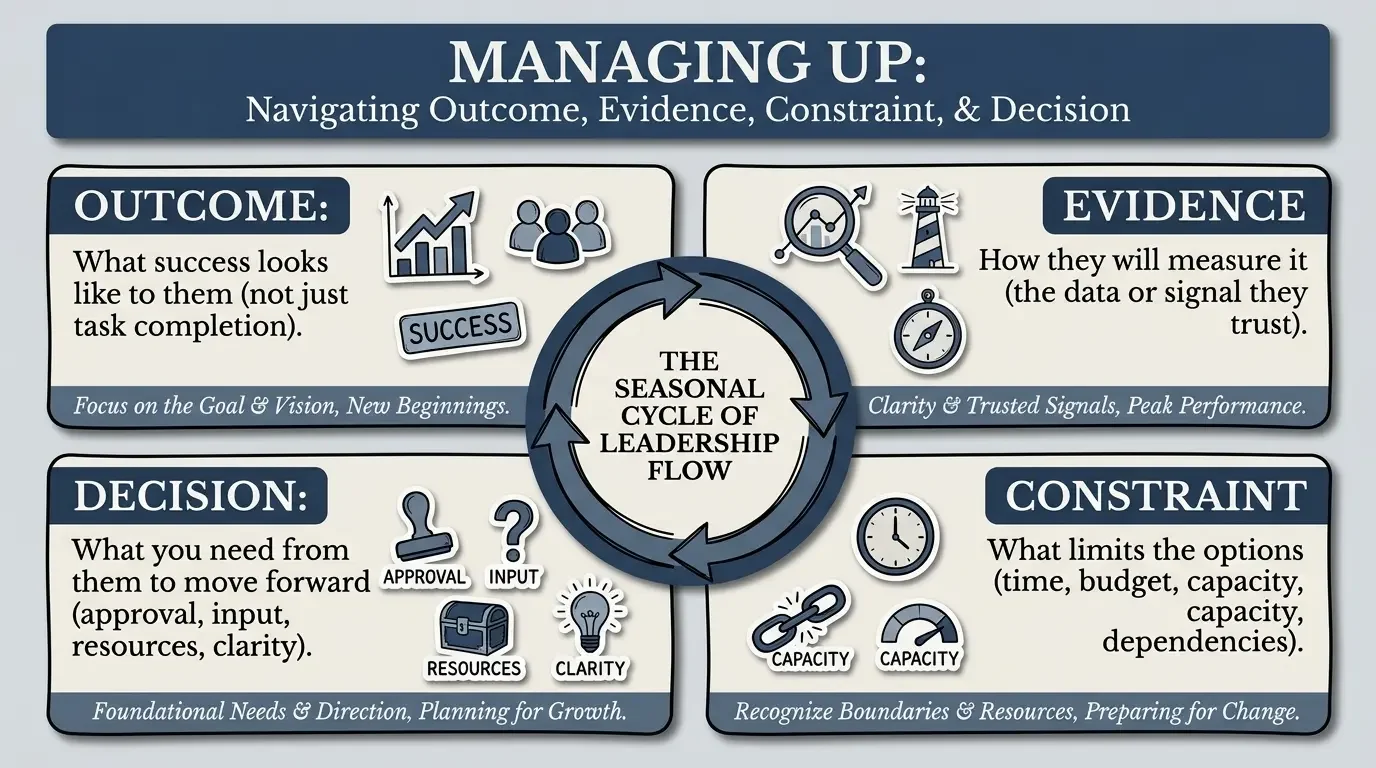
When you're managing from the middle, stop sending effort. Start sending signal. Most managers describe their work — they don't structure it for a decision. These four signals translate your work into a form leaders can move with.
Before your next 1:1, map these four signals. They tell your leader what to do next — not what you need to prove about yourself.
Outcome
What success looks like to them — not just task completion.
Evidence
How they will measure it — the data or signal they trust.
Constraint
What limits the options — time, budget, capacity, dependencies.
Decision
What you need from them to move forward — approval, input, resources, or clarity.
"I'm working on the Q4 vendor analysis. Still gathering data. Should have something next week."
- Outcome: Reduce Q4 operating costs by 15% while maintaining service levels.
- Evidence: Vendor comparison showing 3 qualified alternatives with pricing breakdowns.
- Constraint: Need decision by Dec 10 to meet Jan 1 contract start date.
- Decision: Which vendor shortlist should I pursue, or do you need different evaluation criteria?
"The launch timeline is really tight. Not sure we can make it."
- Outcome: Launch beta to 500 users by March 15 as committed to board.
- Evidence: Current velocity shows 6 weeks of dev work remaining with 4 weeks available.
- Constraint: Team is at capacity; adding contractors requires 2-week onboarding.
- Decision: Do we reduce scope to hit the date, push the date, or add temporary capacity?
The first version signals uncertainty. The second gives your leader everything they need to make a decision with you — not for you. If this still doesn't move things, one of the underlying terrain frictions is active. The structure isn't the problem.
The difference: The first version signals uncertainty. The second version gives your leader everything they need to make a decision with you, not for you.
Now choose how you want to move forward: Use this framework with structured tools, or understand why the pattern exists before committing to a solution.
What this sounds like in practice
When you need a decision
Your work is stalled waiting for clarity from above
When direction keeps shifting
Priorities change but expectations don't adjust
When you need to surface bad news
You have information they need but don't want to hear
Choose your route
There is no single right move here. It depends on what you need first.
Quick Relief
Use this route if you need to communicate across levels with clarity this week.
Start with a structure that makes your impact legible to decision-makers.
- A framework that translates work into outcomes, evidence, constraints, and decisions.
- Scripts for delivering hard truths without burning bridges.
- Tools that surface what your leader actually needs to hear.
Promotion Readiness Map for High Performers | Translate Your Impact Into Executive Language
How do I get promoted when my feedback is vague?
Define promotion readiness in observable behaviors, build portable proof of outcomes, map sponsorship, and use a simple executive translation frame so your impact is easy to see and advocate for.
🧭 What this tool does
If you are doing strong work but feedback stays vague, you do not need more effort. You need legibility.
The Promotion Readiness Map is a 30–45 day, fillable plan that helps you translate what you do into strategic language so leaders can see, repeat, and advocate for your contribution.
This is not a motivation tool. It is a visibility and sponsorship system.
✅ Best for you if…
You consistently deliver, but recognition is inconsistent.
You hear “keep doing what you’re doing,” but cannot get a straight answer on what “ready” means.
You are doing work that matters, but it is not traveling upward.
You want to ask for promotion conversations with clarity, not anxiety.
🧩 What you will build (in 30–45 days)
Clear “ready” criteria in observable behaviors (not vibes)
A portable proof inventory of outcomes leaders care about
A sponsor map so you know who influences the decision and how to engage them
A simple translation frame to communicate impact in executive terms
Clean visibility actions that reduce performance and increase trust
A way to convert vague feedback into usable criteria
A weekly experiment plan so you move steadily, not reactively
📦 What’s inside the guide
A 12-page fillable PDF with a 7-step sequence:
Define “ready” in observable terms
Build portable proof
Map sponsors and low-risk sponsorship
Translate your work for executives
Create clean visibility without performing
Convert vague feedback into usable criteria
Run the 30–45 day promotion experiment
🖨️ Print or digital
Fill it out on your computer or tablet, or print it.
Designed for reuse in skip-levels, performance conversations, and promotion cycles.
⚠️ A grounded note
This tool cannot guarantee a promotion. It can guarantee something more useful: a structured way to make your value visible, repeatable, and decision-ready.
Product details
Format: Fillable PDF
Length: 12 pages
Use: Digital or print
Best for: High performers, senior ICs, new managers, and anyone navigating ambiguous advancement criteria
Explore the Terrain
Use this route if you want to understand the pattern before committing to a tool.
Start here if you want to see why managing from the middle keeps producing the same friction.
- See why managing from the middle creates recurring friction.
- Understand why familiar approaches keep failing.
- Build fluency before committing to a tool.

What is actually happening
Managing up breaks down when you're operating without system governance.
Modern leadership is no longer task supervision. It's governing direction, interpreting signals, and maintaining coordination across levels. When upward leadership friction appears, it's usually a breakdown in one of three core governance areas.
This is not a performance problem. It's a governance gap.
Invisible Priorities
Your leader operates at a different altitude. Without shared direction on what matters and why, you're both working hard toward outcomes that may not align. The gap isn't effort. It's a missing frame for what success actually looks like from above.
The Ambiguity Trap
Executives communicate in outcomes, not instructions. When clarity never arrives, it's often because they assume you can infer the next move. That assumption isn't their leadership style. It's a translation mismatch — and it falls to you to close it.
The Translation Gap
You see effort. They need evidence of impact. Without translating your work into decision-ready signals — outcomes, evidence, constraints, decisions — the system can't act on what you're reporting, regardless of how much is getting done.
Once you identify which governance breakdown is active, your next move becomes clearer.
You're not failing at managing up. You're navigating without the right map.
When this terrain keeps repeating
If this keeps showing up across different situations, you might not need another tactic. You might need orientation. Your leadership Pathway shapes what you notice, what you prioritize, and what you misread under pressure.
You will get your Pathway orientation and next steps there.
Your interpretation. The likely signal.
When you are managing up, your internal story is often reasonable. It is just incomplete.
| You Think: | The System Signal May Be: |
|---|---|
| They do not trust me. | They do not have the data to defend your work. |
| If it matters, they will ask. | They assume you will surface what matters without prompting. |
| I should not have to translate this. | Their constraints are invisible to you. |
| Saying "no" will damage the relationship. | They trust you, but they need you to name the tradeoff and the decision. |
When this pattern repeats, it is not personal. It is structural.
If you want to understand how these patterns surface in real leadership moments, here's where to go next.
These paths help you diagnose what's actually happening, hear how it plays out in real systems, and understand why this pattern exists at all. Start where your curiosity pulls you.
Read The Manager’s Compass to diagnose the exact issue in how you are managing up.
These frameworks help you identify which terrain friction is present and interpret the signals you are receiving through structured Terrain Surveys.
This is where you go when you want clarity before choosing a response.


Read The Manager’s Mind to learn about how these patterns surface in real leadership moments.
Each post traces a lived situation so you can recognize yourself in the signal, not just understand it intellectually.
This is where the framework meets reality.

Read The History of Work to understand how these dynamics formed and why they persist.
This lens connects modern managing-up friction to older systems of authority, professionalism, and control.
This is where personal frustration turns into systemic understanding.

Toolkits
These toolkits are not meant to be used all at once. Each one addresses a different pressure that shows up when you are leading from the middle. Start with the friction you feel most this week.
If your work is invisible to decision-makers, make your impact legible.
Use the Promotion Readiness Map.
- Translate your contributions into outcomes leaders can act on.
- Surface what you have done in decision-ready language.
- Close the gap between doing the work and being seen doing it.
Use this when your effort is real but your visibility is not.
If everything feels urgent and you cannot find signal, reset your weekly priorities.
Use the Weekly Priority Planner.
- Re-anchor your week around a small number of outcomes.
- Separate urgency from importance.
- Prevent priorities from shifting mid-week.
Use this when everything feels important and nothing is holding.
If your week keeps running you, build a rhythm that holds.
Use the Leadership Rhythm Builder.
- Rebuild cadence across daily, weekly, and monthly cycles.
- Surface capacity limits before they surface as burnout.
- Align your planning with a sustainable pace.
Use this when the pressure keeps returning, even after you plan.
Promotion Readiness Map for High Performers | Translate Your Impact Into Executive Language
How do I get promoted when my feedback is vague?
Define promotion readiness in observable behaviors, build portable proof of outcomes, map sponsorship, and use a simple executive translation frame so your impact is easy to see and advocate for.
🧭 What this tool does
If you are doing strong work but feedback stays vague, you do not need more effort. You need legibility.
The Promotion Readiness Map is a 30–45 day, fillable plan that helps you translate what you do into strategic language so leaders can see, repeat, and advocate for your contribution.
This is not a motivation tool. It is a visibility and sponsorship system.
✅ Best for you if…
You consistently deliver, but recognition is inconsistent.
You hear “keep doing what you’re doing,” but cannot get a straight answer on what “ready” means.
You are doing work that matters, but it is not traveling upward.
You want to ask for promotion conversations with clarity, not anxiety.
🧩 What you will build (in 30–45 days)
Clear “ready” criteria in observable behaviors (not vibes)
A portable proof inventory of outcomes leaders care about
A sponsor map so you know who influences the decision and how to engage them
A simple translation frame to communicate impact in executive terms
Clean visibility actions that reduce performance and increase trust
A way to convert vague feedback into usable criteria
A weekly experiment plan so you move steadily, not reactively
📦 What’s inside the guide
A 12-page fillable PDF with a 7-step sequence:
Define “ready” in observable terms
Build portable proof
Map sponsors and low-risk sponsorship
Translate your work for executives
Create clean visibility without performing
Convert vague feedback into usable criteria
Run the 30–45 day promotion experiment
🖨️ Print or digital
Fill it out on your computer or tablet, or print it.
Designed for reuse in skip-levels, performance conversations, and promotion cycles.
⚠️ A grounded note
This tool cannot guarantee a promotion. It can guarantee something more useful: a structured way to make your value visible, repeatable, and decision-ready.
Product details
Format: Fillable PDF
Length: 12 pages
Use: Digital or print
Best for: High performers, senior ICs, new managers, and anyone navigating ambiguous advancement criteria
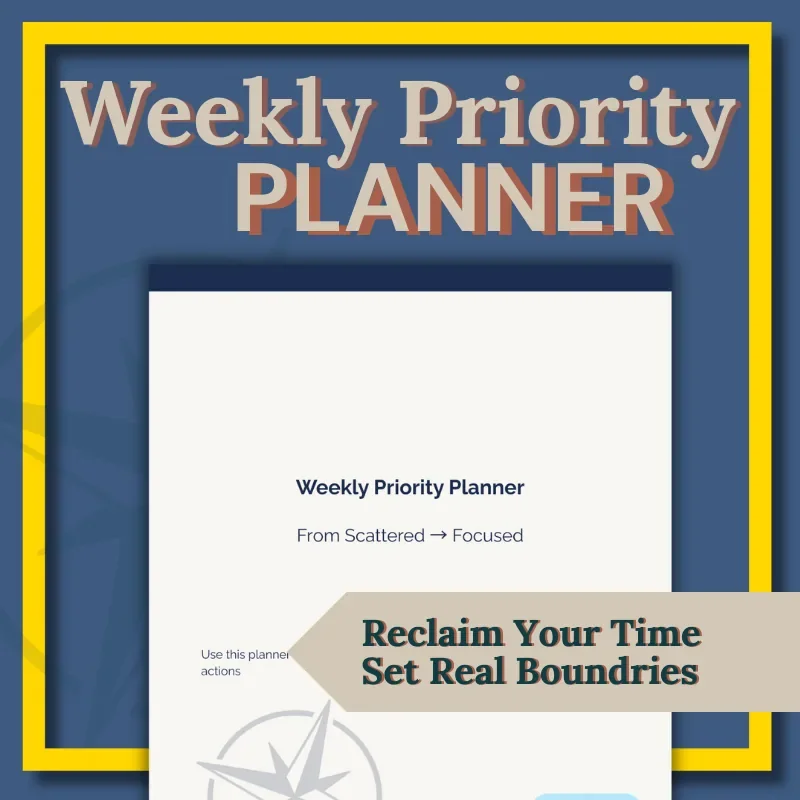
A printable, fillable weekly priority planner template for managers to reset focus, choose what matters, and reduce overload before the week takes over.
When a manager’s week feels scattered, reactive, or overloaded, the issue isn’t effort—it’s a lack of weekly reset structure. The Weekly Priority Planner is a printable, fillable planning tool that helps you step back, clarify priorities, and reset focus so you can plan your week with intention instead of constantly responding to urgency.
Use it at the start of the week (or anytime the week starts drifting) to name what matters most, organize tasks and commitments without over planning, and reduce overwhelm caused by competing demands. The result is a calmer, clearer weekly rhythm—built on direction, not pressure.
What this tool helps you do
Clarify your top priorities for the week ahead
Organize tasks and commitments without complex systems
Reduce overwhelm from competing demands and shifting requests
Regain a sense of control and direction
Build a steadier, more intentional weekly rhythm
What’s inside
Weekly priority planning page
Focus + intention-setting section
Space to track key actions and commitments
Reflection prompts to adjust and refocus
Printable + fillable PDF
Best for
Managers pulled in too many directions, weekly planning/reset routines, leadership roles with shifting priorities, and anyone who wants clarity without overengineering.
Result: a weekly plan that protects what matters and reduces mental fatigue.
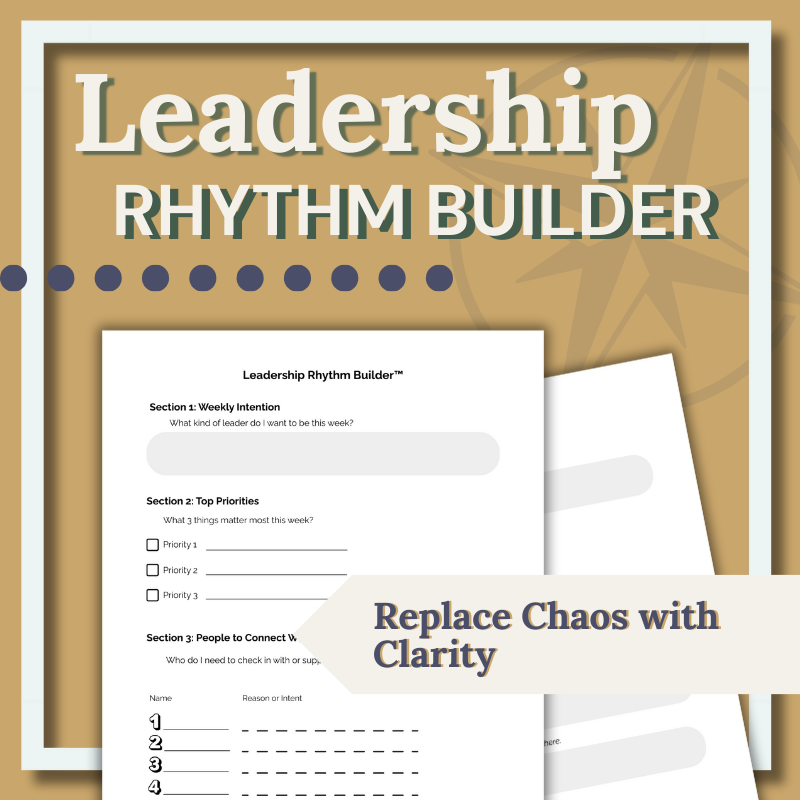
When a manager’s week is full of shifting demands, most plans break by Tuesday. The Leadership Rhythm Builder™ is a printable, fillable weekly clarity system that creates a repeatable operating rhythm—so you lead with steadier structure instead of reaction mode.
This tool helps you set a clear leadership intention for the week, define your top priorities before chaos takes over, and choose which relationships need attention. It also gives you a simple way to track follow-ups, commitments, and unfinished work—so your calendar and your leadership stay aligned.
What this helps you do
Set a clear leadership intention for the week
Identify your top priorities before the week fills itself
Focus on the relationships and communication that need attention
Track follow-ups, commitments, and open loops
Build a steady weekly rhythm you can rely on (even in high-change weeks)
What’s inside
Leadership Rhythm Builder™ (multi-page PDF)
Weekly intention + priority-setting structure
Relationship + communication focus section
Follow-ups + commitments tracker
Printable + fillable PDF
Best for
New managers, team leads, and managers navigating overwhelm, scattered priorities, meeting-heavy weeks, or constant context switching—especially if you want a calmer weekly reset that’s practical, not performative.
Result: a grounded weekly rhythm that replaces chaos with clarity.
Managing Up Map
Before you choose a next move, here are clarifying answers managers tend to need in this terrain.
Why does managing up feel harder than it should?
Because decisions require legible inputs. When your work isn't structured in a way that leaders can quickly interpret, decision authority slows and requests bounce back down the hierarchy.
Is managing up about influence or communication skills?
No. It's primarily a systems design issue. Managing up breaks down when priorities, decision criteria, or escalation paths are unclear — not when communication effort is lacking.
Why do leaders keep asking for more information or revisiting decisions?
Because the system doesn't yet have decision-ready signals. When inputs are incomplete, misaligned, or framed at the wrong altitude, leaders delay commitment to reduce risk.
Should I advocate harder for my work to be seen?
Not necessarily. This map helps you adjust how work is structured and presented so it becomes readable within the decision system, reducing the need for personal advocacy.
What does this page help me do differently?
It helps you translate your work into clear signals that leaders can act on, so decisions move forward without friction, escalation, or repeated clarification loops.

When a boss hovers, the issue is often what they cannot see. Here is how to read the terrain and lower the checking.