
The Essential Guide to Managing Up to Your VP or CEO
Managing up is translation. Turn project work into decisions, signals, and constraints your VP or CEO can act on.
I used to judge senior leaders by the standard I held for myself as a manager. I would never change priorities midweek without naming the tradeoffs, I would not ask for “quick updates” and then expect a full rebuild, and I would never manage my team in a way that kept them guessing about what mattered most.
So when it happened to me from above, I held it as the truth that it was poor leadership, not a different leadership job.
I remember leaving the CEO’s office feeling disoriented. His feedback sounded vague to me, and I did not know how to translate it into next steps.
Looking back, I can see the mismatch. He was trying to explore possibilities and risk. I was trying to confirm whether we could continue as planned.
We were not having the same meeting. In that moment, the decision rights were not clear to me, and the expectation clarity I needed to proceed did not exist.
I did not understand this until I became a COO.
It is hard to hold the reality that an executive is managing for a multitude of outcomes at the same time. Execution is one of them. Risk is another. Resourcing, timing, reputation, stakeholder trust, and downstream impact are all in the mix. A big part of that is stakeholder influence, because what looks like a simple project update to you is often connected to pressures you cannot see.
Once I sat in that seat, I became acutely aware of how people heard what I said. I could tell when a director was listening with fear, trying not to mess up, trying to interpret my tone as a signal about their performance.
That changed how I led.
If you are reading this as part of the weekly series, Week 1 and Week 2 build the foundation that makes this easier.
I learned to acknowledge the work already done without accidentally triggering a rewrite. I learned to separate “this is good work” from “the environment changed.”
Because sometimes new information enters the mix that none of us could see coming. A dependency breaks. A constraint appears. A stakeholder changes course. The strategy has to shift.
When it did, I made it a practice to tell each director exactly why I was changing direction. That is what a prioritization system does at the executive level. It makes the trade visible so the team can shift without spiraling. I named the tradeoff I was making. I explained what the new information was and what it meant. I gave them the clearest possible “now we are optimizing for this.”
I also learned that timing mattered.
The earlier I shared the shift, the less emotional it became. The moment I had a plan of action, I communicated it. A steady reporting cadence lowers anxiety because people stop waiting for surprise shifts and start trusting the rhythm. That steadiness protected trust. It reduced churn. It kept people from guessing.
Not every change deserved a full explanation, and not every detail could be shared in real time.
There were moments when things were still unfolding. There were constraints I could not disclose yet. There were stakeholder dynamics I could not name without creating more risk.
In those moments, I relied on what I think of as the trust bank.
When you have consistently named tradeoffs, shared context early, and protected people from unnecessary rewrite, your team can tolerate a shift they do not fully understand yet. They do not have to guess whether it is arbitrary.
They trust that if you could explain more, you would.
Managing up works the same way. Your job is to make your work legible to the executive scoreboard.
If you are new here, Manager’s Compass is where I publish practical systems for managers who need clarity fast.
What does managing up actually mean when your boss is a VP or CEO?
Managing up means translating work into decision-ready signals so leadership can allocate attention, make tradeoffs, and reduce risk. If managing up has pushed your workload into overdrive, this often overlaps with burnoutor overwhelmpatterns too.
Managing up is the practice of converting your team’s reality into three executive-ready outputs:
A decision they need to make
A signal they need to notice
A constraint they need to respect
If your update does not land as one of those, it often gets treated as noise, even when your work is strong.
Executives are not listening for effort. They are listening for orientation.
What is stable.
What changed.
What is at risk.
What you need from them.
Why does your “good update” keep failing with executives?
It is often a mismatch of intent. They are exploring options and risk while you are seeking permission to proceed. Most managers over-correct in the wrong direction. When executive feedback feels unclear, they respond with more detail.
More context. More data. Longer emails. Bigger decks. It increases cognitive load, which means even accurate information becomes hard to scan and easy to misinterpret.
It feels responsible, but it usually creates the opposite outcome. Your message becomes harder to scan, so the executive grabs a small piece, reacts to that, and you walk away with even less clarity than before.
The fix is not more information. The fix is a better frame.
What is the simplest executive update format that reduces vague feedback?
Use a five-line structure that leads with headline, status, signal, risk, and ask. You can use this immediately. It is short enough for a VP to scan, and strong enough to reduce vague feedback loops.
The 5-Line Executive Update
Headline: The single most important thing to know this week.
Status: On track, at risk, or behind.
Signal: What changed since the last update.
Risk: The one thing that could derail the plan.
Ask: The decision, input, or protection you need.
You can attach details below. Do not bury these five lines inside a long narrative.
Even with a strong update structure, managing up can still feel hard if the problem is not your phrasing. Often the friction comes from the terrain you are operating in.
That is why the next step is diagnostic, not more advice.
Executive Clarity Check
Identify your Managing Up Marker in 60 seconds so you can stop guessing and use the tool that matches your situation.
If you are navigating a promotion or trying to be seen at the next level, use the Promotion Readiness Map to translate your work into decision-ready strategic language.
Read the four markers below and choose the one that matches your week most closely.
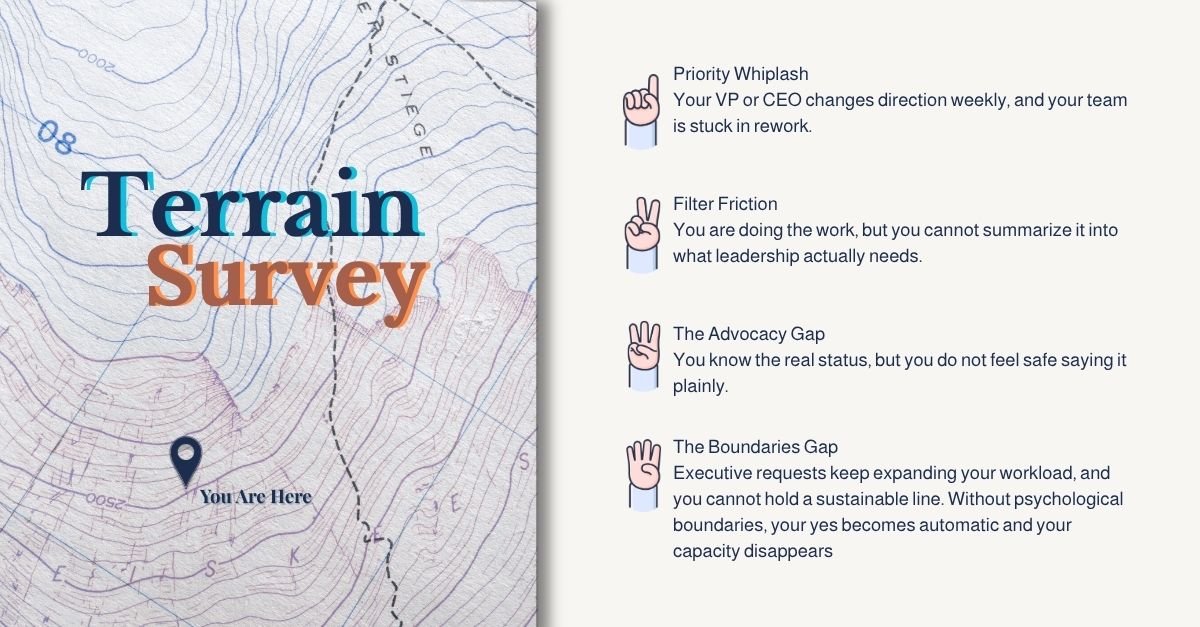
Choose your marker to get the tool that matches your situation this week.
For career-phase growth, the Promotion Readiness Map helps executives see your contribution clearly.
Get the matched tool now so your next update lands with steadier clarity.
Once you know your marker, the next step is simple. Use the matched tool to stabilize that one condition before you try to fix everything else.
How do you respond to vague executive feedback in the moment?
Vague feedback usually means one of three things:
They are not deciding yet. They are exploring.
They do not have criteria, so they cannot evaluate clearly.
They are reacting to a risk they cannot name directly.
Your move is to convert vagueness into a decision prompt.
Ask:
“What decision are you trying to make here.”
“What would make this a yes for you.”
“If we change one thing, which matters most.”
This is not pushback. It is translation.
What is the managing up reframe that makes this easier?
Managing up is not about impressing executives. It is about stabilizing execution by stabilizing decisions.
Once you treat executive conversations as decision environments, you stop chasing approval.
You start building clarity.
And clarity is what protects your team, your time, and your credibility.
Want to build this skill into your next career phase?
If you are getting vague executive feedback, the problem is rarely effort. It is legibility. This tool helps you translate what you are already doing into strategic, decision-ready language so executives can accurately see and hear your contribution. Managing up becomes easier when your work is framed in decisions, risks, tradeoffs, and clear asks..
The Promotion Readiness Map
Promotion Readiness Map for High Performers | Translate Your Impact Into Executive Language
How do I get promoted when my feedback is vague?
Define promotion readiness in observable behaviors, build portable proof of outcomes, map sponsorship, and use a simple executive translation frame so your impact is easy to see and advocate for.
🧭 What this tool does
If you are doing strong work but feedback stays vague, you do not need more effort. You need legibility.
The Promotion Readiness Map is a 30–45 day, fillable plan that helps you translate what you do into strategic language so leaders can see, repeat, and advocate for your contribution.
This is not a motivation tool. It is a visibility and sponsorship system.
✅ Best for you if…
You consistently deliver, but recognition is inconsistent.
You hear “keep doing what you’re doing,” but cannot get a straight answer on what “ready” means.
You are doing work that matters, but it is not traveling upward.
You want to ask for promotion conversations with clarity, not anxiety.
🧩 What you will build (in 30–45 days)
Clear “ready” criteria in observable behaviors (not vibes)
A portable proof inventory of outcomes leaders care about
A sponsor map so you know who influences the decision and how to engage them
A simple translation frame to communicate impact in executive terms
Clean visibility actions that reduce performance and increase trust
A way to convert vague feedback into usable criteria
A weekly experiment plan so you move steadily, not reactively
📦 What’s inside the guide
A 12-page fillable PDF with a 7-step sequence:
Define “ready” in observable terms
Build portable proof
Map sponsors and low-risk sponsorship
Translate your work for executives
Create clean visibility without performing
Convert vague feedback into usable criteria
Run the 30–45 day promotion experiment
🖨️ Print or digital
Fill it out on your computer or tablet, or print it.
Designed for reuse in skip-levels, performance conversations, and promotion cycles.
⚠️ A grounded note
This tool cannot guarantee a promotion. It can guarantee something more useful: a structured way to make your value visible, repeatable, and decision-ready.
Product details
Format: Fillable PDF
Length: 12 pages
Use: Digital or print
Best for: High performers, senior ICs, new managers, and anyone navigating ambiguous advancement criteria
This is a 30–45 day plan to help you move from “strong performer” to sponsor-ready leader. Its most helpful for those would are ready for Director Level positions because it gives you a simple system for building portable proof, clean visibility, and decision-ready communication without performative politics.
Inside the tool, you will get:
A strategic translation framework (so executives can clearly see your contribution in the language they use to make decisions)
A next-level criteria translator (so you stop guessing what “ready” means)
A portable proof inventory (so your impact travels when you are not in the room)
A sponsor map (so you know who needs to believe what)
A decision-ready update format you can use in any forum
A 30–45 day experiment plan with signals to watch
This tool translates your work into decision-ready language so executives can see your impact clearly.