
The Definitive Guide To Effective Delegation
Delegation works when you share the right information up front: the outcome you want, the choices they can make, and when you’ll check in.

When I delegate something, my first concern is simple:
Did I give the information in a way that leads to the result I actually want?
Because that’s where delegation usually breaks. At the beginning.
You hand something off. You walk away. And later, the result comes back.
Sometimes it’s close, but not quite right. Sometimes it misses the point. Sometimes it’s “done,” yet you still can’t use it.
That’s the moment most managers feel disappointed. Then the judgment sneaks in.
Why didn’t they think of this? Why didn’t they ask? How did they miss what was obvious?
Then you replay the handoff.
What did I actually say?
What did I assume they understood?
What did I leave out because it felt like too much detail?
When did we agree to reconnect before the work got too far down the road?
That disappointment is information. It points to three things that needed to be clearer: your words, the choices they owned, and the first check-in point.
My observation: delegation is usually handled like task assignment. That leaves too much to guessing. A real handoff transfers the information that shapes the outcome.
Leadership Cartography is a framework developed by Your Leadership Map™ that helps managers read friction patterns and system conditions so leadership choices become clearer and steadier.
Why effective delegating feels hard in early management
When you become a manager, the work changes shape.
You used to succeed by producing the output. Now you succeed by creating the conditions for output. That shift isn’t obvious at first, then it becomes loud the moment something comes back misaligned and you realize you’re still accountable for the result.
That’s why delegating can feel like a gamble.
The issue is rarely effort. The issue is information. When the handoff leaves too much to guessing, the person fills in the gaps with their best read of the situation. Sometimes that read matches what you meant. Sometimes it doesn’t.
The more important the work is, the more painful that guessing becomes.
The information that shapes the outcome
If you want the output to match what you pictured, the handoff has to carry the information that creates it.
Three pieces of information do most of the work:
The outcome you want
The choices they own
The first check-in point
When these three are clear, the work moves with far less friction, and your mind stops circling as much.
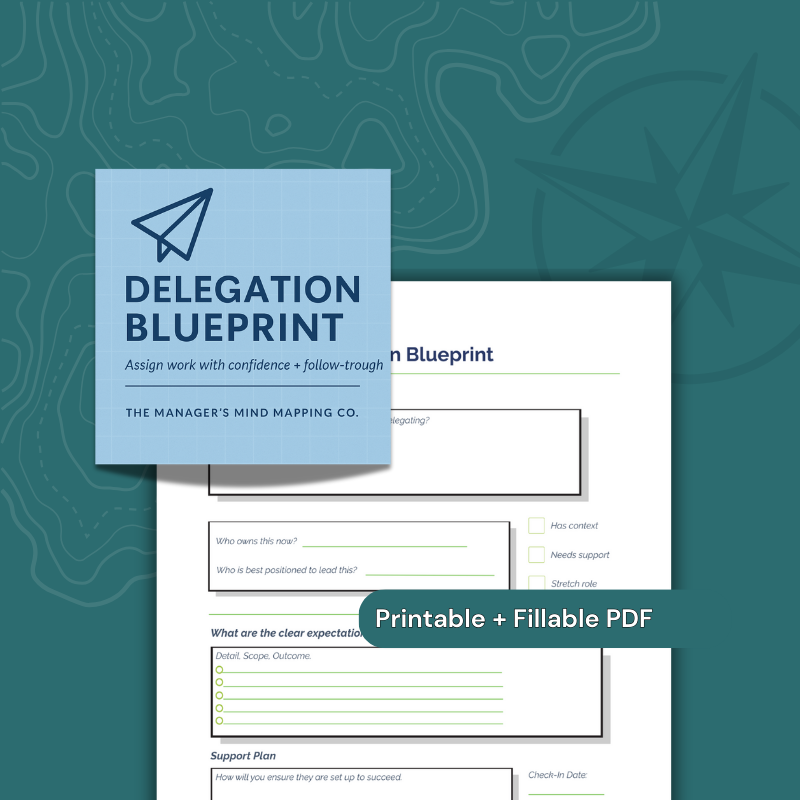
The Delegation Blueprint
If you want language that matches each part of the Delegation Process Roadmap for less than a cup of coffee, grab the Delegation Blueprint, a ready-to-use template for workplace delegation.
A small lens to diagnose what happened
If you want a quick read, use this lens. Three lines.
If you feel disappointed by the result, the outcome needed clearer words.
If small choices keep coming back to you, the choices they owned needed to be defined.
If you wanted updates and never got them, the first check-in point needed to be set.
This gives you enough diagnosis to have a better understanding of how to tighten the handoff.
The Delegation Blueprint
This blueprint gives you a repeatable sequence you can use every time you delegate. The purpose is simple: transfer ownership in a way that keeps expectations clear from the start.
1️⃣ Name the outcome in plain words
State what you want produced and what “done” looks like. Keep it specific.
If it helps, finish this sentence:
“By the end, we should have ________ so we can ________.”
2️⃣ Define the choices they own
Say which choices they can make on their own, and which choices you want brought back to you.
Use simple language:
“You own these choices. Bring me in on these. I’ll decide these.”
3️⃣ Share what shapes the work
Give the conditions that will shape the plan: the deadline, the people it depends on, the limits, the rules, and what “good” looks like in your world.
If you have an example, a past version, or a template, share it here.
This is the step that turns “I assigned it” into “they can actually deliver it.”
4️⃣ Set the first check-in point
Choose one early check-in point that keeps the work aligned.
Name what you’ll review at that check-in:
an outline
a first draft
a proposed plan
a short update with decisions made so far
Early check-ins keep small corrections small.
5️⃣ Keep ownership steady through the finish
Let the owner carry the work to completion. Use your check-in to clarify, remove roadblocks, and adjust the conditions.
This is where capability grows. This is also where trust becomes real.
What this changes for the team
When a manager delegates like this, the team learns something important: ownership here is clear.
People stop trying to read your mind. They start making the right calls because the boundaries are visible. They bring you the right questions because they know what you want involved. They gain confidence because the handoff holds shape.
And you gain capacity because your role becomes clearer: you guide direction, you set boundaries, and you keep the rhythm.
A simple way to apply it today
Pick one task you’ve been holding too tightly.
Before you delegate it, write three lines:
Outcome: ________________________________
Choices they own: _______________________
First check-in: ____________________________
Then delegate from those lines.
Over time, your handoffs get cleaner. Your disappointment drops. Your team gets stronger. Your leadership gets steadier because you can rely on a system instead of re-inventing the handoff every time.
What effective delegating builds over time
When you delegate with clear information, your team starts working with less second-guessing.
People move faster because the target is clear and the choices are defined. They stop holding work back while they wait for you to approve every small step. They bring you the right questions earlier, when changes are still easy.
You also gain something important: your attention comes back.
You stop carrying the work and carrying the worry around the work. You stop reopening the same task in your mind all week. Your energy returns to the parts of leadership only you can do: setting direction, removing roadblocks, and keeping priorities clear.
Over time, this is how trust grows.
Trust grows because your handoffs become consistent. People learn what “good” looks like with you. They learn which choices they can make without checking. They learn when you want to be included. The working relationship becomes steadier because the rules stay the same from one handoff to the next.
Effective delegating builds capability for them and capacity for you. It also sends a culture signal: ownership is real here, and support is available without taking the work back.
Your Next Step
Choose one task you’ve been holding too close.
Before you delegate, answer three questions in plain words:
What outcome do I want?
What choices do they own?
What is the first check-in point?
Then run The Delegation Blueprint once.
If you want weekly tools that support clarity, steadiness, and capability in your leadership, join the Manager’s Map Drawer, your ongoing library of leadership systems.
The Manager’s Map Drawer
Each month, you’ll receive a curated set of leadership tools chosen for the season managers are in — planning, organizing, resetting expectations, running reviews, strengthening team dynamics, or navigating conflict.
Instead of guessing what you need, you’ll receive 2–3 tools from the MMMCo library that fit the real challenges managers face that month.