

Lead with Support™ Pathway
Turn unconditional support
into steadiness that includes you
You do not need to reduce your capacity. You need a system that supports you as much as you support it. The Support Repair Kit helps you audit your load, set boundaries that hold, and restore steadiness to your daily operations.
Get the Repair Kit

The pattern you lead from
the system knows it's there.
When things get uncertain, your first move is to stabilize. You read the temperature of the room before most people have noticed the room has a temperature. You sense the load in a system before the system knows it is carrying one. You have been doing this so long it feels like breathing.
That steadiness is real, and it rarely gets named as leadership. You hold the room together and absorb the shifts before anyone else feels them. The work is invisible, which is exactly why it gets mistaken for doing nothing.
But under pressure, that same steadiness slips into self-sacrifice. You hold too much. You rescue too quickly. You keep supporting the system while it stops supporting you, until you are the one carrying the load alone.
The next step is not to care less or toughen up. It is to build a system that supports you as much as you support it, so the steadiness you give the room finally includes you.
What this pathway is actually about
Most managers hear "leadership support" and picture themselves being endlessly available. Answer every question. Fix every gap. Hold everything together. That version of support is real, and it is also unsustainable as a one-direction current.
In the Lead with Support™ pathway, support is the structure that holds you up, not only what you provide to others. Real support from leadership is the combination of clear expectations, honest feedback, and reliable relationships that allow you to lead without disappearing into everyone else's needs.
The question this pathway keeps asking is not whether you are being supportive enough. It is what kind of support the system owes you, and what happens when you finally ask for it.
Reading your leadership this way is a different exercise than getting a personality label. Here is why personality tests fail managers.
A clear definition
Here is what it actually looks like.
Support is
- Clear expectations and priorities from your leadership, not shifting targets
- Knowing who you can go to for decisions, feedback, and escalation
- Realistic capacity, not a constant "do more with less" signal
- Being supported in setting boundaries, not managed around them
Support is not
- Saying yes to everything so no one is disappointed
- Absorbing every problem so your team doesn't have to feel discomfort
- Working nights and weekends to compensate for unclear direction
- Being praised for "always stepping up" while the role stays unsustainable
Three repair moves
The structure needs to change.
Most of the load is invisible, even to you. Repair starts by naming everything you hold that was never assigned, the gaps you cover and the work that became yours because no one else picked it up. You cannot set down what you have not named.
A boundary that depends on your willpower is not a boundary. Support repair builds the limit into the structure, clear capacity, clear escalation, clear ownership, so it holds whether or not you are there to defend it.
When Support is overextended, you keep giving and never request. The repair is to name what you need from the system, clear expectations, real backup, decisions made above you, and let support finally run both directions.
Support does not need to give less. It needs a structure that carries what you have been carrying alone.
The work is not to care less or step back. It is to build a system that supports you as much as you support it, so the steadiness you give the room finally includes you.
The tension this repair holds

Full Terrain Report
your Support terrain.
If you've been the one holding everything together, this is where you find out what's been holding you. Your load, your boundaries, your feedback, and your sense of what the system owes you share one terrain. The Full Terrain Report shows how your Support pathway moves through the whole map, not just the pressure point in front of you.
Get the Full Terrain Report
Free Tools
Free Tools for Support Leaders
Two tools to use right now — no purchase required.
Free Reflection Tool
The Feedback Clarity Check-In
A free reflection tool to help you get clear on what you are actually responding to when feedback arrives — before you react or absorb it.
Get the Free ToolFree Script Tool
Delegation Scripts
A free script tool to help you hand off work in a way that builds trust and capability — without creating dependency or resentment.
Get the Free Scripts
Explore the terrain
Where this pathway is most tested.
Leadership rarely breaks along one line. When this pathway is active, friction tends to appear where you are quietly carrying more than the system was designed to hold.
You do not need to work on all of these. Noticing which one is active is often enough to change how this week unfolds.
Start with Discovery
The Discovery Toolkit is the first step for Support leaders who are still learning how their steadiness, boundaries, and care show up in real management moments.
Use it to map what you are actually carrying, set boundaries before they are tested, and build a steady rhythm your team can rely on, so support becomes a structure instead of something you hold up alone.
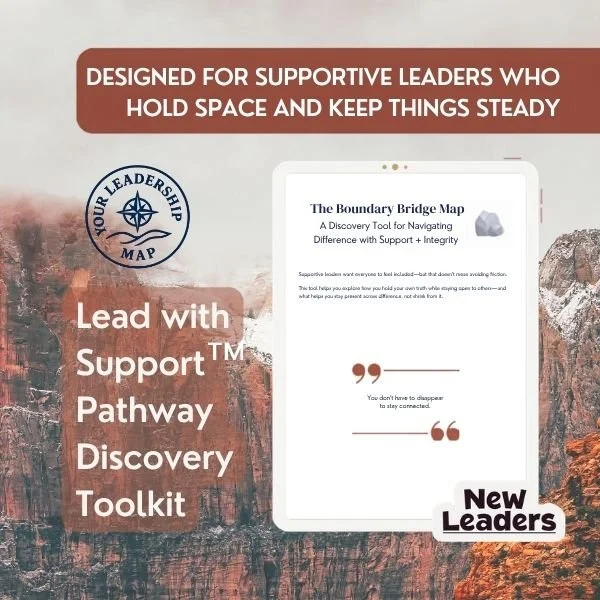
Lead with Support™ helps new managers bring steadiness and structure to their teams without slipping into bottlenecks or over-control.
What you’ll get:
A guided discovery sequence to clarify your natural pace and rhythm
Fillable tools to map responsibilities and track sustainable workflows
Reflection prompts for balancing support with accountability
A one-page map to guide check-ins and team momentum
Format: Fillable PDF (instant download)
Ideal for: New managers, operators, and team leads who want to create dependable structure without stifling growth
Not sure this is your pathway? Start with the assessment.
This page assumes Support is already your result. If you are not sure, take the Source Assessment first. It will show you the leadership pathway you default to under pressure, so you are not trying to repair the wrong terrain.
Ten minutes. Free. Your result arrives by email.
Common questions
about this pathway.