
The Steam Engine: The Day Work Stopped Following the Sun
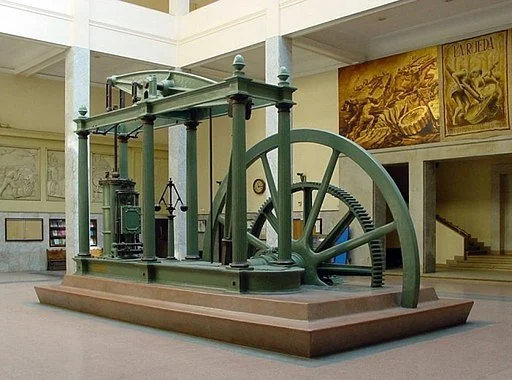
Nicolás Pérez, CC BY-SA 3.0 <http://creativecommons.org/licenses/by-sa/3.0/>, via Wikimedia Commons
In 1781, James Watt patented a steam engine that produced rotary motion. This allowed factories to move away from riverbanks and into the heart of the city. More importantly, it allowed work to happen twenty-four hours a day. The steam engine did not just provide power. It provided a new coordinate for the workplace: the machine-driven deadline.
The Necessity of Synchronization
Steam power required a level of precision the world had never seen. If one person on the line was slow, the entire system backed up, but the engine kept turning. The pressure did not come from a foreman; it came from the boiler.
This created a new kind of Team Dynamics. For the first time, workers had to synchronize their movements not with each other, but with a mechanical heartbeat. The terrain shifted from a collection of individual craftsmen to a synchronized team of operators. If you were out of sync, you were a danger to the gears and a bottleneck to the profit. Precision became the primary survival skill because the engine did not have a "pause" button.
The Job Description: The 1840s Engine Tender
If you were an Engine Tender in a Manchester textile mill, your job was the ultimate study in high-stakes precision. You did not touch the fabric. You touched the iron.
Your day was a cycle of monitoring pressure gauges, oiling valves, and listening for a change in the hiss of the steam. You were the translator between the mechanical world and the human one. If you misread a dial, the boiler could explode. If you failed to maintain the rhythm, the entire factory went silent. You were the first worker whose primary responsibility was the maintenance of a system rather than the creation of a product. You lived and breathed by the touchpoints of the machine.
The Team Dynamics Map
We see the remnants of the steam engine today in the way we treat our digital workflows. We have traded the iron boiler for the "always-on" Slack channel or the "real-time" project board.
This creates a Pain Point Cluster where the human need for rest collides with a digital pulse that never stops. When a team feels like they are constantly behind, they are often reacting to a Team Dynamics map that was designed for a steam engine. They are trying to synchronize their lives with a system that has no inherent respect for the human lung. They aren't failing to collaborate; they are just exhausted by a mechanical pace.
Leadership Cartography: Reading the Pulse
In Leadership Cartography, we notice when the "mechanical pulse" is dominating the human terrain.
We lead through our inherent pathways.
A Precision leader will look at each touchpoint in the system first. They are naturally drawn to the "gauges" of the team—the metrics, the deadlines, the status updates. In a steam-driven terrain, their drive for accuracy is vital. But if they aren't careful, they can become an extension of the engine, demanding a level of synchronization that the human team cannot sustain.
The practice of Cartography allows you to notice when your drive for Precision is being used to tune the machine instead of supporting the people. Once you see the terrain, you realize that your job is not to make the people run as fast as the engine. It is to ensure the system is legible enough that the people can navigate it without being crushed by the gears.
If the digital pulse of your office stopped for one hour, would your team find their own rhythm, or have they been following the machine for so long they’ve forgotten how to breathe on their own?

Do you feel like you are racing against a clock that never sleeps? Take the Leadership Style Quiz to identify your inherent pathway and see how you naturally respond to mechanical pressure.
If your team's coordination feels like it's being driven by the boiler rather than the mission, explore our Team Dynamics Map.