
Manager Hours vs. Maker Hours: Why You Can’t Think Clearly Anymore

The objectives and strategic initiatives were always changing.
Every time I went into a planning session, I had to start by rebuilding context. Where the work had begun. What assumptions were true at the time. How the project had already shifted once or twice to accommodate earlier changes in direction.
Only after that could I explain where the work currently stood.
And almost every time, there were new updates from leadership. A reframing of priorities. A subtle but meaningful change in focus.
So I would go back through the work again. Re-thread the logic. Adjust the framing. Incorporate the new direction without breaking what had already been built.
It was exhausting.
What suffered most was depth. The work rarely reached the real substance. The meat and bones. Not because the thinking was weak, but because I was always bracing for interruption.
Even when momentum finally built, there was a question running quietly in the background.
If I let this go deep, will someone stop it next week because the focus has changed again?
Over time, flexibility stopped feeling like adaptability and started feeling like erosion.
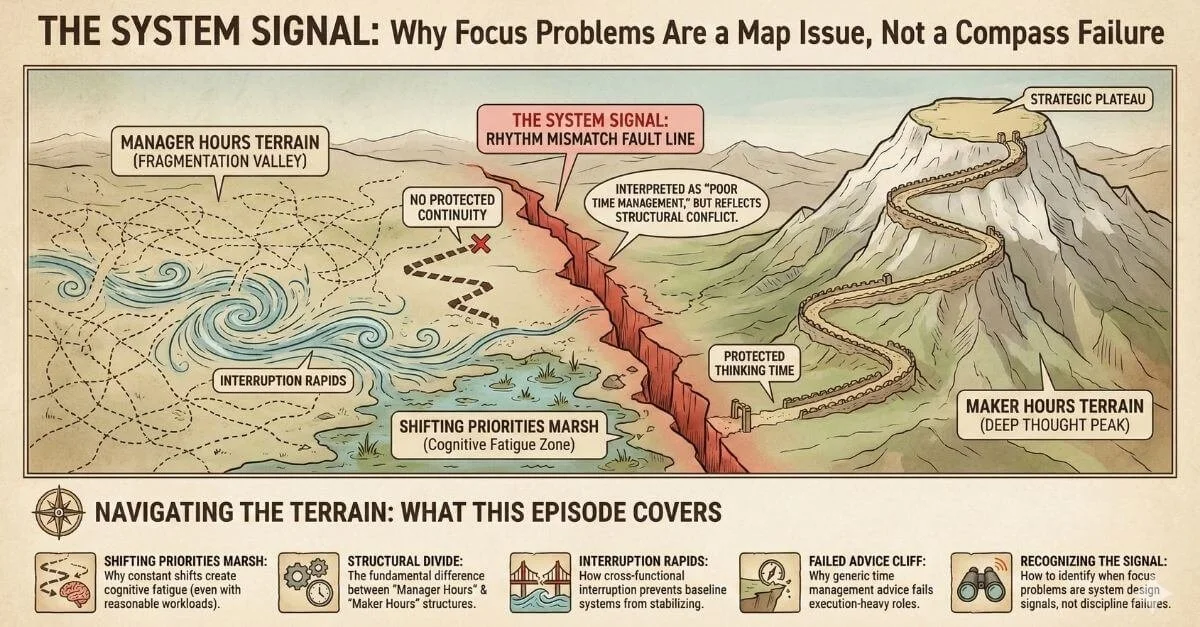
The System Signal
Difficulty thinking clearly as a manager is often not a personal focus problem. It is a system signal that the role is operating almost entirely in manager hours, leaving no protected continuity for deep or strategic thought. Many managers interpret this as poor time management, when it more accurately reflects a rhythm mismatch between coordination demands and thinking requirements.
What This Article Covers
This article clarifies:
Why constantly shifting priorities create cognitive fatigue even when workloads look reasonable
The structural difference between manager hours and maker hours
How cross-functional interruption prevents baseline systems from stabilizing
Why most time management advice fails managers in execution-heavy roles
How to recognize when focus problems are signals of system design, not discipline
🎙️ Prefer to Listen?
The Pattern Under the Problem
There was a distinction I did not understand at the time.
When I was building foundational infrastructure inside the supply chain, people mostly left me alone. The work lived below the surface. It was structural, technical, and not immediately visible to most teams.
But the moment the work touched operations, everything changed.
Operations is where the company executes. It is where everyone feels the impact. As soon as the work entered that space, people wanted to get into the middle of it. They added ideas, preferences, and assumptions about how things should work. Sometimes this came from care. Sometimes from self-protection.
Either way, the project became a shared whiteboard.
That made it nearly impossible to establish a baseline system. A baseline is not optional. It is what allows stability, measurement, and improvement to exist at all.
That was where my expertise actually lived. In building systems that could hold.
Instead, the work stayed provisional. Always adjustable. Always interruptible.
What the System Is Doing
Ironically, the infrastructure systems built within the supply chain became some of the most profitable work the company produced.
Those systems created foundational practices the business could rely on. They also gave marketing something stable to pull from. Campaigns were not invented in isolation. They were built on operational truths the systems made visible.
Here is the pattern many organizations miss.
When work is structural and below the surface, it is treated as specialist territory and given autonomy.
When work is operational and visible, it is treated as communal property and constantly interrupted.
The work that requires the most continuity is given the least.
When execution becomes crowded, planning turns into re-justification.
When planning turns into re-justification, deep thinking never finishes a thought.
This is not a collaboration failure. It is a governance failure.
The Lens We’re Using: Leadership Cartography
Leadership Cartography is a framework developed by Your Leadership Map that helps leaders interpret overload, feedback, and misalignment as system signals rather than personal deficiency. It focuses on locating what is happening in the terrain so leaders can respond with clarity without erasing who they are.
Through this lens, the issue here is not discipline.
Manager hours are designed for coordination. Meetings. Alignment. Updates. Decisions. Handoffs.
Maker hours require continuity. Unbroken time to think, design, stabilize, and refine.
Asking someone to do maker-level thinking inside a calendar built entirely for manager hours is not demanding. It is structurally incompatible.
What to Notice
You can often see this pattern when:
You technically have time, but cannot enter it mentally
Strategy work keeps getting deferred in favor of alignment conversations
Projects never feel finished, only paused
You spend more time explaining work than advancing it
Depth feels risky because priorities shift too often
These are not personal shortcomings. They are signals about how the role has been designed.
If You Only Remember One Thing
You are not bad at time management. The problem is not your discipline. Thinking cannot survive inside a rhythm designed entirely for coordination.
This matters most in roles where execution pressure is constant and priorities evolve quickly.
In those environments, the question is not whether you are capable of strategic thought. The real question is whether the system protects continuity long enough for thinking to occur at all.
Seeing that clearly is not passive. It is the first act of leadership in systems that quietly erode depth.
Once you can name the terrain, you stop blaming yourself for what the system never made possible.

Finding Your Rhythm
When your calendar is a wall of coordination, depth becomes a luxury you cannot afford. This is not a failure of your willpower; it is a mismatch in your map. You deserve a workspace where your thinking can finally finish a thought.
If you feel like you are constantly "re-threading the logic" instead of moving forward, take the Leadership Style Quiz. It helps you identify how you naturally process pressure so you can stop blaming your discipline and start reading the terrain.