
Saturday Half-Days and the Battle for Rest
Saturday half-days became common in the United States in the early 20th century after decades of labor organizing. Workers originally labored six full days per week, and reduced Saturday hours were won through strikes and collective pressure. This boundary reshaped management structures and laid groundwork for the eventual 40-hour work week. The history reveals that rest at work has rarely been granted voluntarily. It has been structurally secured.
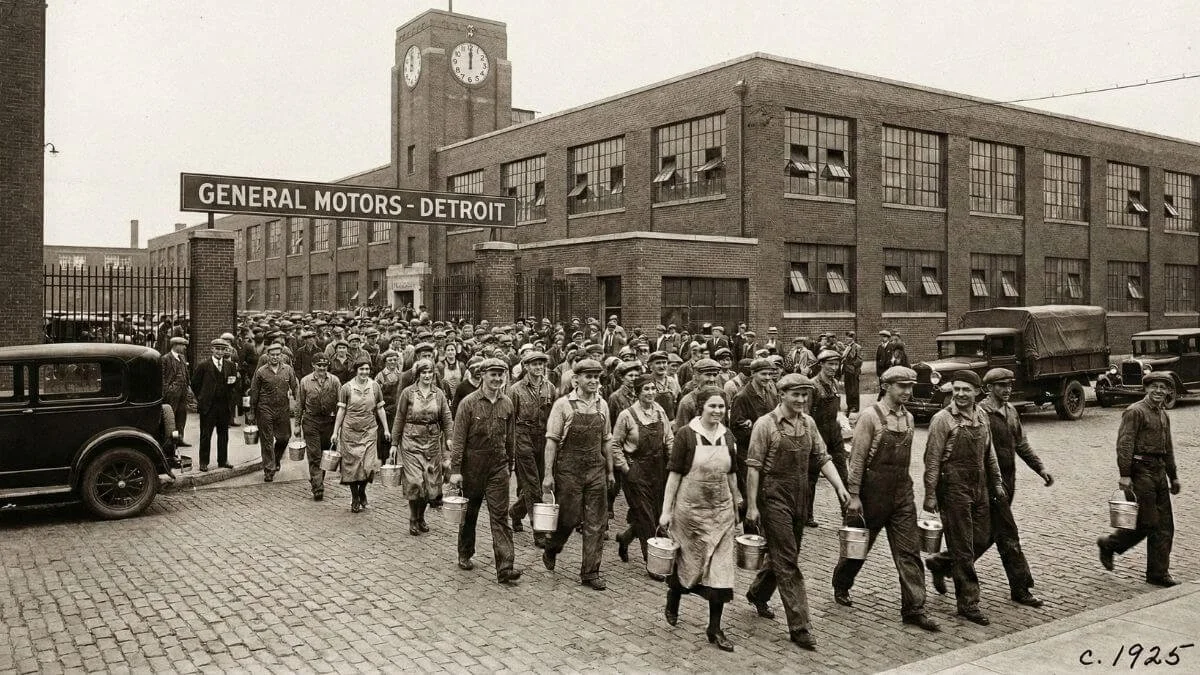
When Half a Weekend Off Required a 40-Year Fight
In 1880, the standard American work week was six full days.
Monday through Saturday. Sunrise to sunset. Sunday off only because religious institutions had enough influence to enforce it.
Workers did not get Saturday afternoons. They did not get evenings that began before dark. The factory bell ended the day only after exhaustion had already settled into muscle and bone. Sustainability was not the factory’s concern. Exhaustion was the worker’s problem.
It took four decades of organizing, strikes, and collective refusal before workers secured Saturday half-days in the 1920s. And even then, it was not presented as generosity. It was negotiated. It was demanded. It was taken.
The Job: The Saturday Shift Foreman
Before the half-day Saturday, the Saturday Shift Foreman ran the most fragile shift of the week.
Workers arrived depleted from five consecutive days of labor. Injury rates increased. Output quality dropped. Tempers shortened. The Foreman’s job was to extract a full day of productivity from people who had little left to give.
They were not managing fresh capacity. They were managing biological systems in decline. The only tool available was pressure.
After Saturday half-days became standard, the dynamic shifted. Workers still labored Saturday morning, but they knew the bell would ring at noon. That boundary changed behavior.
The Foreman no longer relied solely on intimidation or urgency. The promise of an afternoon off altered tolerance thresholds. Workers pushed through the morning because they knew there was an endpoint. The boundary itself became a management tool.
The half-day did not simply grant rest.
It stabilized the system.
Definition: Saturday Half-Day (Historical Context)
A Saturday half-day was a reduced work schedule introduced in the early 20th century after decades of labor organizing. It shortened the six-day industrial work week and became a precursor to the modern 40-hour work week.
What This Pattern Signals
The six-day work week was standard until labor resistance reduced it.
Saturday half-days were structurally secured, not gifted.
Boundaries reshape behavior and management dynamics.
Rest stabilizes systems.
When managers remove their own boundaries, the system expands to fill the space.
The Modern Correlation
Today, most managers technically work five days.
But if you lead with Heart, there is a quiet pattern that often emerges.
You protect your team’s weekends while working through your own.
You enforce their time off while checking Slack “just in case.”
You absorb overflow so they can rest.
You tell yourself this is leadership.
Historically, the half-day Saturday was not a kindness. It was a boundary that prevented systemic overreach. It limited expansion. It contained demand.
When you remove that boundary for yourself while defending it for others, you recreate the six-day week in a different form.
Heart-led managers often interpret care as availability. Protection becomes proximity. Support becomes absorption.
But the labor movement understood something structural. Rest is not what remains after the work is complete. It is a condition that prevents the work from expanding indefinitely.
Without a boundary, the system will consume the available time.
Your team did not fight for Saturday afternoons. The culture already includes them. But if you quietly surrender your own rest each week, you are running a pre-1920 schedule inside a post-1920 structure.
You are protecting the boundary for others while dissolving it for yourself.
If it took forty years of organized resistance to secure half a weekend, and you surrender yours every week in the name of protecting your team, are you leading with Heart, or are you the last person still working the six-day shift?

Identify Your Terrain: Are you a Heart™ pathway leader who protects everyone's time except your own? Take the Leadership Style Quiz to see if your care orientation has turned into a pre-1920s work schedule that you'd never allow your team to keep.
Lower the Pressure: If your team has weekends and you don't, you're experiencing a Boundary Asymmetry pain point. Explore the Time_Management_Map to see how the Saturday Shift Foreman role shows up in your modern calendar and learn to claim the rest boundaries workers spent 40 years fighting for.