
The Stenographer and the Speed of Invisible Accuracy
When Capturing Someone Else’s Words at 100 Words Per Minute Became a Full-Time Job
In the late 19th century, stenographers were hired to capture executive speech at high speed using shorthand systems. Their role was to translate spoken authority into permanent written record with near-perfect accuracy. This historical need for invisible precision mirrors the modern challenge of remote leadership, where managers must interpret team activity without direct observation and maintain accuracy across distance.
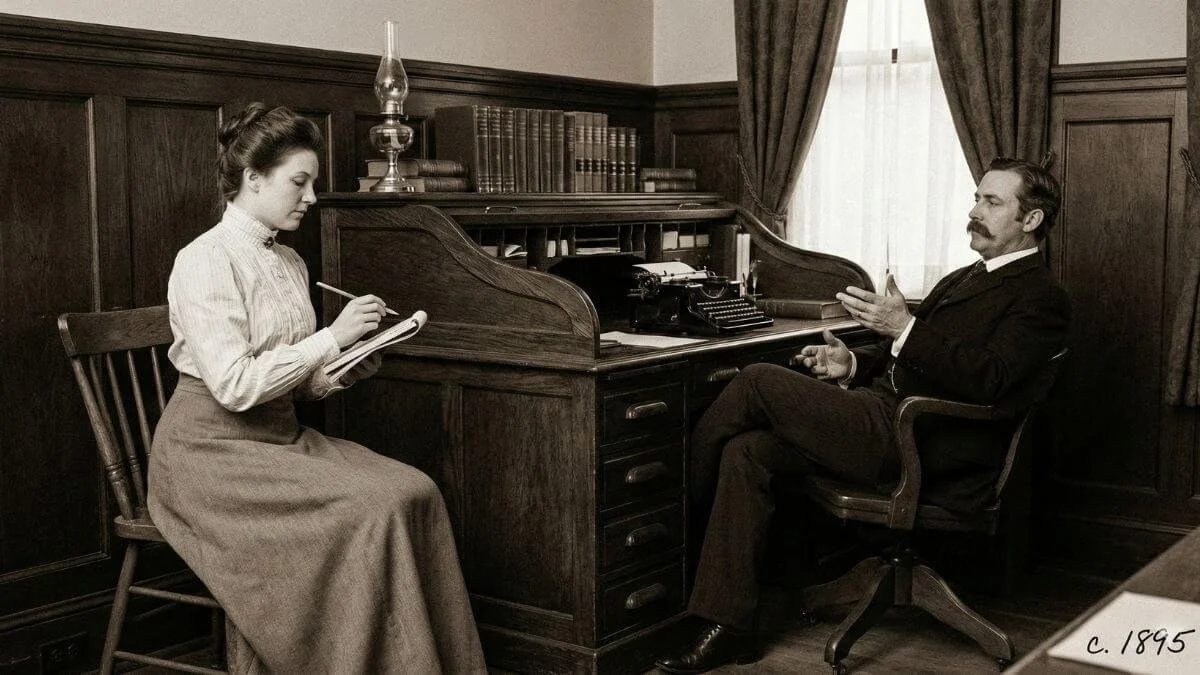
In the 1880s, business moved faster than handwriting could capture it.
Executives dictated letters, contracts, and internal memos at the speed of speech. Most clerks could write longhand at roughly 30 words per minute. Critical clauses were missed. Legal language was approximated. Entire negotiations had to be repeated because no one could reproduce exactly what had been said.
The problem was not intelligence.
It was transmission speed.
Shorthand systems such as Pitman and Gregg emerged to solve it. A trained stenographer could capture speech at 100 words per minute and later translate symbolic notation into flawless typewritten English.
The gap between decision and documentation closed. But the human cost of that precision was rarely discussed.
The Job: The Stenographer
The Stenographer did not “take notes.” They translated spoken authority into permanent record under conditions of extreme precision. An executive dictated a contract without pause. The Stenographer captured every clause in symbolic shorthand. There was no rewind button. No collaborative editing. No real-time clarification loop.
A single missed word could invalidate an agreement. A single transposition could cost the company thousands.
The Stenographer was physically present but structurally invisible. They were not permitted to interpret, challenge, or clarify. Their job was transmission without distortion.
Precision did not simply mean accuracy of words. It meant accuracy of silence. The Stenographer who interrupted the flow was considered incompetent. The system required them to understand everything while appearing to understand nothing.
Essential.
Unseen.
Exact.
Stenography (Historical Context)
Stenography is a system of shorthand writing developed to capture spoken language at high speed. In the late 19th century, it became essential for corporations that needed accurate documentation of executive speech, contracts, and legal agreements.
What This Pattern Signals
Stenography emerged to close the gap between speech and documentation.
Precision historically required physical presence.
Remote leadership removes observation while maintaining accountability for accuracy.
Managers are often expected to translate incomplete information into decision-ready clarity.
The friction is structural, not personal.
The Modern Correlation
Today, most managers are not sitting beside executives with shorthand notebooks. But if you lead with Precision and manage remote or distributed teams, you have inherited a similar structural tension. You are trying to capture reality without full presence.
You read Slack threads and decode tone.
You scan project boards for clues.
You watch for what is not said in video calls.
You translate asynchronous updates into executive summaries.
You are expected to produce accurate understanding from partial transmission.
Remote leadership is often described as “leadership with better tools.” The historical record suggests something different. When direct observation disappears, accuracy becomes probabilistic.
Precision requires proximity. When you remove shared space, you remove nonverbal signals, side conversations, spontaneous clarification, and immediate correction. You remove the conditions that allow fidelity.
Precision-led managers feel this strain deeply. Details matter to you. Accuracy matters. Yet the system has removed your ability to verify in real time.
The Stenographer’s constraint was speed.
Yours is distance.
If you are managing teams you cannot see and making decisions based on translations of activity you cannot directly observe, what does precision mean now?

Identify Your Terrain: Are you a Precision™ pathway leader who feels like you're guessing at reality because you can't see the work directly? Take the Leadership Style Quiz to see if your need for accuracy is being undermined by a system that removed your ability to observe it.
Lower the Pressure: If you're exhausted from trying to piece together what's actually happening on your remote team from asynchronous breadcrumbs, you're experiencing a Visibility Gap pain point. Explore the Remote_Leadership_Map to see how the 1880s Stenographer role shows up in your modern leadership and learn to build systems that create accuracy without requiring you to be in every room.