
The First Office and the Architecture of Accountability
The Old Admiralty Office, built in London in 1726, is considered one of the first purpose-built office buildings designed to centralize administrative workers under management supervision. Its primary function was not collaboration but oversight. By gathering clerks into a single observable space, the British Navy created architectural accountability. Modern office design still reflects this historical origin.
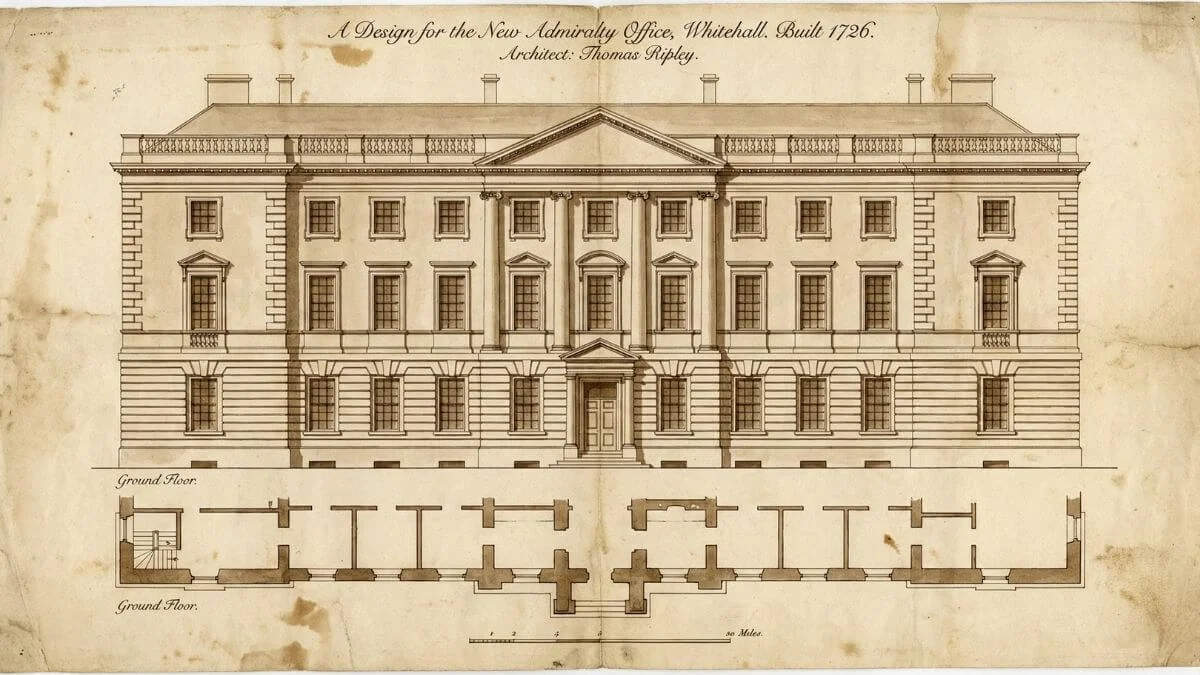
When the British Navy Invented a Building to Watch People Work
In 1726, the British Royal Navy faced a coordination problem.
Administrative staff were scattered across London in coffeehouses, private homes, and rented rooms. Clerks kept records in personal notebooks. Contracts were drafted in taverns. Critical documents disappeared into coat pockets and resurfaced weeks later.
Supervisors could not verify who was working, where records were stored, or whether correspondence had been completed.
The solution was not a memo.
It was a building.
The Old Admiralty Office became one of the first purpose-built structures designed specifically to centralize administrative workers under supervision.
The office was not created for collaboration.
It was created for visibility.
The Job: The Office Keeper
The Old Admiralty Office created a new role.
The Office Keeper. This person did not process Navy paperwork. They maintained the building where paperwork occurred. They unlocked doors at dawn. Ensured clerks were at assigned desks. Monitored departures and returns and locked the building at dusk.
The Office Keeper did not manage the work itself. They managed the container that made the work observable.
Before the centralized office, a supervisor had no reliable way to know whether a clerk spent Tuesday drafting contracts or drinking ale. After the office, presence became proxy.
If you were in the building, you were working. If you were not, you were suspect.
Architecture converted attendance into evidence. The building functioned as infrastructure, but its logic was surveillance. It reduced uncertainty not by trusting workers, but by concentrating them.
Definition: Purpose-Built Office (Historical Context)
A purpose-built office is a structure designed specifically to house administrative workers in a centralized, supervised location. Early examples, such as the 1726 Old Admiralty Office, were constructed to improve oversight, record control, and accountability rather than to enhance collaboration.
What This Pattern Signals
The first offices centralized workers for oversight.
Presence became a proxy for productivity.
Architecture shapes management expectations.
Modern debates about remote work are layered onto buildings designed for supervision.
Support-led managers often navigate tension between trust and visibility.
The Modern Correlation
Today, the office is often described as a place for culture, creativity, and teamwork.
Some of that is real.
But the original design logic still lingers.
If you lead with Support, you likely care about creating stable environments where your team can do meaningful work. You think about psychological safety. You consider workspace layout. You advocate for flexibility.
Yet the architecture you inherited was not built to support people.
It was built to make them visible.
The return-to-office debate often centers on productivity metrics, but beneath that conversation is a 300-year-old assumption. Workers must be gathered into a supervised container to be trusted.
Support-led managers feel this tension acutely. You want to design conditions that help people thrive. At the same time, your own leadership may be evaluated by stakeholders who equate physical oversight with accountability.
If they cannot see you seeing your team, the work feels less real.
We continue to build management philosophy on top of architecture originally designed to reduce uncertainty through observation.
The office did not emerge from a timeless truth about collaboration.
It emerged from a naval administration problem.
Three centuries later, the structure remains.
If the office was invented to make workers visible to supervisors, and we still defend it as essential to accountability, are we supporting our teams, or are we just Office Keepers maintaining a three-hundred-year-old surveillance structure?

Identify Your Terrain: Are you a Support™ pathway leader stuck defending office policies designed for 1726 supervision models? Take the Leadership Style Quiz to see if your desire to create supportive conditions is being undermined by buildings designed for control.
Lower the Pressure: If you're caught between supporting flexible work and organizational pressure to "get people back in the office," you're experiencing a Structure vs. Autonomy pain point. Explore the Support™ Pathway to see how the Office Keeper role shows up in modern workplace debates and learn to separate infrastructure that enables work from infrastructure that just makes work visible.