
The Commute and the Unpaid Journey to Work
Trains did not create work-life balance. They created the first mass, daily commute, which extended the workday without extending pay. That unpaid travel time became a hidden system cost. In modern hybrid teams, Support™ leaders often absorb that cost by coordinating schedules, exceptions, and meeting timing so the system looks humane without changing the underlying rules.
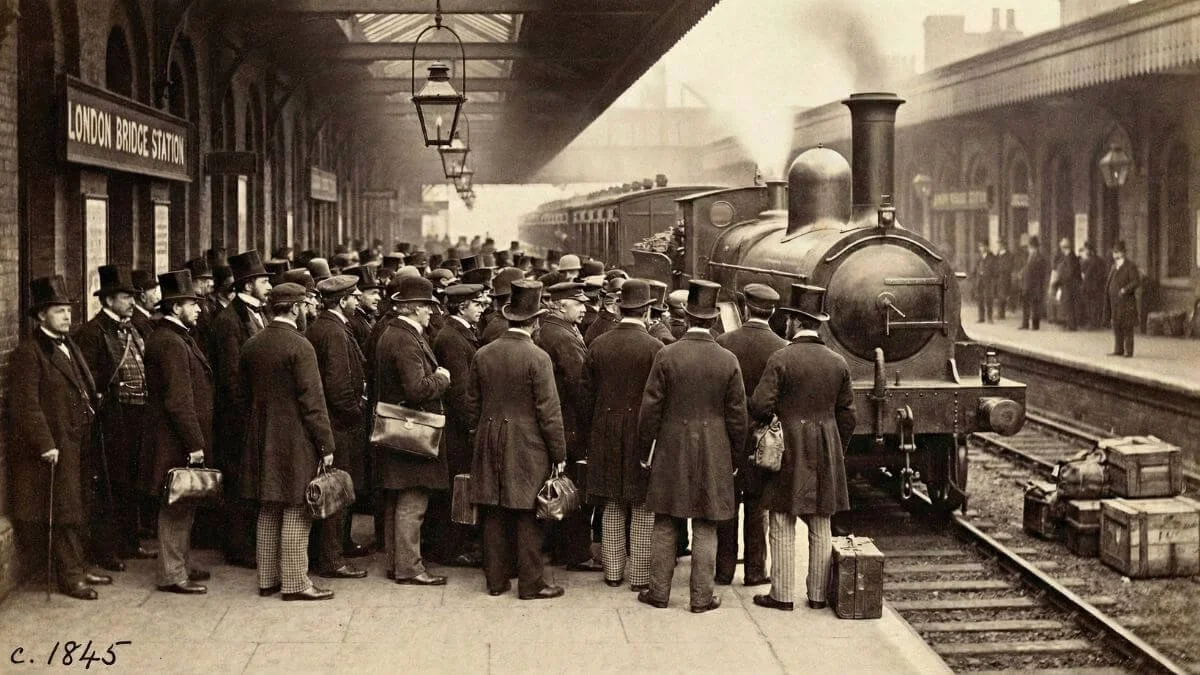
How trains created the first daily migration that no one got paid for
In the 1840s, expanding railway networks across Britain and America created something entirely new. For the first time, you could live in one place and work in another.
Before trains, most workers lived within walking distance of their jobs because anything farther was impractical. The factory, shop, or office determined where you slept. Geography and employment were fused together. Railways split them apart.
You could now live five, ten, even twenty miles away and still arrive on time every morning.
This looked like freedom.
It was not.
It was the birth of the unpaid commute.
A new daily migration formed. Workers boarded early trains into city centers and returned home after dusk. Travel time was not treated as labor. It was framed as personal choice. A privilege of living somewhere cheaper. A lifestyle preference.
But the math told a different story.
The Job: The Railway Commuter Clerk
Consider the Railway Commuter Clerk.
He wakes before dawn to catch the 6:00 AM train. He stands shoulder to shoulder in a railcar for nearly an hour. He arrives at the office by 8:00 AM and works until 6:00 PM. He boards the evening train and reaches home after 7:30 PM.
The official workday is ten hours.
The lived workday is twelve.
The two extra hours are invisible.
No compensation for travel. No acknowledgment of the time extension. The commute simply became part of the cost of having a job in the city.
Railways did not reduce labor. They expanded it beyond the factory walls.
Workers absorbed the cost because the alternative was overcrowded urban housing they could not afford. Geography shifted. Payroll did not.
A structural cost was created and quietly transferred to the worker.
The Modern Correlation
Now fast forward.
Your team is not boarding steam trains. But the structure remains.
Some of your people commute. Some are fully remote. Some split their week between home and office.
This is the terrain your Remote Leadership Map is actually describing, even when the surface conversation sounds like flexibility.
And if you lead through the Support™ pathway inside Leadership Cartography™, you feel the strain first.
You move meetings so someone does not travel for a single call. You design hybrid schedules to minimize back-and-forth days. You absorb calendar friction so your team can function.
You do this because you can see the cost.
Two hours of commuting is not neutral. It affects childcare, energy, health, and bandwidth. You know this. So you manage around it.
But pause for a moment.
The commute problem is not new. It is 180 years old.
The system never solved it. It normalized it.
And now you are smoothing its edges.
What This Pattern Signals
There is a difference between caring for people and absorbing structural costs.
When organizations mandate presence without redesigning expectations, managers coordinate around traffic patterns, school pickups, and train delays. They stretch meeting times. They create exceptions. They juggle fairness debates.
That labor is rarely visible upward.
It is coordination labor. Emotional labor. Infrastructure translation.
It is what happens when industrial-era geography collides with modern identity and family systems.
If you are exhausted from managing hybrid complexity, that exhaustion is not necessarily a personal time management failure. It may be a systems signal.
This is one reason the Support™ Pathway is so often misread as “soft.” Support is not softness. Support is load-bearing.
If your calendar is collapsing under hybrid coordination, the Time Management Map may help you name the actual friction, especially when “too many meetings” is really a workaround for structural mismatch.
And when the pressure is coming from above, the Managing Up Map is often the missing layer, because commute burden is rarely owned by the person who sets the policy.The Deeper Question
Workers in the 1840s did not commute because they loved trains. They commuted because wages were concentrated in cities and affordable housing was not.
Your team does not commute because they enjoy traffic. They commute because opportunity, policy, and signaling still concentrate in physical offices.
If the commute began as unpaid labor that extended the workday, and you are spending hours each week managing its impact, what exactly are you supporting? Your team? Or a system that never intended to pay for the cost it created?

Basecamp
Identify Your Terrain: Are you a Support™ pathway leader who spends hours managing schedules around commutes the system doesn't count? Take the Leadership Style Quiz to see if your supportive instincts are being exploited by infrastructure problems disguised as personal accommodation requests.