
The Carbon Copy Clerk: Why We Still Use 1806 Management Logic
How 19th-Century Proof Systems Shaped Modern Documentation Culture
Trust is a luxury that distance usually kills.
In 1806, Ralph Wedgwood patented carbon paper. It was a simple, messy invention. He coated thin sheets of paper with ink or wax. When you placed this sheet between two pieces of paper and applied pressure, the ink transferred to the bottom page. You created an identical copy in real time.
Before this moment, duplication was a manual struggle. Every contract, bill of sale, and invoice had to be rewritten by hand. If you needed three copies of a letter, you wrote it three times. This manual recreation invited human drift. A slipped pen or a tired eye created discrepancies. In business, a small change in wording between two copies could invalidate an agreement or spark a decade of litigation.
Carbon paper solved the problem of the shifting truth.
It created synchronized documentation at the exact moment of creation. The copy was not reconstructed later from memory. It was born alongside the original. This changed the speed of commerce. It meant that two people in different cities could hold the exact same reality in their hands without a second thought.
Why It Was Necessary
By the 19th century, the world was stretching. Railroads moved goods across state lines. Banks financed industrial growth across oceans. Business was no longer a handshake in a local square. It was a transaction across distance.
Distance weakens memory. Distance weakens trust.
The industrial machine needed proof that could travel. Carbon paper mechanized sameness. If the original stated a term, the duplicate stated it too. This was not about convenience. It was about risk control. Identical wording reduced legal friction and interpretive ambiguity. Carbon paper was a technology built to stabilize expanding, invisible systems.
The Carbon Copy Clerk
Holding a job as a clerk in a 19th-century counting house required physical stamina and a steady hand. You were not just a writer. You were a manager of layers.
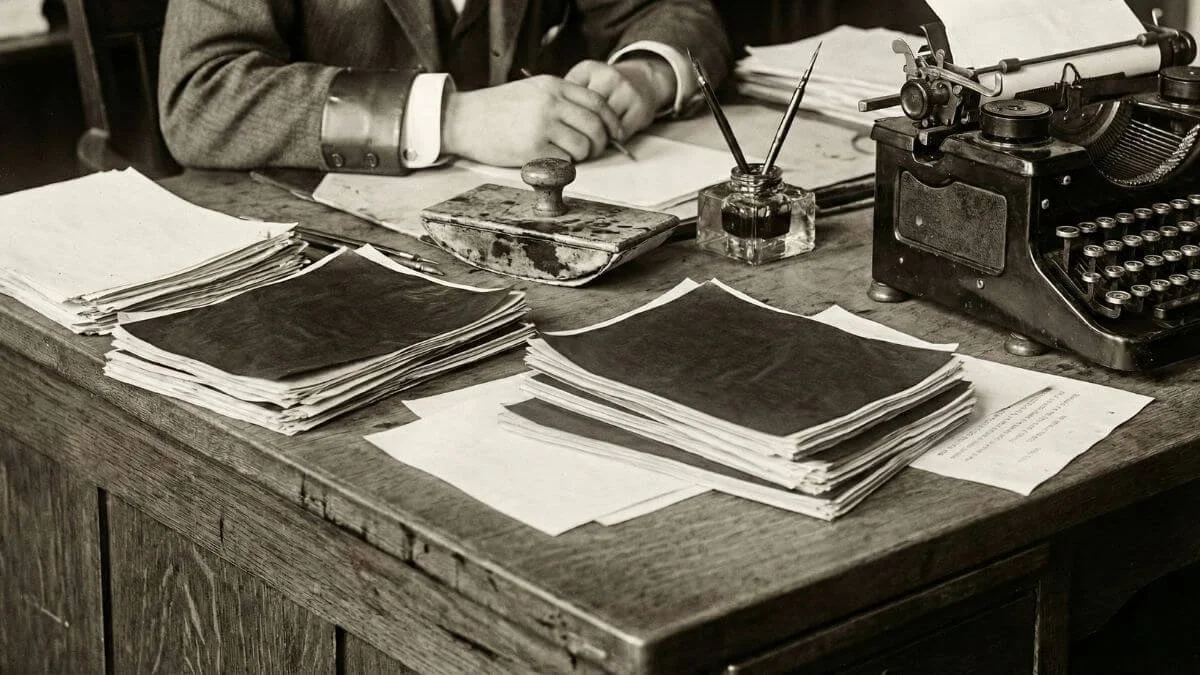
A clerk assembled the stack with ritualistic care. You placed the original sheet on top. You placed the carbon layer ink-side down. You placed the copy sheet beneath.
The job required perfect pressure management. If you pressed too lightly, the duplicate was a ghost. If you pressed too hard, the ink smeared into an illegible cloud. A typo was a disaster. You had to dismantle the stack and correct every sheet simultaneously without shifting the alignment. Your fingers were permanently darkened by indigo and wax. You were not just recording data. You were preserving an identical reality across physical documents. Documentation was heavy labor.
The Modern Correlation
Today, carbon paper is a relic. But the logic is a ghost in our machines. The CC in your email inbox stands for Carbon Copy.
When you CC a dozen colleagues on a thread, you are following Wedgwood’s 1806 patent. You are creating duplicate records to ensure everyone is holding the same version of the truth. When you write a meeting summary and distribute it to three departments, you are synchronizing documentation to prevent the variation that sparks disputes.
The technology moved from wax to pixels. The logic stayed the same. We still believe that duplication reduces dispute. That is the through line from the 19th-century counting house to a modern Slack thread.
Remote and distributed teams have intensified this reflex. When a leader cannot rely on physical presence, documentation becomes a form of verification. Every interaction requires a written confirmation to feel real. Conversations move into written channels. Decisions are archived. Agreements are recorded.
The system begins to equate documentation with safety. You stop leading people and start managing the carbon. There is value in a shared record. But friction arises when we use documentation to compensate for low trust. We have moved from physical ink on our fingers to cognitive load on our brains.
If your calendar is filled with follow-up emails that repeat what was just said, you are still in 1806. If your Slack threads feel like legal exhibits being prepared for a trial, the carbon paper is just digital.
If we are still using the logic of a 200-year-old patent to manage teams we cannot see, are we actually leading, or are we just clerks making messy duplicates to prove the work happened?

Stop Managing The Copies
Identify Your Terrain: Are you a Precision™ pathway leader who creates documentation trails because you can't verify reality in person? Take the Leadership Style Quiz to see if your need for accuracy has turned you into a Carbon Copy Clerk managing through proof instead of presence.
Lower the Pressure: If every conversation requires a follow-up email summary and every decision needs a paper trail because your team is distributed, you're experiencing a Documentation Burden pain point. Explore the Remote_Leadership_Map to see how the 1806 Carbon Copy Clerk role shows up in your modern leadership and learn to build precision without turning every interaction into a duplicated record.