
Telegram Anxiety: The History of Instant Communication Friction

Western Union telegram to Jane Judge of Georgia from Annie G. Wright on passage of Nineteenth Amendment, August 26, 1920, Public domain, via Wikimedia Commons
Before the 1850s, the world moved at the speed of a galloping horse. If a merchant in London needed to communicate with a partner in New York, the message was a physical object that traveled across an ocean, subject to the mercy of the wind and the waves. There was a natural, built-in "lag" to human existence—a period of forced reflection that allowed for a steadying of the nerves. You could not react to news until the news was already old. This delay was a form of protection; it prevented the world from vibrating too fast for the human nervous system to handle.
Then came the click. The telegraph didn't just move information; it collapsed the map. For the first time in human history, an event in a distant city could cause a physical jolt of adrenaline in a person hundreds of miles away, instantaneously. This was the birth of "Telegram Anxiety"—the suffocating feeling that the world could change entirely in the time it took to hear a rhythmic tapping on a copper wire. It turned the world into a high-voltage circuit, and the manager was the fuse. This shift marked the beginning of the Support™ friction: the exhaustion of being the bridge between a constant, urgent signal and a necessary, thoughtful action.

Image Source: Library of Congress Prints and Photographs Division Washington, D.C. 20540 USA
The Job Description: The Morse Operator
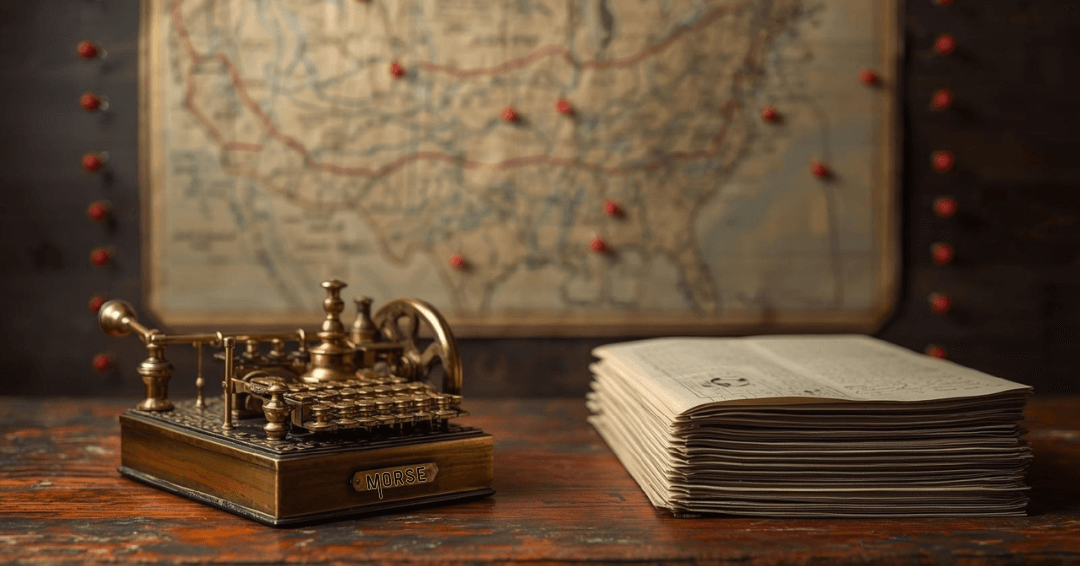
At the center of this storm was the Telegraph Operator (or Morse Operator). Their job description was one of constant, high-stakes alertness. They sat in small, cramped stations, their ears tuned to the clicking of the key. They had to translate a ghost-code of dots and dashes into human language in real-time. They were the first "always-on" workers, unable to look away for fear of missing a signal that could mean a market crash or a family disaster.
They were supported by the Telegraph Messenger, a role often filled by young boys who spent their days sprinting from the station to the doorsteps of the powerful. Their knock was often feared, as a telegram rarely brought casual news. We see this today as the ancestor of our digital notifications. We’ve removed the "lag," but we’ve also removed the space required for Together™ leadership—the space to think, consult, and choose a move rather than just vibrating in reaction to a "ping."
The Map Marker: This story anchors our Remote Leadership coordinates, reminding us that distance isn't what creates the stress—it's the lack of boundaries between the signal and the person.
If we’ve successfully removed the "lag" from our communication, have we also accidentally removed our ability to actually think?
Lowering the Pressure: Telegram Anxiety
If we have successfully removed the "lag" from our communication, have we also accidentally removed our ability to actually think? If you are tired of vibrating in reaction to a "ping" and ready for a system built on human steadiness, let us find a better way to navigate.
Tier 1; YOUR STEADY NEXT MOVE Not sure if you are a "signal" or a "ping"? Receive clarity on your natural leadership style by taking the five-minute quiz to see how you navigate digital distance.
Tier 2: If the weight of instant notifications is fracturing your team, receive the Remote Team Check-In Agenda. This tool is your small, immediate way to reclaim the space to think, consult, and choose a move rather than just reacting to a notification..
Tier 3: For a long-term way to read the signals of your workplace without the anxiety, secure your seat in The Map Drawer. Receive 3 curated tactical tools designed to lower the pressure, Delivered to your inbox monthly.