
The Darwinian Pivot: Why the Boss Got Wheels Before the Factory Did
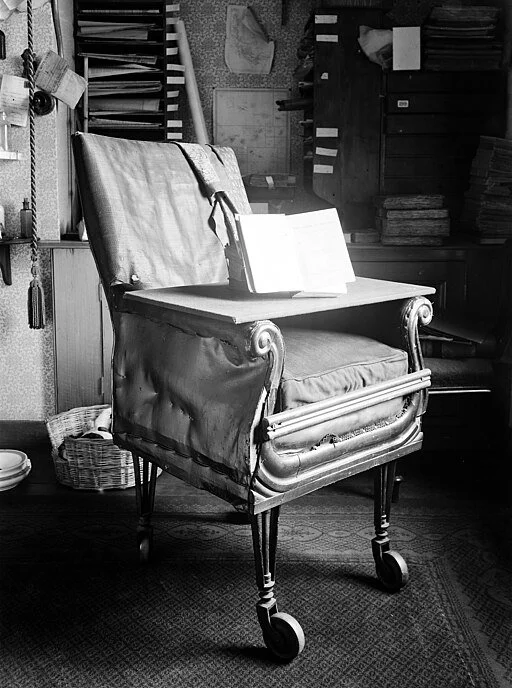
The air in Charles Darwin’s study at Down House was thick with the scent of old parchment, briny specimen jars, and the metallic tang of Victorian ink. By the 1840s, his work on The Origin of Species had turned his workspace into a cluttered map of biological history. Darwin was a man obsessed with the minute details of the natural world, but he found himself increasingly irritated by the physical limitations of his own furniture. Every time he needed to move from his writing desk to his microscope or his specimen table, the simple act of standing up felt like a catastrophic break in his cognitive flow. The heavy wooden armchair he inhabited was a stationary anchor in a room that demanded constant, fluid movement.
This was an era where the furniture of the "thinking class" was designed for stasis, mirroring the rigid social hierarchies of the time. To move was to labor; to sit still was to govern. But Darwin’s mind was moving faster than his environment allowed. He saw the physical friction of his study as a bottleneck to his Precision™ pathway. In a moment of sheer frustration with the "static" nature of his work, he took a set of iron bed casters and fastened them to the legs of his armchair. He didn't just modify a seat; he engineered the first wheeled office chair, allowing him to glide across the floor without ever breaking his train of thought. He had successfully synchronized his chair to his pulse.
The Job Description: The High-Stool Clerk
While Darwin was gliding, the rest of the Victorian workforce was being forced into rigid, backless stools. If you were a Clerk or a Copyist, your job description was to be a human extension of the ledger. These stools were purposefully uncomfortable, designed by the system to ensure that the worker remained alert and upright. Slouching was a fireable offense, seen as a sign of a wandering, unproductive mind.
To enforce this, the system utilized the Watch Keeper. Their sole responsibility was to patrol the rows of desks, ensuring that no body softened and no head bowed too low. Darwin’s invention was a radical act of liberation for the intellectual, but it unintentionally birthed the "tether" that keeps us glued to our desks today. We’ve perfected the "glidability" of our workspace only to realize we’ve glided right past our own physical limits.
The Map Marker: This story lives in our Development Approach coordinates. It’s where we examine how our tools shape our growth—or stunt it.
If the chair was redesigned to make sure you never have to stand up, are you sitting in a tool or a trap?

Find Relief In the 1840s, Charles Darwin realized his stationary stool was a friction point in his evolution. He added wheels to move between his specimens faster. He didn't wait for a "corporate furniture" revolution; he modified his map to fit his pace. If you are feeling stuck in a static system, it’s time to mark a new trail.
Tier 1: Your Steady Next Move Stop guessing which way to turn. Receive your personalized leadership map by taking the style quiz to see how your natural rhythm interacts with the pressure of your current map.
Tier 2: The Precision™ Reset Darwin didn't just move; he moved with purpose. Receive the Weekly Rhythm Productivity and Planning Bundle to audit your calendar and remove the "stationary" friction points that are slowing your team's evolution.
Tier 3: Access The Map Drawer If you need a permanent guide, secure your seat in The Map Drawer. Receive an entire library of tactical tools designed to lower the pressure and keep your footing steady for the long haul.