


Why Am I Developing My Team but Still Seeing the Same Problems?
Growth stalls when development focuses on skills while systems remain untouched.
Translate once. Then keep the language.
Growth stalls when development focuses on skills while systems remain untouched. Insight accumulates. Feedback arrives. Goals are named. But none of it converts into protected, repeatable practice.
This map helps you locate where the translation is breaking down so progress can become steady again.
I need relief now
I want to understand the pattern

Start with your map.
When development feels scattered, the issue is rarely a lack of effort. It often reflects a deeper leadership pattern: what you are trying to improve first, what kind of growth you trust, and what you default to when you are not sure where to begin.
The Source Assessment helps you identify that pattern so you can choose a development route that fits the way you actually lead.
Ten minutes. Free. Your result arrives by email.
Is this your terrain?
If two or more of these are true, your development may be drifting.
- You invest time in learning, but your day-to-day leadership looks the same.
- Feedback arrives, but you're unsure what to practice next.
- Development goals exist, but they're rarely revisited.
- Growth work happens in bursts, then fades.
- You rely on motivation instead of structure to follow through.
- Insight feels familiar, but behavior does not change.
- Progress is hard to point to, even when effort is real.
- Development feels private, so nothing reinforces it.
- You are "working on yourself," but it is not visible in outcomes.
If this is your terrain, you don't need more effort. You need a clearer map. Start with the framework that makes leadership identity navigable.
Where development breaks down
The Development Drift shows up when one or more of these system functions stop converting intention into practice.
Where development breaks down
Direction
Growth has no clear target
Development effort exists, but it is not anchored to a specific capability. Goals are broad or aspirational, which makes it difficult to know what "better" looks like in practice. Without a defined outcome, learning cannot compound.
Sensemaking
Signals accumulate without interpretation
Feedback, insight, and advice arrive, but there is no shared process for deciding what matters now. Learning becomes familiar instead of formative. Without interpretation, signals show up as noise rather than direction.
Coordination
Practice is not integrated into real work
Development happens outside the flow of work instead of inside it. Practice is optional, informal, or isolated, so it disappears when attention shifts. Growth relies on memory and motivation rather than coordination.
Governance
Nothing protects the practice
There are no rhythms, expectations, or reinforcement mechanisms holding development in place. Progress is private and therefore unstable. Without governance, even good practices erode over time.
Team member asks for development. You send them to a course. Three months later, nothing's changed in their performance.
- Capability: "What specific skill needs strengthening? Let's name it precisely before choosing a method."
- Application: "How will you practice this in your actual work? Development without application doesn't transfer."
- Feedback Loop: "Who will give you signal on progress? Development without feedback stays invisible."
- System Support: "What structural support do you need? Time blocks? Reduced load? Shadow opportunities?"
You invest heavily in training. People complete courses but performance gaps remain. Investment doesn't translate to capability.
- Capability: "Is this a skill gap or a clarity gap? Training won't fix unclear expectations."
- Application: "Where's the practice environment? Learning in a classroom doesn't equal performance on the job."
- Feedback Loop: "How will they know if they're improving? Progress needs observable signal."
- System Support: "Does the system allow them to apply this? Or does workload and structure prevent practice?"
The first approach treats development as content delivery. The second identifies which structural element is missing so growth can actually happen.
Now choose how you want to move forward: Use this framework with structured tools, or understand why the pattern exists before committing to a solution.

When development plans don't translate
Training happens but capability doesn't improve
When feedback on growth is missing
People don't know if they're improving
When the system blocks growth
Person is capable but structure prevents performance
Choose your route
Employee development is not fast. What can be fast is stopping the drift.
Stop the Drift
If development conversations keep restarting from scratch, start here.
This system helps you choose one growth focus, define what "better" looks like in observable terms, and set a simple cadence for practice and check-ins. It stops the slow slide into vague goals and endless coaching loops.
- Clarifies one clear development target
- Anchors expectations in visible behaviors
- Creates a repeatable check-in rhythm
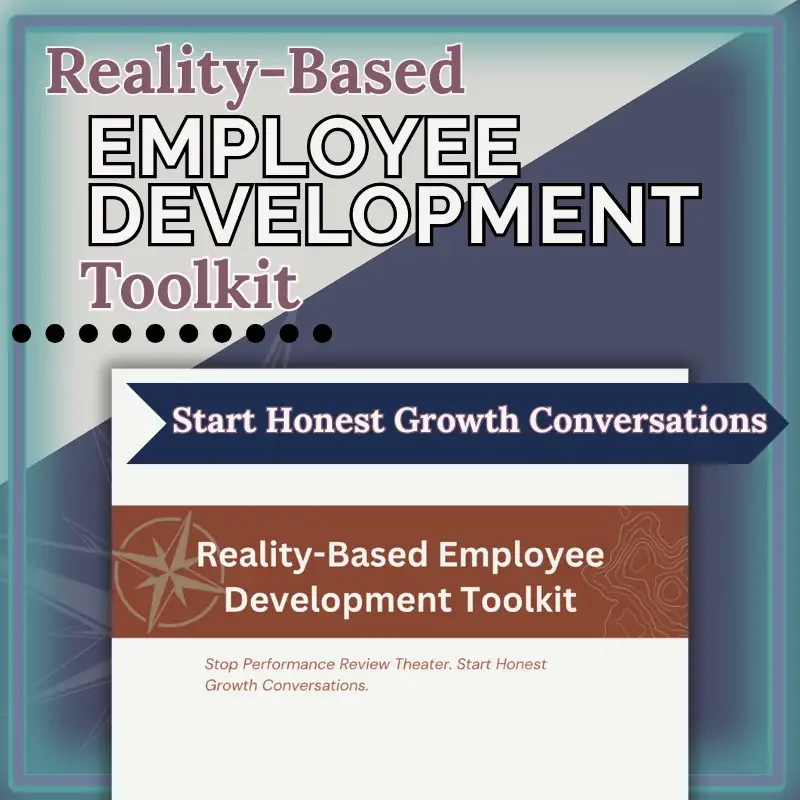
Stop Performance Review Theater. Start Honest Growth Conversations.
Most development plans fail because they protect feelings instead of building capability. Managers leave conversations relieved, employees leave confused, and no one gets better.
This toolkit changes that.
Designed for managers who care enough to tell the truth — and skilled enough to make it land — the Reality-Based Employee Development Toolkit gives you the frameworks, scripts, and templates you need to have honest growth conversations that create measurable change.
What’s Inside
The Reality-Based Framework → Diagnose real gaps, not vague traits.
Honest Feedback Conversation Guide → Step-by-step flow and ready-to-use scripts.
Development Plan Builder → Fillable PDF template for measurable goals.
Scenario Library → Four real-world profiles with feedback + focus areas.
Tracking System → Monthly check-in sheets and observation log.
Resource Library → Books, coaching cues, and internal development options.
When to Use It
Before performance reviews, to name real development needs.
After a missed promotion, when your employee deserves clarity.
When coaching someone who’s “stuck” and generic advice isn’t working.
Anytime you want to replace vague encouragement with actionable growth.
Why It Works
Anchors development to business reality (not personality traits).
Builds trust through specificity and clarity.
Saves time — ready-to-use scripts, templates, and tracking forms.
Moves employees forward with confidence, not guesswork.
Format & Access
Instant digital download (fillable PDF)
Use on desktop, tablet, or print for in-person sessions
For individual professional use
Your Next Step
Clarity is care. If you’ve been waiting for a way to move past vague development conversations, this toolkit gives you the words, structure, and confidence to make it happen.
Add to Cart today and transform your next development conversation.
Explore the Terrain
If you want to understand why development keeps stalling, go here.
This route helps you identify what is actually blocking growth. It might be role clarity, feedback translation, practice design, or the trust and rhythm needed for improvement to take hold.

What is actually happening
Development Drift emerges when learning is treated as input instead of practice. Insight arrives through feedback, reading, or reflection, but the system does not convert that signal into protected, repeatable behavior. Without structure to hold practice in place, growth dissipates between moments of attention.
This is not a motivation issue. It is a design issue.
Practice Erosion
Development relies on intention rather than structure. Practice happens when there is energy, urgency, or time, not because it is protected by rhythm or expectation. When attention shifts, practice disappears.
Reinforcement Gaps
Growth work is rarely visible to others. Because progress is private, it is not reinforced by feedback, recognition, or consequence. Without reinforcement, behavior change does not stabilize.
Signal Overload Without Translation
Feedback, insight, and advice arrive faster than they can be converted into action. Signals accumulate, but there is no mechanism to decide what to practice now. Learning becomes familiar instead of formative.
If you want to understand how these patterns surface in real leadership moments, here's where to go next.
These paths help you diagnose what's actually happening, hear how it plays out in real systems, and understand why this pattern exists at all. Start where your curiosity pulls you.
When this terrain keeps repeating
If this keeps showing up across different situations, you might not need another tactic. You might need orientation. Your leadership Pathway shapes what you notice, what you prioritize, and what you misread under pressure.
You will get your Pathway orientation and next steps there.
Your interpretation. The likely signal.
| You think: | The system signal may be: |
|---|---|
| I just need to try harder to work on myself. | Development relies on motivation instead of protected practice. |
| I know what I should be doing. I just don't follow through. | There is no structure translating insight into repeatable behavior. |
| I'm getting feedback, but I'm not improving fast enough. | Signals are arriving without a clear decision about what to practice now. |
| I start development plans but they fade. | Nothing reinforces the practice once attention shifts. |
| My growth isn't visible, so it feels like it doesn't count. | Progress is private, so the system cannot stabilize it. |
When this pattern repeats, the signal is structural, not individual.
Read The Manager’s Compass to diagnose where growth is breaking down.
These frameworks help you identify which part of the development system is failing. Is it direction, sensemaking, coordination, or governance? Use the Terrain Surveys to translate vague frustration into a clear signal you can work with.
This is where you go when you want clarity before choosing a method.


Listen to The Manager’s Mind Podcast
to learn how drift shows up in real moments.
Each episode traces a lived leadership situation so you can recognize the pattern in context. Development Drift often sounds like “I’m doing the work, but nothing is changing.” This is where the framework meets reality and the signal becomes easier to trust.
This is where insight becomes actionable..
Read The History of Work
To understand why development so often stalls, it helps to see how work itself was designed. This lens traces how modern management systems prioritized control, efficiency, and measurement, while leaving learning and growth informal, unprotected, and largely invisible.
This is where personal frustration turns into systemic understanding.

Toolkits
These toolkits are not meant to be used all at once. Each one stabilizes a different break between signal and practice when development stalls.
Start with the pressure that repeats, even when effort increases. That signal tells you which system function needs attention first.
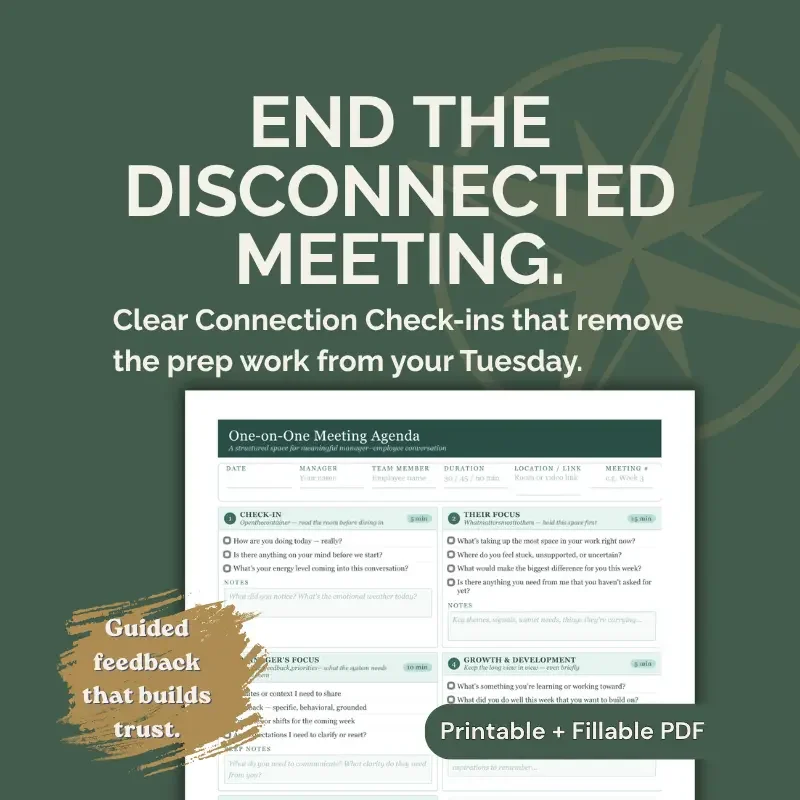
A printable, fillable 1:1 agenda that moves your one-on-ones beyond “updates-only” into progress, coaching, and clear follow-through.
If your one-on-ones keep stalling at surface-level updates, you’re not failing as a manager—your meeting structure is. The One-on-One Meeting Agenda is a printable, fillable 1:1 template for managers who want a clear format that shifts conversations toward progress, coaching, and meaningful development.
Built for weekly or biweekly check-ins, this agenda creates a repeatable rhythm: employees come prepared, priorities stay visible, feedback doesn’t get lost, and follow-ups don’t disappear after the call. Use it to move out of “vibes and updates” mode and into a steadier system of accountability and trust.
What this tool helps you do
Turn unproductive updates into growth-focused conversations
Add structure so employees come prepared
Keep discussions aligned with goals, feedback, and priorities
Create clearer accountability with consistent follow-through
Build a reliable 1:1 rhythm that strengthens trust and performance
What’s inside
One-on-One Meeting Agenda (focus areas + guided questions)
Sections for feedback, development, priorities, and follow-up
Printable + fillable PDF
Best for
Managers whose 1:1s feel repetitive or unfocused, new managers who need a steady meeting structure, coaching conversations that need more depth, and weekly/biweekly check-ins.
Result: clearer conversations, better follow-through, and one-on-ones that actually move work and growth forward.
Stop Performance Review Theater. Start Honest Growth Conversations.
Most development plans fail because they protect feelings instead of building capability. Managers leave conversations relieved, employees leave confused, and no one gets better.
This toolkit changes that.
Designed for managers who care enough to tell the truth — and skilled enough to make it land — the Reality-Based Employee Development Toolkit gives you the frameworks, scripts, and templates you need to have honest growth conversations that create measurable change.
What’s Inside
The Reality-Based Framework → Diagnose real gaps, not vague traits.
Honest Feedback Conversation Guide → Step-by-step flow and ready-to-use scripts.
Development Plan Builder → Fillable PDF template for measurable goals.
Scenario Library → Four real-world profiles with feedback + focus areas.
Tracking System → Monthly check-in sheets and observation log.
Resource Library → Books, coaching cues, and internal development options.
When to Use It
Before performance reviews, to name real development needs.
After a missed promotion, when your employee deserves clarity.
When coaching someone who’s “stuck” and generic advice isn’t working.
Anytime you want to replace vague encouragement with actionable growth.
Why It Works
Anchors development to business reality (not personality traits).
Builds trust through specificity and clarity.
Saves time — ready-to-use scripts, templates, and tracking forms.
Moves employees forward with confidence, not guesswork.
Format & Access
Instant digital download (fillable PDF)
Use on desktop, tablet, or print for in-person sessions
For individual professional use
Your Next Step
Clarity is care. If you’ve been waiting for a way to move past vague development conversations, this toolkit gives you the words, structure, and confidence to make it happen.
Add to Cart today and transform your next development conversation.
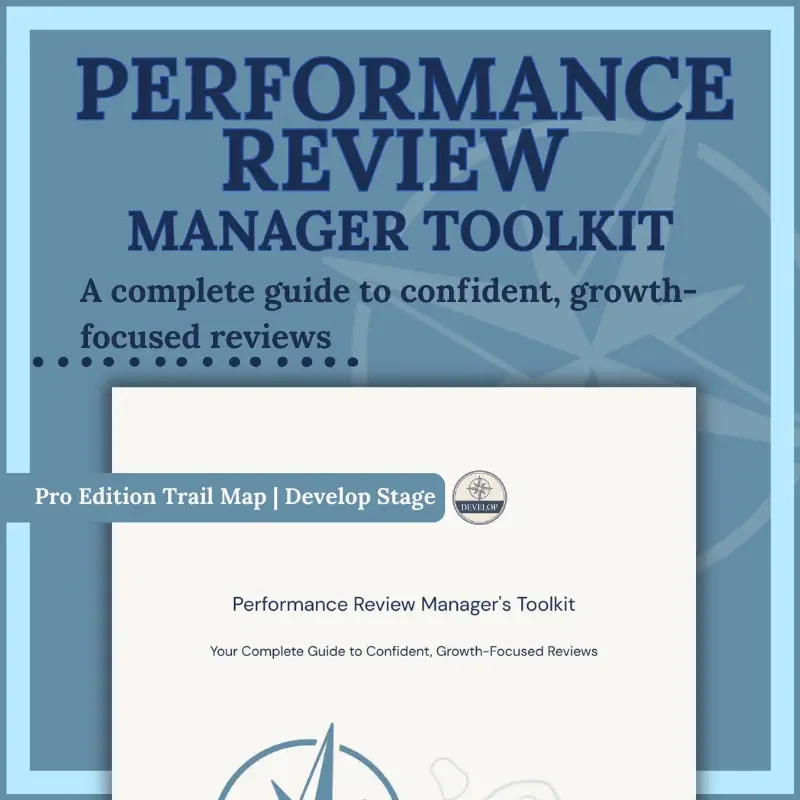
Turn performance reviews from stressful obligations into steady, growth-focused conversations.
This complete toolkit gives you:
The 3 Landmarks Framework to orient any review
A Pre-Review Checklist and employee prep email
A 60-Minute Review Structure with scripts and questions
The Clear Feedback Map™ for constructive conversations
Troubleshooting guidance for common challenges
Follow-up templates and a development planning worksheet
Designed for new managers and emerging leaders, this toolkit helps you Discover steady practices so reviews become a map for growth, not just a judgment.
Fillable, printable pages to use digitally or print out, use either way.

Want to see where else this pattern shows up?
Development drift rarely exists in isolation. If you are here, one or more of these neighboring terrains may be active too.
Feedback Pattern Map
When pressure rises because hard truths are not landing cleanly or safely.
Former Peer Transition Map
When authority is still settling and coordination costs are higher than expected.
Time Management Pattern Map
When shifting priorities fragment attention and erase recovery space.
Managing Up Map
When priorities, constraints, and decision points are not legible across levels.
Mini FAQ — Development Drift Map
Before you choose a next move, here are a few clarifying answers managers tend to need in this terrain.
Why does my development feel busy but not effective?
Because insight is accumulating without being converted into protected, repeatable practice. Learning is happening, but the system is not designed to hold it in place.
Is this a motivation or discipline problem?
No. Development Drift occurs when structure, rhythm, or reinforcement are missing. Effort increases, but the system does not translate effort into durable change.
Why do improvements fade after a few weeks?
Because practice is not embedded into how work is sequenced or reviewed. Without structural reinforcement, growth depends on memory and willpower, which always decay under pressure.
What does this map help me do differently?
It helps you locate where the translation from signal to practice is breaking down so you can stabilize growth instead of restarting it.

You write the development plan. You both sign it. Then it sits in a folder for six months. When review time comes, neither of you remembers what it said.