
How to Write a Development Plan That Actually Drives Growth
Development plans tend to fail when they are treated as compliance documents instead of growth systems. The issue is rarely effort or intent. It is that vague goals create vague development. Without clearly named skills, visible practice opportunities, and regular feedback loops, development plans become aspirational wish lists that neither person knows how to execute. Growth depends on specificity, and most development plans never get specific enough to change behavior.

You write the development plan. You both sign it. Then it sits in a folder for six months.
When review time comes, neither of you remembers what it said. The goals felt reasonable when you wrote them.
“Improve communication skills.”
“Develop strategic thinking.”
“Increase project ownership.”
But nothing actually changed. Your team member is doing the same work in the same way. You feel like you failed at something, but you cannot quite name what. And now you are supposed to write another development plan, knowing it will probably end up in the same place.
It keeps raising the same quiet question. There has to be a better way to do this.
What the System Is Signaling
When development plans stall, the system is not signaling laziness, resistance, or lack of ambition.
It is signaling a mismatch between how growth is being recorded and how growth actually forms.
Most development plans are designed to prove that a conversation occurred. They are legible to HR systems, audit trails, and review cycles. They are not legible to learning.
The system cannot register skill unless it shows up inside real work. Abstract goals like “be more strategic” create no sensory input. There is nothing observable, repeatable, or calibratable inside daily operations.
The system also rewards end states over learning processes. Annual plans assume growth happens slowly and linearly, but skills form through short cycles of attempt, feedback, and adjustment. When progress feels invisible for months, it is often because the measurement window is too wide to detect learning while it is happening.
Finally, the system quietly externalizes responsibility. When development lives in a document, failure is interpreted as a personal shortcoming instead of a structural gap.
The core signal underneath all of this is simple:
The system is asking for proof of intention, not evidence of learning.
A Brief Orientation Pause
Nothing needs to be fixed yet.
Simply noticing where development keeps breaking down is enough to restore clarity. From this position, different routes become visible.
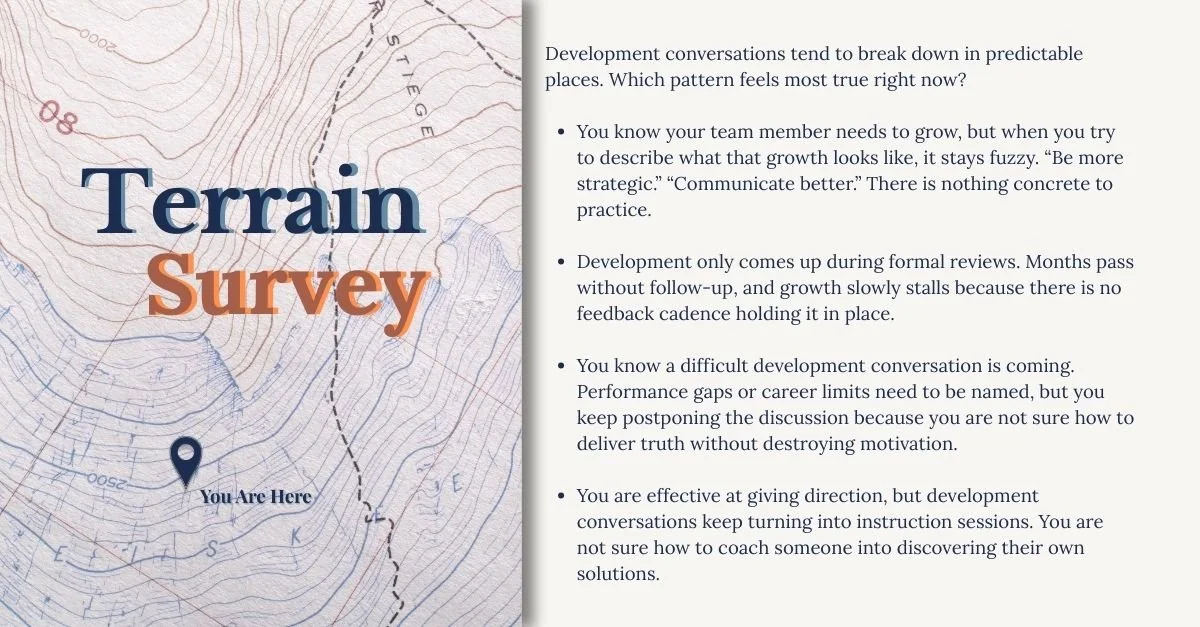
The Development Pass: Where Are You on the Growth Map?
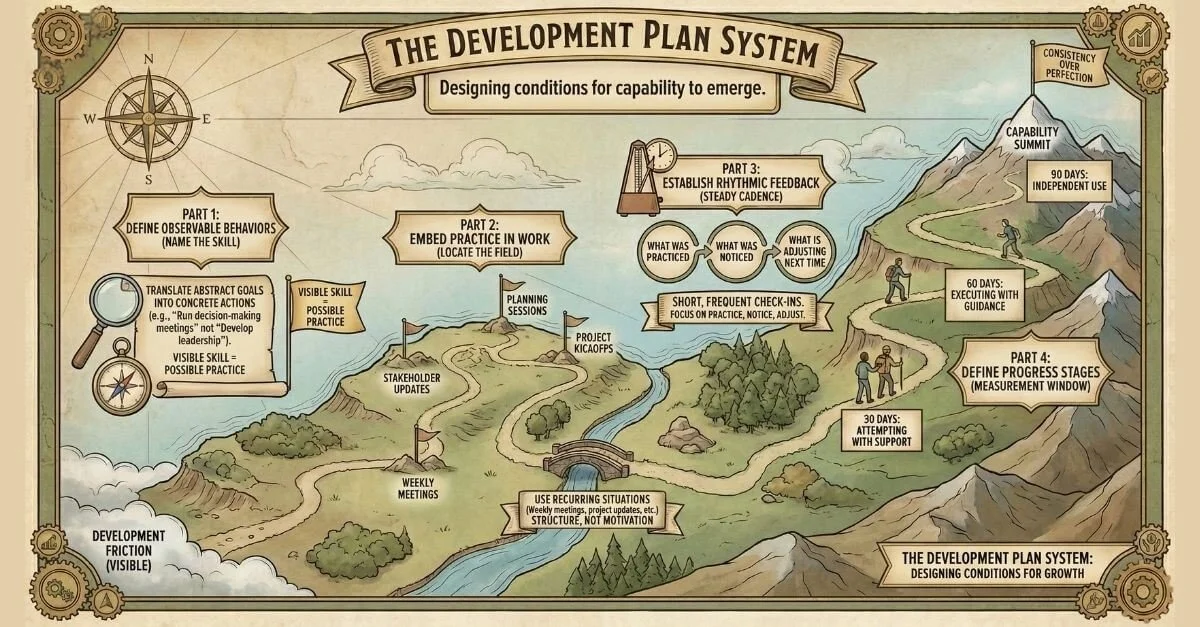
The Development Plan System
This is not about writing better documents. It is about designing the conditions that allow capability to emerge.
Once a development friction becomes visible, a growth system tends to take shape around four structural elements.
Part 1: Naming the Skill That Is Trying to Form
The first shift happens when abstract goals are translated into observable behaviors.
Not “improve communication,” but “deliver project updates that include context, risks, and decision points without follow-up questions.”
Not “develop leadership,” but “run meetings where decisions are made in the room.”
When the skill is visible, practice becomes possible.
Part 2: Locating the Practice Field
Skills grow inside recurring situations. Weekly meetings. Stakeholder updates. Project kickoffs. Planning sessions.
When development is attached to predictable work, repetition stops relying on motivation and starts relying on structure.
Part 3: Making Feedback Rhythmic
Growth becomes legible when feedback has a steady cadence.
Short, frequent check-ins create visibility before problems harden. Five minutes is often enough when it happens consistently.
What was practiced.
What was noticed.
What is adjusting next time.
Part 4: Narrowing the Measurement Window
Progress becomes clearer when it is defined in stages.
Thirty days often looks like attempting the skill with support.
Sixty days looks like executing with occasional guidance.
Ninety days looks like consistent, independent use.
Consistency matters more than perfection.
What Tends to Shift When a Plan Starts Working
When the skill becomes observable, ambiguity tends to drop. Both people can point to the same behavior in the work.
When practice has a predictable place to happen, momentum tends to appear without extra effort.
When feedback has a rhythm, anxiety tends to soften. Course-correction becomes normal instead of dramatic.
When progress is defined in short intervals, trust tends to increase. People stop waiting months to learn whether they are off track.
In Action: What This Looks Like
Alex manages Maya, a project coordinator who wants to grow into a project manager role. Her goal was “become more strategic,” but after months, nothing had shifted.
The system changed.
The skill became anticipating project risks and flagging them early.
The practice field became kickoff meetings and weekly updates.
The feedback rhythm became brief biweekly check-ins.
Progress was defined across three months.
By sixty days, Maya was naming risks before Alex did. By ninety days, risk identification was embedded into how she ran meetings.
The change did not come from motivation. It came from structure.
The Cartographic Lens
Leadership Cartography approaches development planning as a practice design problem, not a documentation problem.
When development plans fail, it is rarely because someone lacks potential. It is because the system cannot detect growth unless it is designed into visible, repeatable work.
Growth emerges when skills are named, practice is embedded, and feedback is steady. The work is not to perfect the plan. It is to design the field where learning can take root.
The Larger Purpose: Holding Reality Without Breaking Trust
Most development plans fail quietly because the hardest part never gets held. The truth stays unnamed. The conversation gets softened. Everyone keeps performing optimism, and growth becomes a document instead of a practice.
If you are standing in the High-Stakes Fear terrain, you do not need a better goal statement. You need a structure that can hold reality clearly, without turning the conversation into shame or threat.
That is what theReality-Based Employee Development Toolkit is for. It is not a “more motivation” tool. It is a steadier container for the part most managers avoid.
Use it when the plan is not the problem. The conversation is.
If this is your terrain, return to the Development Approach Map to choose your route.