
The Coffee Break: The Fight for Personal Time
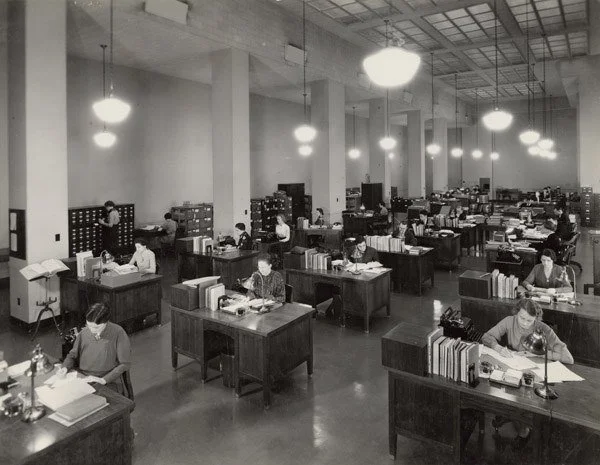
Office Workers in the 1950s. Photo Credit: The U.S. National Archives, No restrictions, via Wikimedia Commons
In the early 1900s, the concept of a break was non-existent in the industrial landscape. You worked from the moment you clocked in until the moment the whistle blew at the end of the day. The system viewed a person as a machine that did not need rest, only fuel. But the introduction of the coffee break changed the friction of the factory floor forever. It began as a necessity in a necktie factory in 1901, where owners realized that a mid-morning pause actually increased the velocity of production.
This change was a mathematical calculation. Business owners found that after hours of repetitive motion, the workers’ pace began to degrade. Errors increased and speed slowed. By the 1950s, the coffee break became a federally protected right in many labor contracts, moving from a radical idea to a fundamental expectation. It was not a gift of leisure; it was a strategic adjustment to maintain the worker as machinery. The coffee break provided the first formal gap in the map where a worker could exist outside of their job description for fifteen minutes.
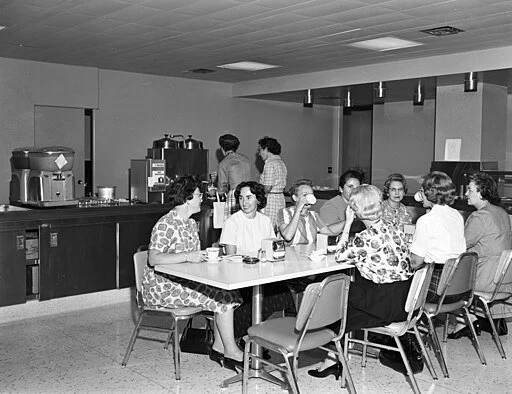
Employees on a Coffee Break 1960s. Seattle Municipal Archives, CC BY 2.0 <https://creativecommons.org/licenses/by/2.0>, via Wikimedia Commons
The Job Description: The Relief Operator
The Relief Operator was the person who stepped into the line so others could step away. Their entire job was to be the temporary map for someone else’s position. They had to master every station on the floor to ensure the system never stopped moving, even when the humans did.
The Relief Operator lived in a state of constant transition. They were tasked with maintaining the precision of the station they inherited while knowing they would only hold it for a few minutes. Their value was measured by how invisible they were. If the transition was seamless, they had succeeded. They were the human bridge between a person’s need for rest and the system’s need for output. They experienced the friction of being a placeholder, always holding the space but never owning the ground.
Modern Correlation: Leadership Cartography™
Today, we no longer fight for a fifteen-minute coffee break, but we are still fighting for the mental permission to take one. The modern office has replaced the factory whistle with a constant stream of digital pings that follow us into our kitchens and our bedrooms. We have the coffee, but we have completely lost the break. We are often so busy performing the act of "doing work" that we have become our own Relief Operators, frantically stepping into our own gaps to ensure the "line" of our availability never stops moving.
This is where Leadership Cartography™ and the Lead with Support™ pathway expose the absurdity. Leading with Support™ is about recognizing that your team is currently navigating an Overwhelm Map designed by 19th-century logic. When you use a tool like Time Blocking, you aren't just "organizing a schedule." You are staging a quiet rebellion against a system that still views your brain as a steam engine that doesn't need to cool down. You are finally marking a "gap in the map" that the system cannot colonize.
If the 1901 factory owner eventually realized that a tired machine breaks the profit margin, why are you still trying to prove you’re the only piece of equipment that doesn't need to be turned off?
Your Next Step

Identify Your Terrain
Are you Leading with Support™, or is the constant noise of the Overwhelm Map causing your team to stall?
Lower the Pressure
Stop reacting to every ping and start reclaiming your capacity. I have chosen the Manager's Time Blocking Sheets for this piece because they help you build intentional gaps back into your day. It moves you from "always available" to "strategically present" by helping you protect the space you need to actually lead.
Join the Map Drawer
Get monthly tactical kits delivered to your inbox, designed to help you lead with clarity and boundaries.