
Golden Handcuffs and the Price of Loyalty
How 1920s Pensions Turned Devotion into a Corporate Asset
In the 1920s, American companies created pension plans to stop worker turnover by making employees forfeit everything if they left before 20-30 years. This article explores how the Pension Administrator role enforced retention and how modern development programs still use the same control mechanisms disguised as career growth.
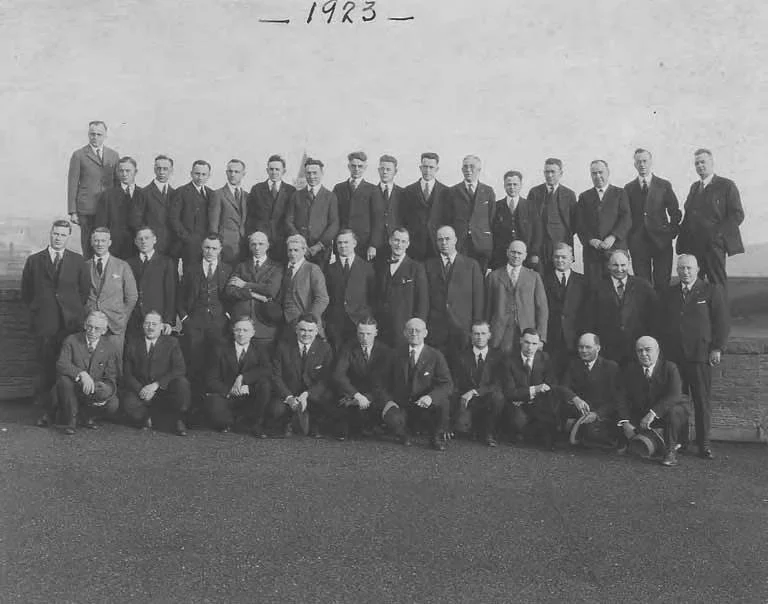
Photo Credit: Group of Employees of Seattle Hardware: University of Washington, Public domain, via Wikimedia Commons
In the early 1920s, American companies faced a crisis they'd never seen before: workers kept leaving.
The system of industrial labor had created a paradox. Factory wages were higher than ever, and yet skilled workers moved from company to company every two or three years, chasing pennies-per-hour raises. This constant turnover wasn't just expensive, it was destabilizing. Every time a trained machinist or experienced foreman walked out the door, they took institutional knowledge with them. Training costs multiplied. Production slowed. Managers spent more time recruiting than managing.
The solution wasn't higher wages or better conditions. It was something far more clever: the company pension plan. If you stayed for twenty or thirty years, the company promised to pay you a modest income for the rest of your life after you stopped working. But if you left early, even after nineteen years, you forfeited everything.
The Job: The Pension Administrator
Before pensions, there was no such thing as a "Pension Administrator." But by the mid-1920s, large corporations like General Electric, AT&T, and U.S. Steel had created entire departments dedicated to managing these new loyalty programs. The Pension Administrator kept ledgers tracking every employee's years of service, calculating vesting schedules, and most importantly, reminding workers exactly how much they stood to lose if they left.
Their desk held thick bound volumes listing every employee's accumulated pension credits. They used actuarial tables to calculate life expectancy and benefit payouts. When a worker came in asking about leaving for a better opportunity, the Pension Administrator would open the ledger, run their finger down the columns, and show them the math: "You have fourteen years in. If you leave now, you get nothing. But if you stay six more years..."
They weren't HR. They were retention enforcers. Their job was to make leaving feel impossible.
The Modern Correlation
Today, we've moved from pension ledgers to equity vesting schedules, but the mechanism remains identical. In the Leadership Cartography™ system, we recognize this as the Purpose™ pathway, the place where meaning, identity, and value alignment intersect with organizational control.
Modern managers inherit this system when they offer "career development plans" that conveniently require three to five more years of commitment, or when they frame departure as "walking away from your potential here." The golden handcuffs have simply moved from retirement benefits to stock options, from pension credits to "invested time in your growth."
If you feel uncomfortable when a talented team member considers leaving, it's worth asking: are you genuinely concerned about their wellbeing and trajectory, or are you worried about losing the institutional knowledge and productivity they represent? The Pension Administrator's job was to conflate company loyalty with personal wisdom. Many managers still perform this function without realizing it.
We've inherited a belief that retention equals care, when often it's just control with better marketing.
If the original pensions were designed to stop workers from seeking better opportunities, are our modern "development programs" actually about employee growth, or are we just running a more sophisticated version of the same retention ledger?

Tier 1: Discovery
Not sure if your modern development programs are actually about growth or just another version of the retention ledger? Take the Leadership Style Quiz to see how your map is currently drawn.
Tier 2: Tactical
If you feel stuck in the overwhelm of "vesting schedules" and "invested time," explore how this historical pattern of employee control becomes modern burnout at work. We help you identify where the mechanism of the pension administrator is still running your calendar.
Tier 3: Subscription
Need a permanent place to store your insights on loyalty and growth? Join The Map Drawer for a standing library of leadership maps you can return to whenever the terrain of organizational control feels too heavy. Correlate your path to purpose without the weight of the golden handcuffs.