
What Systems Do I Need in My First 90 Days as a Manager?
Your title changes fast. The relationships around you do not.
You walk into meetings with people who knew you as a peer last week. The tone is familiar, but something has shifted. Decisions slow down a little when you speak. People watch you differently. You are trying to lead without sounding forced, while figuring out what needs to change and what should stay the same.
That is why the first 90 days as a manager can feel so disorienting. You are not only learning a new role. You are setting the terms people will use to read your authority, your boundaries, and your follow-through.
Why the first 90 days get messy
A manager transition puts pressure on several things at once. The team is adjusting to a new reporting relationship. The organization is paying attention to whether you can carry formal responsibility. You are trying to keep your footing while the social rules around you keep moving.
Without structure, people fill the gap with assumption. The team starts deciding what you will and will not address. You start making judgment calls in the moment without a stable operating rhythm underneath them. Small moments begin setting expectations you did not mean to create.
This is where early drift starts. You stay too available because you do not want to overcorrect. You avoid a hard conversation because it feels too early. You keep doing work yourself because delegation still feels awkward. None of that stays small for long.
What this costs when it stays unclear
The first 90 days shape what your team comes to expect from you. If accountability stays soft, people notice. If decision rights stay vague, work slows down or routes back through informal channels. If boundaries are inconsistent, accessibility turns into overreach and resentment follows close behind.
It also costs you internally. You can start second-guessing every move because nothing feels settled. You spend energy reacting to what is in front of you instead of installing the routines and expectations that make the job more stable.
That is how a transition starts to feel harder than it needs to. The problem is not only that the role is new. The problem is that the operating structure is still missing.
What changes when the transition is structured
When the first 90 days have a clear sequence, the role gets easier to inhabit. Expectations get said early instead of corrected late. Authority shows up through consistency. The team learns how decisions move, how follow-up works, and what you will take seriously.
That lowers friction on both sides. You stop improvising your leadership in public. The team stops guessing where the line is. The role starts to feel more grounded because the expectations around it are no longer floating.
You still have to lead. But you are no longer building the role from scratch every week.
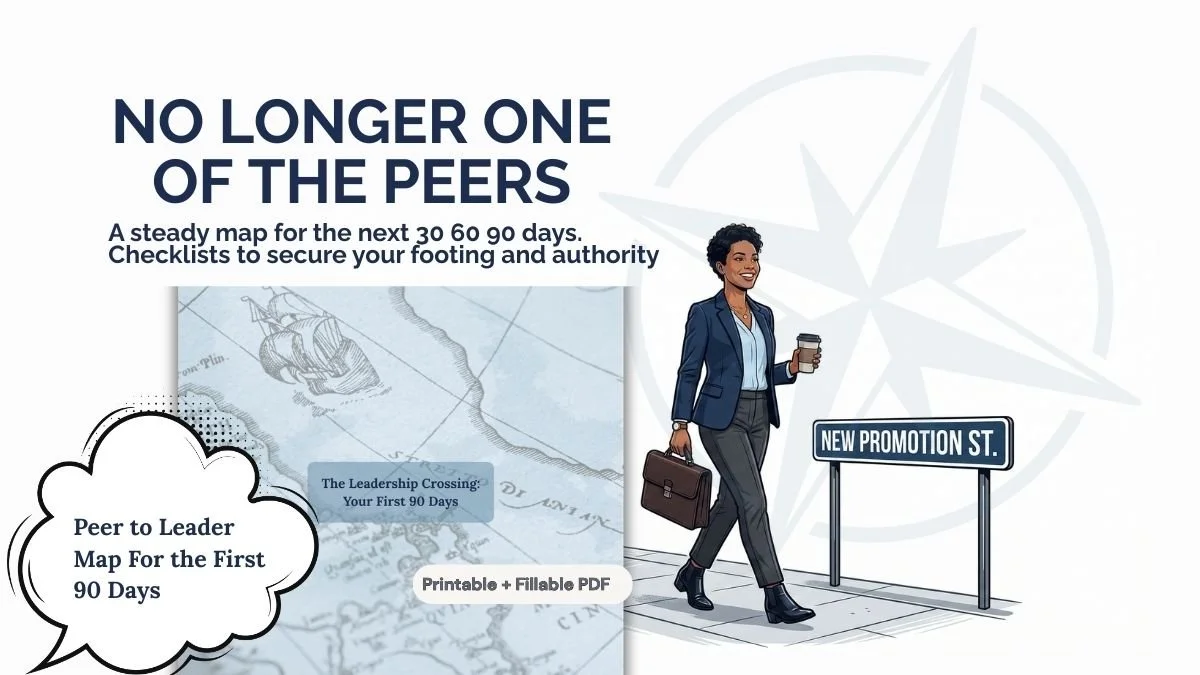
The Leadership Crossing: Your First 90 Days
A structured transition checklist for managers stepping into a new leadership role. It breaks the first three months into phases so you can install authority, expectations, and rhythm with more intention.
What it helps you do
It helps you move through the transition in a sequence instead of relying on instinct. That matters because former peer dynamics, unclear authority, and delayed accountability create most of the early friction. A tool like this gives you a steadier way to prepare, enter, and stabilize the role.
It also helps you catch avoidance early. If you are hesitating on boundaries, decision-making, delegation, or team expectations, the structure makes those gaps easier to see before they become habits.
What is included / how it works
A pre-start planning section for clarifying decision rights, access, and authority signals before Day 1
A first-week checklist for announcement framing, one-on-ones, and early boundary setting
Week two and three planning pages for delegation, expectation resets, and operating rhythm
Reflection prompts at 30, 60, and 90 days to catch drift and recalibrate
A forward-planning section so the transition does not slide into reactive management
Is This Tool for You?
This tool is for new managers, newly promoted leaders, and former peers who need clearer structure in the first 90 days of a role change.
Use it when you are stepping into formal authority, especially over people who used to work alongside you, and you want to set cleaner expectations before informal habits harden.
You need a different route if the main issue is already a damaged relationship, a live conflict, or a team performance problem that needs immediate correction. This tool helps you install transition structure. It does not replace direct feedback, conflict repair, or broader leadership development support.
Choose Your Next Route
A tool only works if it fits the hand using it.
You have the tactical fix for the friction. Now, make sure you know how to wield it. Get Your Map to see how your inherent orientation interacts with this terrain.

If the issue runs deeper, go to the Former Peer Transition Map.
If an adjacent pattern is also present, use Managing Former Peers.
For the full library, visit The Supply Post.