
How Do I Lead Without Burning Out?
You wake up tired before the day even starts. Your calendar is full, your brain is already working, and the week feels heavy before you have done anything yet.
You are still leading. You are still showing up. But the role is taking more out of you than you can keep replacing.
That is when burnout starts to stop feeling abstract. It becomes physical, emotional, and operational all at once. A burnout prevention assessment helps when leadership keeps draining you and you cannot tell what is costing so much.
Why leadership starts to feel unsustainable
Burnout builds when the role keeps taking energy and nothing is measuring the cost. You move from meeting to meeting, decision to decision, problem to problem, without any real way to track what is depleting you faster than you can recover.
Some parts of management drain more than they look like they should. Repeated emotional labor. Constant context switching. Carrying tension for other people. Trying to stay available while still getting your own work done. The output still happens, so the strain stays easy to miss.
That is why people can look functional from the outside and still feel close to collapse on the inside. The role keeps moving. Your capacity keeps dropping. Nothing in the workweek is built to catch that early.
What this costs when it stays unclear
When capacity stays invisible, you start paying for it everywhere. You get shorter with people. Strategic thinking gets replaced by reaction. Recovery time stops working because the depletion is deeper than a weekend can fix.
The work also gets worse. You avoid conversations because you do not have the energy for them. Small problems feel bigger than they are. Decisions take longer. Your team gets a thinner version of you because too much of your energy is already gone before the real work starts.
Over time, this changes how you read yourself. You start wondering whether you are losing your edge, when what is actually happening is that the role has exceeded your available capacity for too long.
What changes when the drain becomes visible
Once the pattern is visible, you can stop treating burnout like a mystery. You can see which parts of the week are draining you most, which responsibilities keep stacking without relief, and where restoration is too weak to offset the cost of the role.
That makes better decisions possible. You can protect certain hours, reduce unnecessary load, change how you prepare for known drains, and stop pretending that every part of leadership costs the same amount.
You may still be working hard. But you are no longer blind to what the work is taking.
The Burnout Prevention Assessment
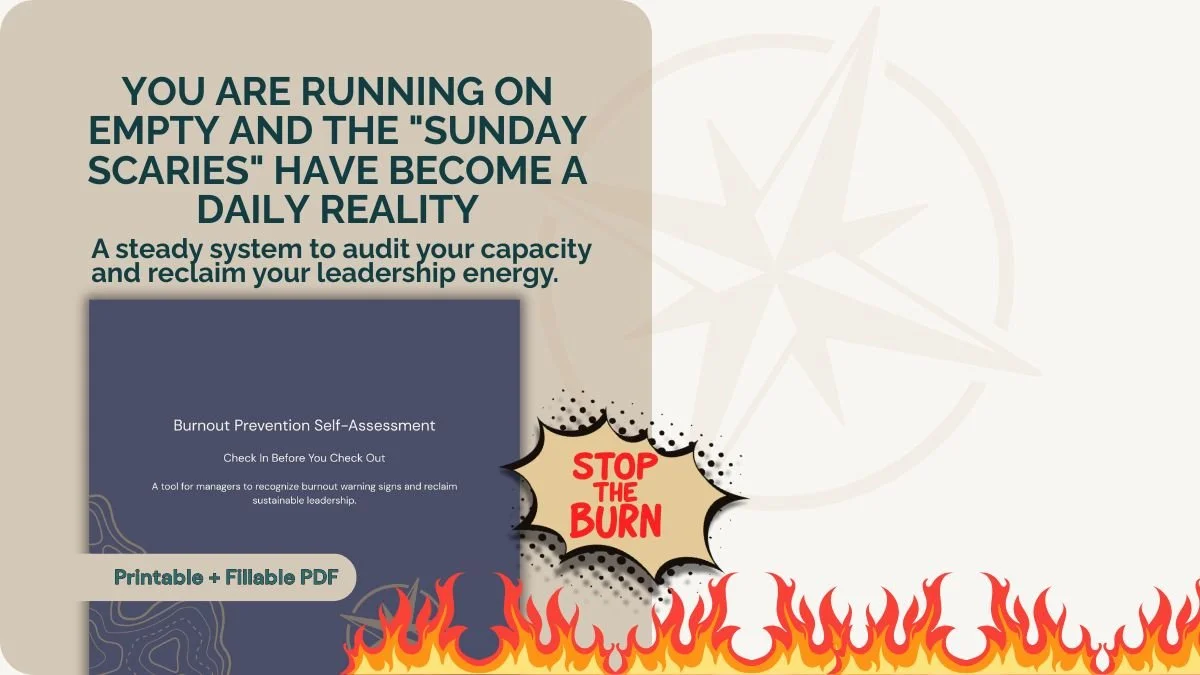
A structured capacity audit for tracking what drains your leadership energy and what restores it. It walks you through identifying depletion patterns and building restoration structures before burnout becomes chronic.
What it is
The Burnout Prevention Assessment is a structured capacity audit for managers who feel depleted by leadership. It helps you examine where your energy is going, what parts of the job keep taking too much, and where restoration is missing.
What it helps you do
It gives you a clearer read on your current load so you can separate general exhaustion from specific patterns of depletion. That matters because vague burnout is hard to respond to. Clear burnout patterns are easier to work with.
This tool helps you see whether the strain is coming from people load, decision load, schedule overload, emotional carry, or weak recovery structure across the week.
What is included / how it works
A capacity audit to track where your leadership energy is going
Prompts to identify repeated drains across meetings, responsibilities, and people dynamics
Space to document what restores you and where recovery is currently too weak
Planning pages to adjust boundaries, workload, and weekly rhythm
Printable and fillable formats for repeat use over time
Is This Tool for You?
This tool is for managers who feel tired before the day starts, dread the constant demand of the role, or can tell their leadership capacity is slipping but have not been able to read the pattern clearly.
Use it when the exhaustion feels ongoing, when your workweek keeps taking more than it gives back, or when you need a more specific read on what is draining you before burnout gets worse.
You need a different route if you are in a medical or mental health crisis, need clinical care, or are already fully burned out and unable to function day to day. This tool helps you assess workload and capacity patterns. It does not replace medical care, therapy, leave planning, or organizational intervention when the situation is already severe.
Choose Your Next Route
A tool only works if it fits the hand using it.
You have the tactical fix for the friction. Now, make sure you know how to wield it. Get Your Map to see how your inherent orientation interacts with this terrain.

If the issue runs deeper, go to the Time Management Map.
If an adjacent pattern is also present, use the Delegation Block Map.
For the full library, visit The Supply Post.