
Why Can't My Team Handle This Without Me?
You delegated the task last week. You explained what needed to happen. Now the work is back in front of you with questions, partial progress, or a draft that still needs too much correction.
The task left your mouth, but it never fully left your head.
That is the point where delegation starts to feel fake. You assign the work, but you still carry the judgment, the decisions, and the risk. A delegation planning template helps when the handoff keeps collapsing back into your workload.
Why delegation keeps falling apart
Most delegation problems start before the work begins. The goal may have been clear enough to you, but the ownership line stayed blurry. The team member knows the assignment exists, but they do not know how far their authority goes, what tradeoffs they can make, or what counts as done.
That creates predictable check-ins. They come back to confirm the approach. They pause when something changes. They ask for approval at every turn because the boundary between your role and theirs was never made explicit.
Over time, this trains both of you. You keep watching the work because you do not trust the handoff. They keep checking with you because they do not trust their room to act.
What this costs when it stays unclear
When delegation stays loose, your workload does not actually go down. You still spend time answering follow-up questions, reworking drafts, and keeping half-finished tasks in your head so nothing gets dropped.
Your team also loses ground. People cannot build ownership when every decision still routes back through you. Confidence stays low. Speed stays uneven. Initiative gets replaced by caution because the stakes feel unclear and the edges of responsibility never got said out loud.
This is where managers start saying they have to do everything themselves. What they usually have is a weak handoff process that keeps recreating dependence.
What changes when the handoff is clear
A clean delegation handoff gives the other person enough structure to move without waiting on you. They know the goal. They know the constraints. They know which calls they can make alone and which ones still need your input.
That changes the quality of the follow-up. Questions get narrower. Updates get cleaner. The work has a real owner, which means it stops living in two places at once.
You still stay accountable for the outcome. You just stop carrying every decision inside the task.
The Delegation Planning Template
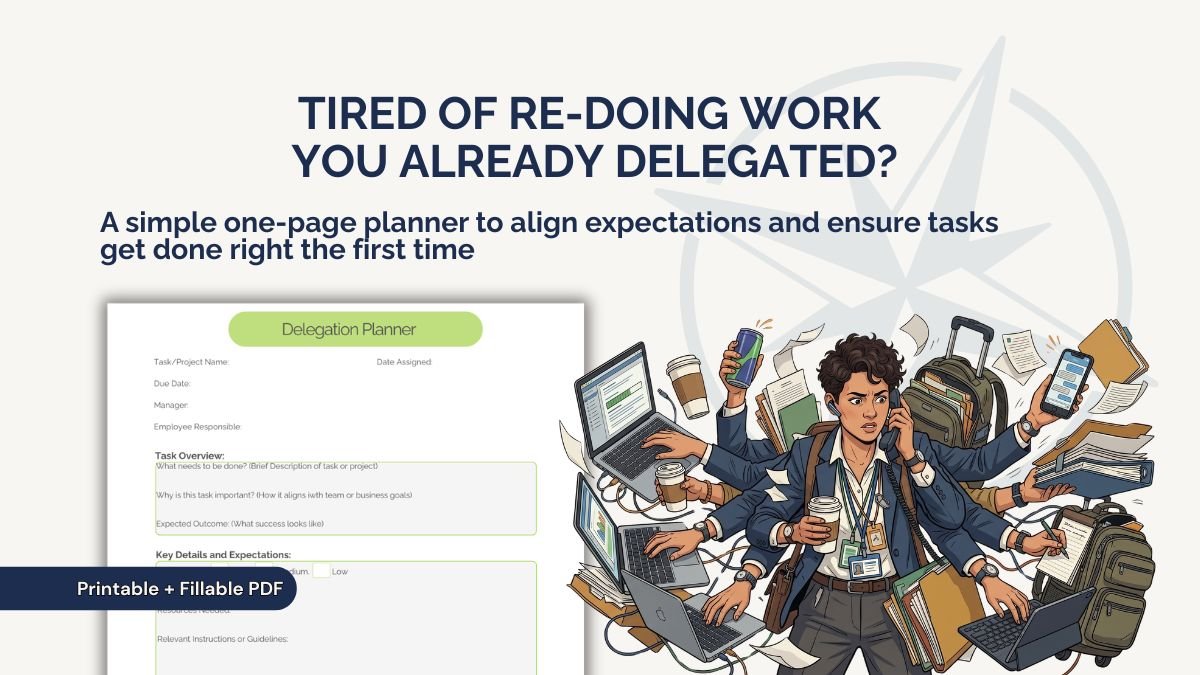
A structured worksheet for handing work off with clearer ownership. It helps you prepare the delegation conversation before the assignment starts drifting.
What it helps you do
It gives you a way to define the work beyond “please take this.” You get clearer on the outcome, the boundaries, the decision rights, and the approval points before the task leaves your desk.
That makes delegation easier to trust because the assignment is no longer vague. It is documented, bounded, and easier for another person to carry without pulling you back in.
What is included / how it works
A planning sheet to clarify the task, outcome, timing, and success criteria
Prompts to define what the other person can decide without checking in
Space to document where your approval is still required
A task handoff script for the delegation conversation
Boundary-setting prompts to reduce vague ownership and repeat questions
Is this tool for you?
This tool is for managers who keep assigning work that comes back incomplete, stalled, or dependent on constant check-ins.
Use it when delegation feels heavier than just doing the task yourself, when you keep re-answering the same questions, or when your team hesitates because authority is unclear.
You need a different route if the issue is performance management, skill gaps that require training, or a trust breach that has already damaged working confidence. This tool helps with handoff structure. It does not replace coaching, feedback conversations, or capability building.
Choose Your Next Route
A tool only works if it fits the hand using it.
You have the tactical fix for the friction. Now, make sure you know how to wield it. Get Your Map to see how your inherent orientation interacts with this terrain.

If the issue runs deeper, go to the Delegation Block Map.
For the full library, visit the The Supply Post