
How to Manage a Remote Team Without Micromanaging
You manage a remote team, and most days you cannot see what is happening. Work looks quiet until something slips. A deadline moves. A deliverable comes in half-finished. Someone pulls back and you do not catch it until the distance is already showing up in the work.
Then the pressure shifts to you. You start asking for more updates because you need a clearer read on progress. The team starts to feel watched. You start to feel responsible for reading work you cannot see.
That is the point where remote management starts to get strained.
What This May Be Showing
Remote teams need more designed visibility than in-person teams do. In an office, managers catch small changes in tone, pace, and coordination through ordinary contact. Remote work removes most of that.
Without a shared rhythm for check-ins, silence starts doing too much work. It gets read as stability when it may only mean no one has spoken up yet. It gets read as autonomy when someone may already be stuck.
This is where managers get pulled into two bad options. They either back off too far and lose visibility, or they overcorrect and start checking too often.
What This Costs When It Stays Unclear
When remote work is hard to read, small problems sit longer. Rework grows. Deadlines slip later than they should. Recognition gets uneven because the most visible people get the most attention.
It also changes the relationship. Managers start second-guessing what they cannot see. Team members start filtering what they share because every update feels loaded. The work slows down and trust gets harder to maintain.
What Changes When the Problem Is Read Clearly
Remote teams work better when visibility is built into the week instead of pulled out through scattered follow-ups. A short weekly check-in gives you a repeatable way to track movement, blockers, and support needs. A monthly depth conversation gives space for development, connection, and early strain.
That changes the job of the manager. You are no longer trying to read progress from silence. You have a structure that gives both you and the team a cleaner read on what is happening.
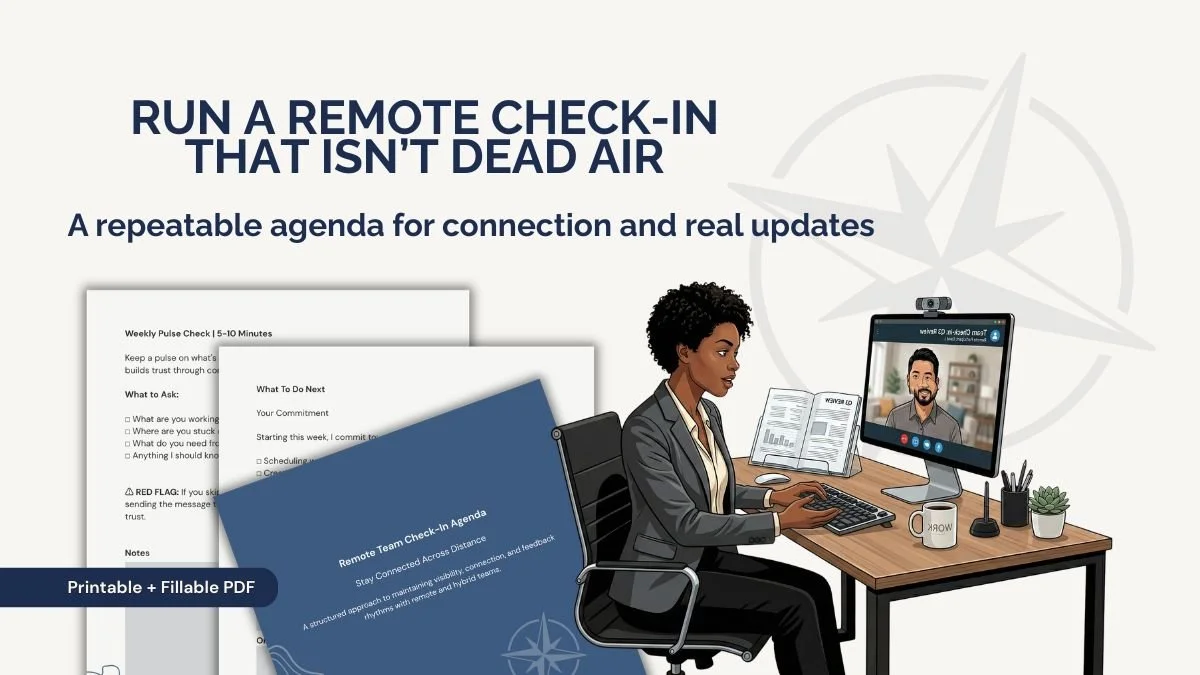
The Remote Team Check-In Agenda is a printable PDF for weekly pulse check-ins and monthly one-on-one conversations with remote or hybrid employees.
What it helps you do
It gives remote management a steady structure. You can see progress earlier, catch blockers sooner, and stay connected to people without filling the week with random status pings.
What is included / how it works
A short weekly check-in format to review current work, blockers, and needed support
A monthly conversation structure for connection, visibility, and development
Prompts that help employees raise issues that are easy to miss in remote settings
A repeatable rhythm that makes follow-up more consistent across the team
Is This Tool for You?
This tool is for managers leading remote or hybrid employees who need a better way to keep visibility, support, and accountability in place across distance.
It fits when work is getting harder to read, updates are getting uneven, or you can feel yourself drifting toward over-checking because the signal is weak.
It is not the right route if the main issue is role confusion, recurring performance failure, or a trust breach that already needs a direct conversation. It also does not replace performance management, conflict repair, or a broader team operating system.
Choose Your Next Route
A tool only works if it fits the hand using it.
You have the tactical fix for the friction. Now, make sure you know how to wield it. Get Your Map to see how your inherent orientation interacts with this terrain.

If the issue runs deeper, go to the Remote Leadership Map.
For the full library, visit The Supply Post .