
When Hard Conversations at Work Start Spiraling
Difficult Conversations Framework for Managers
You schedule the conversation because it needs to happen.
Performance has slipped. A deadline was missed. A boundary got crossed. Something was said in a meeting that cannot be left alone.
You start clearly, then the discussion starts to slide. They get defensive. They interrupt. They pull in old grievances. Your body tightens and your language changes with it. By the end, the issue is still there, and now the tension is bigger than when you started.
What this may be showing
When a difficult conversation falls apart like this, the problem is often preparation at the structural level.
Most managers think through what they want to say. Fewer prepare the sequence, boundaries, evidence, and next-step logic that keep the conversation from drifting or going sideways.
Once that structure is missing, the discussion starts moving in too many directions at once. The purpose gets blurry. Facts mix with interpretations and the conversation turns into an argument about what this meeting is even about.
That is where the exhaustion from these types of hard talks comes from. You are trying to manage the issue, the emotion, and the shape of the exchange all at the same time.
What this costs when it stays unclear
And when this pattern repeats, managers start hesitating before necessary conversations. They over-explain, soften too much, or wait too long to address the issue to avoid the confrontational mess.
That delay creates more than discomfort. It creates repeated behavior, blurred expectations, inconsistent accountability, and a growing loss of self-trust. You stop feeling steady in conversations that are an essential part of your job and not going away any time soon.
What changes when the problem is read clearly
A hard conversation gets easier to lead when the sequence is clear before the meeting starts.
The purpose is clear. The evidence is clear. The outcome is clear. The next step is clear.
That changes the tone of the exchange because the conversation has direction. Pushback still may happen. Emotion still may show up but, the discussion has the shape and weight that keeps the issue from getting buried.
The Difficult Conversations Framework
This guide is a printable and fillable PDF that helps you prepare before the conversation happens.
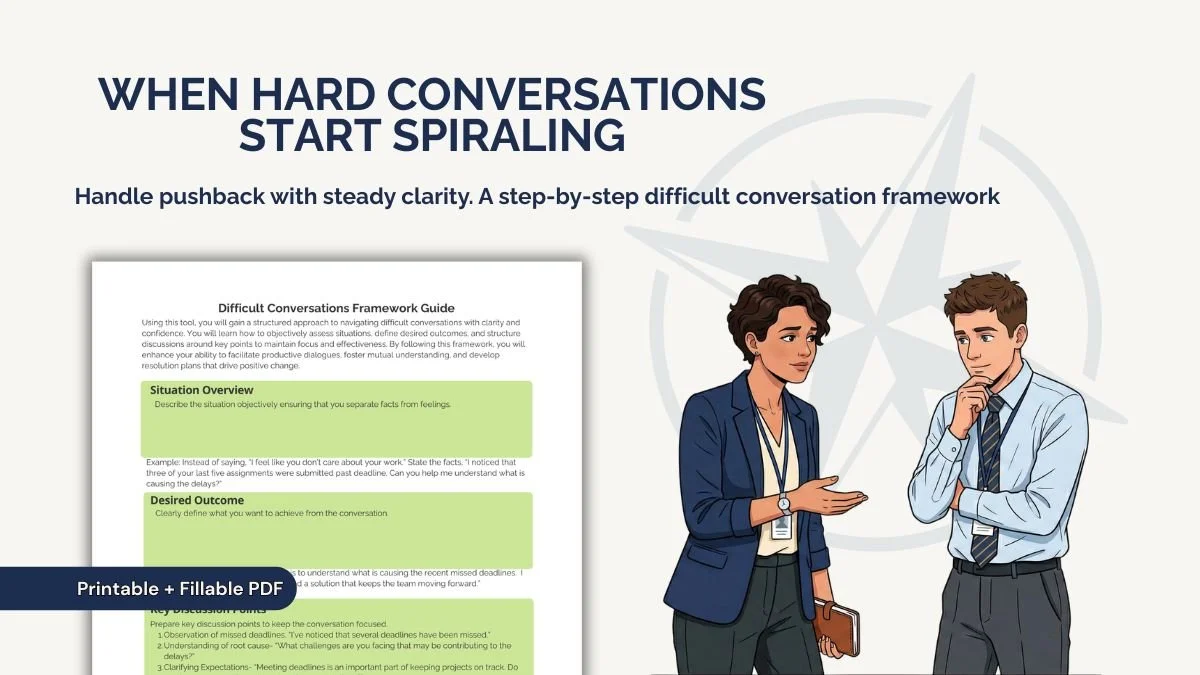
It helps you sort the issue, the evidence, the purpose of the conversation, and the next step you need to hold. That makes it easier to walk in with steadier language and less reactivity.
What is included and how it works:
A planning structure to clarify the exact issue you need to address
Space to separate facts from interpretation before the meeting
Prompts to define the purpose and desired outcome of the conversation
A way to organize discussion points in a cleaner sequence
A section to document next steps, ownership, and follow-up
You also get a companion guide with this so you never have to just wing-it again
Is This Tool for You?
This tool is for you if you know a conversation needs to happen and you do not want it to turn into defensiveness, drift, or emotional confusion.
Use it when performance has slipped, expectations were crossed, trust took a hit, or something needs to be addressed directly and clearly.
This is not the right route if the issue is a full employee relations matter, a legal risk, or a crisis that needs HR involvement first.
It also does not replace judgment, documentation requirements, or formal performance management process. It helps you prepare the conversation more clearly before you walk in.
Choose Your Next Route
A tool only works if it fits the hand using it.
You have the tactical fix for the friction. Now, make sure you know how to wield it. Get Your Map to see how your inherent orientation interacts with this terrain.

If the issue runs deeper, go to Feedback Pattern Map.
If an adjacent pattern is also present, use Peer to Leader Map.
For the full library, visit The Supply Post.