
When Being Micromanaged Makes You Doubt Your Own Judgment
How constant watching trains hesitation, and why the doubt is a condition, not a verdict on you.

There was a stretch of months when I read my own work as if someone else had written it, looking for the mistake before it could be found for me.
I was a district manager then, responsible for 10 to 12 managers at any given time, and I knew the job.
That is the part that still catches me.
I knew the job, and I had started to check whether I knew it.
The director of operations, my boss, was always in the bullpen, the shared space where the district managers planned, compared notes, and kept the business moving. She hovered. She wanted the same report again and again and never did anything with it.
At first, I read the hovering as her problem. Then it became a question I carried into my own work.
Am I actually getting this wrong? Is that why she will not step back?
The belief that she did not trust us turned into something I could not shake. I started to wonder whether I could trust myself. Nothing in my results said I should doubt my judgment, but I did.
Micromanagement slows the work. Over time, it can also change how you read your own judgment. The second-guessing can feel like proof that you have lost your edge. More often, constant watching has trained hesitation into the work.
Hesitation then looks like the very thing the watching was worried about.
Why does being micromanaged make you doubt yourself?
The pattern under being micromanaged is trained hesitation. When you are watched closely enough, for long enough, the watching becomes part of how you decide.
The pause before sending the report. The second read. The instinct to wait for a check before moving.
None of it was there before. All of it shows up once judgment stops feeling like it belongs to you.
The cost is slow and specific. Decisions that used to take minutes start to take longer because you are no longer deciding cleanly. You are seeking permission you have not been told you need. Initiative drops, since the safest move under observation is the move someone else has already approved.
You begin managing the watcher’s comfort instead of the work, and the work gets more cautious as a result.
What makes this hard to see from the inside is that it feels personal. You assume the hesitation is evidence of a real gap, when the hesitation may be a response to being watched.
That misread carries the pattern forward.
What is the workplace doing that feeds the doubt?
The doubt forms inside specific gaps in how work is structured.
There is no standard way for your work to be seen as it happens. When nothing makes the work visible on its own, a nervous supervisor reaches for the only channel left, which is the person doing it. You.
Watching becomes the substitute for a system that was never built.
Reporting measures effort more easily than it measures outcome. Status updates and check-ins capture activity. The results you actually produce are harder to see on the same schedule, so looking busy becomes the visible proof, and the real work competes with the performance of it.
Trust is treated as a personal trait instead of a built structure. There is rarely a shared agreement about what a manager owns outright and what gets escalated. Without that agreement, trust defaults to whatever a supervisor can personally observe, which is very little.
Information runs in one direction. Reports go up. Little comes back that helps you calibrate. Without a return signal, you cannot tell whether the doubt is warranted, so you start to assume it is.
This is the condition a self-fulfilling prophecy needs.
The sociologist Robert K. Merton described the dynamic in 1948: a false expectation can produce the behavior that makes the expectation come true. The workplace version is the Golem effect, where low expectations from a supervisor lead to lower performance from the person carrying them.
Confidence drops. The work gets more cautious. The dip reads back to everyone as proof the watching was justified.
Where did micromanagement actually come from?
This expectation was built into management more than a century ago.
In 1911, Frederick Winslow Taylor published The Principles of Scientific Management, which split work into 2 parts. Managers planned, measured, and analyzed. Workers executed. In Taylor’s design, almost every act of the worker was meant to be preceded by an act of management.
Control depended on watching. Time and motion studies measured the worker so management could own the method, and the manager’s job became observation and correction. Workers and their unions read the studies as tools for exploitation, with good reason. The arrangement moved judgment up and left execution down.
The factory floor is gone for most managers now, but the logic stayed in the furniture. When a supervisor cannot see the work and reaches for watching the person, they are using a design that is more than 100 years old.
The micromanaged manager today inherits the position the system once handed the line worker: do the task, and leave the judgment to someone above you.
The doubt that follows is old.
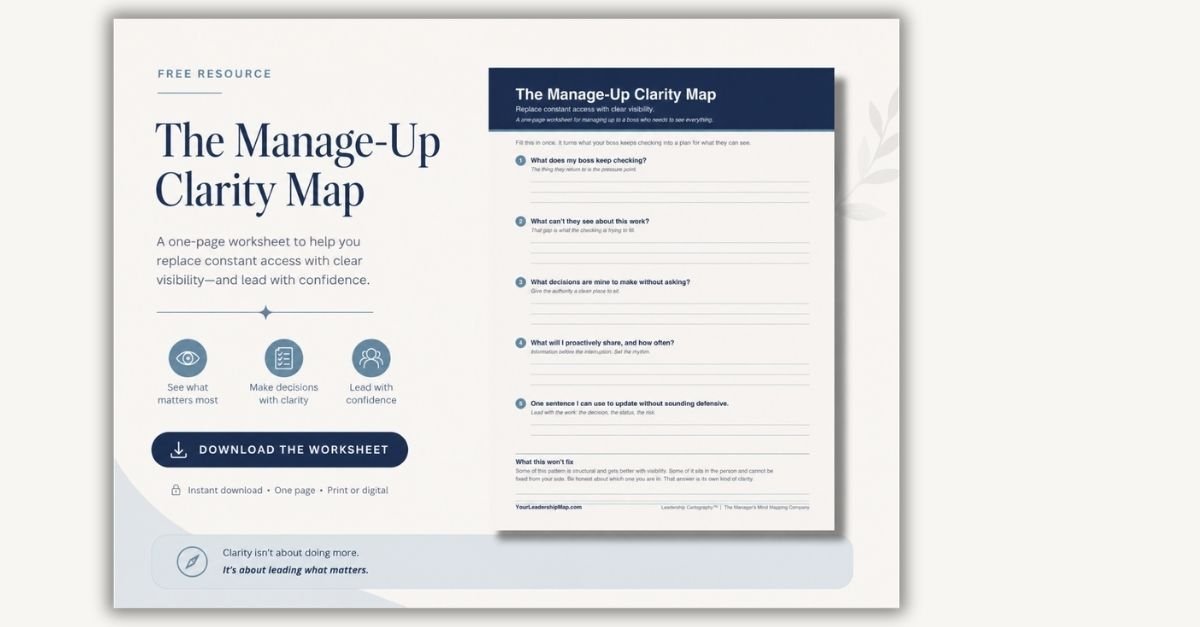
The Manage-Up Clarity Map
If the checking has started to shape how you work, it helps to get the pattern out of your head and onto paper. The Manage-Up Clarity Map gives you one place to sort what your boss keeps returning to, what they cannot yet see, and what you need to make clearer without making yourself more available.
What it is
A one-page worksheet for managers dealing with a boss who needs to see everything.
Why use it
It helps you turn constant checking into clearer visibility, steadier updates, and cleaner decision space.
Best used when
your boss keeps asking for the same status
you are over-explaining your work
you are unsure what to share proactively
you need to reduce defensive communication
Time to complete
5 to 10 minutes
You’ll work through
what your boss keeps checking
what they cannot see
what is yours to decide
what you will share and how often
one sentence for upward updates
How this lands for different managers
If you have years of a strong track record, this pattern tends to read as proof you have slipped. You trust your history, so the contradiction between what you have done and how you are being watched is destabilizing. The easiest explanation your mind reaches for is that the problem must be you.
If you are newer to the role, the same watching reads as confirmation that you are not ready. The hovering becomes evidence for a fear you already carried in, and every check-in feels like the system agreeing with the part of you that was already unsure.
Watched closely enough for long enough, a capable manager starts auditing the judgment they used to trust.
Leadership Cartography reads the condition before it judges the person standing inside it. The doubt has a shape. Being watched without trust produces hesitation in almost anyone placed inside it. That is worth knowing before you decide what the hesitation means about you.
Seeing the condition is what loosens its grip on your judgment. When you can tell the difference between a real gap and a response to being watched, you get your decisions back, even if the watching continues.
Your boss may never change. What can change is whose assessment you are using to measure your own work.
If the hesitation has started to feel like the truth about you, it may be worth asking where it came from before you let it settle.

Related Reading
If this resonated, these go further:
How to Manage Up When Your Boss Is a Micromanager
How to Say No to Your Boss Without Damaging Your Reputation
Difficult Conversations: 3 Scripts Managers Must Master
If this is your terrain, return to the Managing Up Map to choose your route.