
The Worth Verdict
The belief that value equals output, and what it does to how we read our own work

We are entering a season where the old equation gets exposed.
Money equals performance. Performance equals value. Value determines whether we still belong. Most of us would not say we believe that out loud. It sounds too harsh. Too transactional. Too cold.
But the system has trained us well.
If the business makes money, the work has value. If the product sells, the idea has value. If the performance review is strong, the person has value. If the raise comes through, the contribution has value. If the title stays intact, the identity stays intact.
And when the money does not come, when the review is poor, when the title disappears, when the role ends, when the marriage breaks, when the market does not respond, when the thing we built sits there unchosen, the old question is already in the room. It is one part of us that asks it.
Who am I if I am no longer wanted here?
The rest of us is still here, watching that part panic. That is the part we do not talk about honestly enough. We talk about performance as if it is clean. As if it is neutral. As if it simply measures output, contribution, behavior, results, and alignment. And yes, at its best, that is what performance management is supposed to do.
Many people carry a belief that worth equals output, that value is whatever produces money. The belief feels like common sense because the world keeps confirming it. When something sells it reads as real, and when it does not it reads as worthless, including the person who made it. The belief gets trained into people long before they examine it. Money and output can account for an exchange and a result. Neither one was ever built to measure whether a person has worth.
What This Article Covers
The loop runs in two directions. A culture that treats monetary return as the proof of value trains a person to read every outcome as a verdict on themselves, and that reading changes how they work, what they risk, and what they let themselves believe during a slow season. What follows is where the equation came from, what it costs, and what each of its measures can actually account for.
The Pattern Under the Problem
Underneath all of it is one move. Call it the worth verdict. A person takes an outside measure of their work and turns it into a private measure of themselves. Output becomes proof of value, and value becomes the price of belonging.
From there, a bargain begins. If I produce, I am safe. If I produce, I matter. If I produce, I belong. The bargain feels like drive from the inside. It runs on fear. The reverse is always sitting in the same sentence. If I stop producing, I lose standing, and I may lose my place.
For a capable person this gets expensive. The effort that could go into the work now goes into proving you deserve to be there. The belief that output equals worth raises the stakes. Each result gets treated as a verdict on something it cannot possibly measure.
The belief is not invented by the person. It is taught and inherited by the work structure.
What the System Is Doing
Several things outside you keep the equation supplied with proof.
The first is legitimacy by sale. In a market, the thing that earns money reads as the thing that is real. A product that sells is treated as a good idea, and a product that does not is treated as a bad one, regardless of what either product contains. Money stands in as the verdict on the idea.
The second is the collapse of separate measures into one. Performance becomes pay. Pay becomes proof. Proof becomes worth. Worth becomes belonging. Four different things get welded into a single chain, so a movement at one end is felt along the whole length. A loss of income is experienced as a loss in community standing.
The third is the rewarding of proxies. Organizations often reward visibility, availability, proximity to power, and ease of fit, then file all of it under merit. A person who reads the reward and works backward will conclude that being chosen is the same as being valuable, when much of what got rewarded was position rather than contribution. This is where performing culture begins. When the visible signals of deserving are the thing that gets rewarded, people learn to produce the signals, and the display of working starts to stand in for the work. People start sending an avatar to do the visible work, a version of themselves built to be seen.
Together these keep the equation in place. It rarely has to be argued, because the environment keeps producing the evidence. The cost is that the equation gets confirmed daily and examined almost never.
What It Costs
The cost shows up first as exhaustion. Underneath it is distortion. A person who believes output equals worth stops reading outcomes as information and starts reading them as identity. A missed goal becomes a character sentence. A slow sales month becomes evidence of uselessness. A poor review becomes proof that the person has been seen correctly at last.
The work gets harder because the work is no longer just the work. It is the trial.
What It Can't Measure
The equation survives because each measure does carry some truth. Money can measure exchange. Performance can measure work against expectation. Demand can measure market movement. A title can measure role. A review can measure a partial record inside a particular terrain.
Each of these measures carries real truth. The trouble is that it gets promoted past what it can account for.
Returning Each Measure to Its Jurisdiction
There is a way to read the equation that keeps worth out of it. It works by returning each measure to the thing it can actually account for.
Money accounts for an exchange. It shows that someone saw enough use, trust, or want to give something in return. It carries real information about a transaction, and none about whether a person has worth.
Performance accounts for work against an expectation, inside a particular set of conditions. It can show that a target was met or missed. It cannot reach the question of whether the person who did the work has value.
Demand accounts for movement in a market. It can show that an audience responded, or did not, to a particular offer at a particular time. It says nothing about whether the thing made was meaningful.
A title accounts for a role. It can change or end when an organization changes direction, and the identity of the person who held it stays where it was.
Read this way, each measure stays useful and stays small. The trouble starts only when one of them is asked to rule on belonging, which is the one thing none of them was built to do.
The damage is not that systems measure outcomes. The damage is that people are trained to experience those measurements as verdicts on belonging.
None of this makes money optional. Money pays the bill, feeds the family, and creates room to breathe, and treating it as shallow is its own kind of dishonesty. The work is to put it back in its place. Money measures exchange. It does not measure the soul.
Leadership Cartography reads the terrain a person is standing in before it reads the person. That order is the whole correction here. The worth verdict depends on the reverse order, treating the outcome as the fact and the person as the thing the outcome judges. When the terrain comes first, a slow season becomes information about conditions, available to be understood instead of swallowed as a sentence.
Your performance can be evaluated. Your model can be tested. Your work needs a channel of return if it is going to support you. None of those systems was ever given the authority to decide whether you belong. An outcome can be measured, but it was never given the authority to become a verdict on your worth.
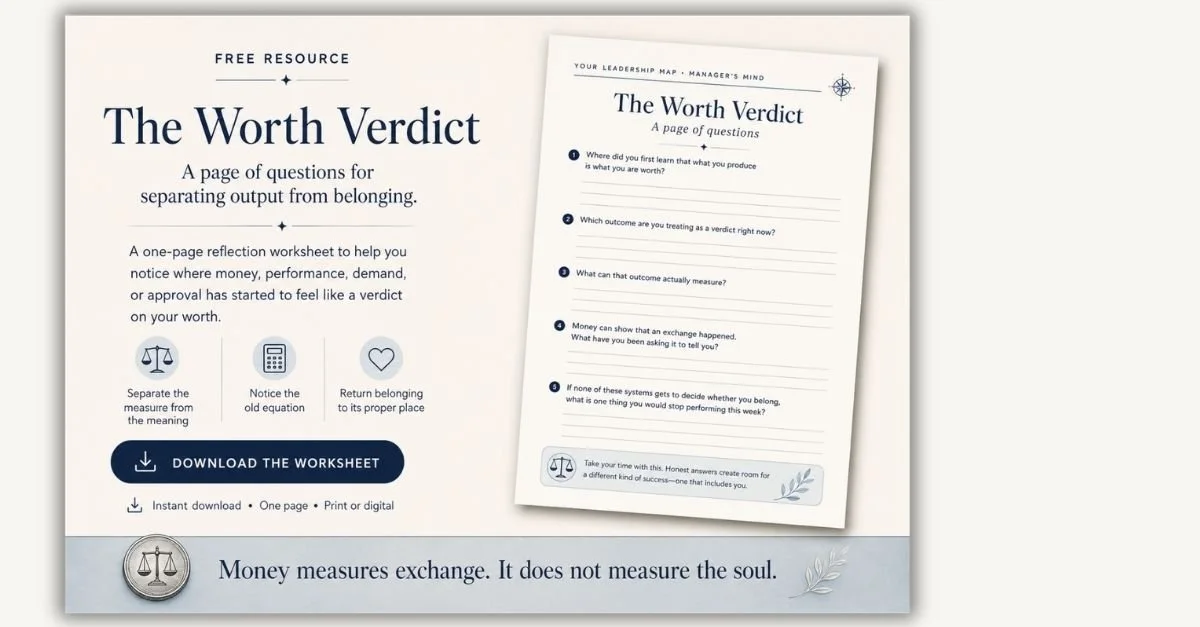
The Worth Verdict: A Page of Questions
When an outcome starts to feel like a verdict on who you are, it helps to slow the collapse. This page of questions gives you one place to separate what can actually be measured from what you may have been asking the measure to decide.
What it is- A free one-page reflection worksheet for the part of you that has started treating output, money, performance, demand, or external approval as proof of whether you belong.
Why use it? It helps you return each measure to its proper place, so a number, review, slow season, or unchosen piece of work does not become a ruling on your worth.
Best used when
you are treating a result as a verdict on yourself
money has started to feel like the only proof that something matters
a review, layoff, slow business season, or lack of response has shaken your sense of place
you are performing a version of yourself to stay chosen
you need to separate business data from belonging
Time to complete- 10 to 15 minutes
You’ll work through
where you first learned that what you produce is what you are worth
which outcome you are treating as a verdict right now
what that outcome can actually measure
what you have been asking money, performance, or demand to tell you
where you may be sending an avatar to be seen
one thing you can stop performing this week
Related Reading
If this resonated, these go further:
Discover your pattern. How much a result feels like a verdict depends on the pattern you lead from. Find your Source to see which one is yours.