
How Managers Absorb Team Stress (And Learn To Interrupt It)
When emotional attunement becomes a system design problem
Collective grief at work often goes unnamed when teams lack shared structures for acknowledging loss, change, or disruption. When there is no collective container, emotional information concentrates in emotionally attuned leaders, turning awareness into exhaustion. This is a system design issue. Structure allows emotional data to be held briefly, integrated, and returned to the system rather than absorbed by one person.
You can care deeply without becoming the place everything lands.
This post looks at why that pattern develops, where it comes from historically, and what changes when a team has a structure for holding emotional data collectively.

I went through a period of time where I cried almost every day at work.
Not in a dramatic way. There were no scenes. No blowups. No single moment that explained it.
It was quieter than that. Heavier.
I was exhausted and deeply frustrated by how little movement I could actually make, no matter how hard I pushed. I was responsible for decisions that mattered. Decisions meant to stabilize the supply chain, reduce risk, and stop the bleeding. And yet I found myself constantly defending those same decisions, often to people who were insulated from their consequences.
What stands out most now is that I felt the entire strain long before I could articulate what was happening.
Before I had language, my body knew.
I was overwhelmed most days by the sheer number of teams I was expected to be on. I rarely knew where I needed to be most, or what actually required my authority versus my presence. Even when I was making decent strides in my work, it never felt like enough to counterbalance the demand.
That was also the period when I started receiving feedback that I didn’t "embody the mission."
That feedback landed hard, because I was already stretched thin. I was heavily involved in business coaching where my belonging was under constant scrutiny. I was being challenged, implicitly and explicitly, around whether I fit, whether I aligned, whether I was the right kind of leader for that environment.
It was a tough and trying time for me personally. At one point, I believed I was digesting everything. The misalignment. The incongruencies. The constant pressure. The angry outbursts of the CEO.
He was taking credit for my work and presenting it as his own. There was no real financial responsibility anywhere in the company, and the organization was bleeding. Still, the pressure seemed to flow downward, toward whoever was willing to absorb it.
That was me.
I had no way to assess how much I was absorbing at any given moment. There was no internal gauge. No process for translating what was coming at me into something that made sense. Emotional input arrived, and I held it. That was it.
I absorbed people's frustration. I absorbed their fear. I absorbed their anger and their confusion. And I did not know how to recover from it.
I would go home without a real recovery process. Not rest, not release. Just collapse, sleep lightly, and wake up already bracing for the next day.
At the time, I told myself this was because I was a particularly sensitive person.
That explanation felt plausible. It gave the experience a reason. It suggested the problem lived in me, not in the environment I was trying to operate inside.
That interpretation was available because it was the one the system had prepared. When emotional load concentrates in one person, the most accessible explanation is that this person is built differently. Sensitive. Absorptive. A certain kind of leader. The explanation locates the experience inside the individual because there is no structure to locate it anywhere else.
What Is Happening Beneath Emotional Exhaustion?
Many managers who are highly attuned arrive at the same conclusion.
They notice tension before it is spoken. They feel morale shifts before metrics change. They register fear, frustration, or disengagement before anyone names it.
That experience is often labeled sensitivity, empathy, or emotional intelligence. Over time, it can start to feel like a liability. Something to manage better. Something to harden against.
But that interpretation misses what is actually happening.
In systems that lack shared ways to process disruption, loss, or volatility, emotional information does not disappear.
It concentrates.
It moves until it finds someone capable of registering it. That person becomes the container. The system has not built a collective place for emotional reality to land. So it routes through the person most willing to hold it. When that happens, awareness turns into weight. Sensitivity starts to feel like exhaustion.
How Does Emotional Data Become Burden?
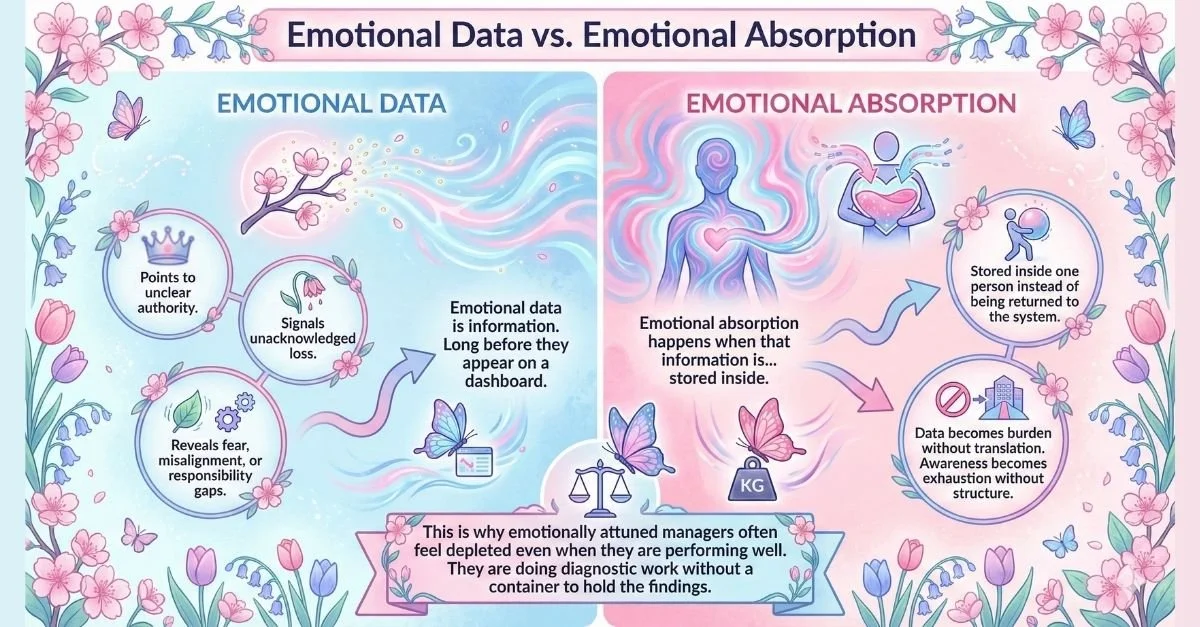
Emotional data is information. It points to unclear authority. It signals unacknowledged loss. It reveals fear, misalignment, or responsibility gaps long before they appear on a dashboard. Emotional absorption happens when that information is stored inside one person instead of being returned to the system that produced it.
Without translation, data becomes burden. Without structure, awareness becomes exhaustion. This is why emotionally attuned managers often feel depleted even when they are performing well. They are doing diagnostic work without a container to hold the findings.
What Lens Makes This Visible?
Leadership Cartography™ is a framework developed by Your Leadership Map™ that helps managers interpret behavior, feedback, and emotional patterns as system signals rather than personal failure. It prioritizes orientation before action, so leaders can respond clearly without absorbing what does not belong to them.
Through this lens, emotional attunement is system visibility. The question is not how to stop noticing. The question is where what you notice is meant to go.
Why Did the System Get Built This Way?
In the 1930s and 1940s, researchers studying American factory floors made a finding that changed how organizations thought about management. The Hawthorne Studies, conducted at Western Electric plants in Illinois, discovered that worker productivity increased when employees felt they were being paid attention to.
The response was not to improve conditions.
The response was to train managers to listen better.
The Human Relations Movement that followed embedded emotional absorption into the manager's role by design. Supervisors were trained to receive complaint, absorb discontent, and return workers to productive function. The goal was not resolution. The goal was containment. A well-trained manager could hold worker frustration long enough for it to dissipate before becoming collective action.
For decades, this function was invisible. It was not called emotional labor. It was called management skill.
When attuned leaders arrived in organizations that had inherited this structure, they were useful precisely because they could do what the design required. They noticed. They absorbed. They stabilized.
The word "sensitivity" arrived later to explain why some managers carried more than others. It personalized a structural function. It suggested the issue lived in the individual's capacity rather than in the organization's architecture.
When you feel the weight of your team before anyone names it, you are functioning as the system was designed. The question is whether the organization has built anything to receive what you collect, or whether it still relies on you to hold it alone.
What Changes When Structure Holds the Weight?
When teams are given a shared way to acknowledge what has changed, emotional information no longer has to travel privately.
It can be named. It can be held briefly. It can be integrated.
That shift alone reduces the need for any one person to carry it.
Grief at work is not limited to death. It surfaces when projects are canceled after months of effort, when trusted colleagues leave and take their steadiness with them, when the mission shifts without input, when capacity erodes and no one names it. These are real losses. And when they go unacknowledged, the weight concentrates in whoever is most willing to hold it.
The Ritual of Transitions™ was built for this terrain. It offers a three-part structure: acknowledgment, pause, and integration. The first step names what is happening without rushing to resolve it. The second creates space without forcing performance. The third asks the team what they want to keep, what they are ready to release, and what they want to honor.
None of these steps require anyone to process emotion publicly. They give the system a place for emotional reality to land so it does not live inside the manager's body.
If this pattern is showing up in your team, The Ritual of Transitions™ provides language for naming what is happening, a framework for reading how your team holds grief, and a structure that redistributes the weight. It is part of the Lead with Heart™ pathway.

How Do You Locate Yourself in This Terrain?
This pattern is present when:
You feel team stress before anyone names it
Others leave conversations relieved while you feel heavier
Emotional volatility shows up without clear ownership
Losses are minimized in the name of momentum
You are relied on to smooth things over without authority to resolve what caused it
These are signs of a system routing emotional load through you.
When emotional information is shared, named, and briefly held in common, it stops accumulating in one place. It becomes informative instead of exhausting.
That is structural relief. It operates at the level of design, not personal practice.
You can care deeply without becoming the place everything lands.
If you are noticing this weight, that awareness is already the beginning of something. The system you are operating inside has been routing emotional information through you, and you have been carrying it without a structure to share the load.
That can change. Not by caring less. By building something that holds more.