
Why Manager Delegation Fails: Trust and Clarity
Delegation breaks when the handoff doesn't transfer authority, context, or success criteria

The manager delegates work. The work comes back. Something is wrong, but the manager cannot articulate what. The team member asks, "What do you want?" The manager says, "Just use your judgment." The judgment does not match. The work gets redone. The pattern repeats.
Last week's Compass post examined why micromanaging emerges as a system response. This episode looks at what is actually missing in the delegation handoff that makes staying close feel necessary.
Delegation failure is rarely a capability problem. It is a handoff problem that surfaces when authority, context, or success criteria don't transfer with the task.
What This Post Covers
This post examines what actually transfers in a complete handoff versus an incomplete one, and why assigning work is not the same as transferring ownership. We look at the three elements that must move with every delegation, how to make implicit standards explicit, and where handoffs break down structurally.
This post covers:
What distinguishes task assignment from ownership transfer
The three elements every handoff requires (authority, context, criteria)
Why work comes back wrong when the structure is incomplete
How implicit standards create rework loops
Where handoff design breaks down in organizations
The Incomplete Handoff
The pattern shows up in recognizable ways. Work is delegated. It returns, and something feels off. The manager cannot explain what is wrong in concrete terms, only that it is not right. The team member executed the task but missed something essential. Both people feel frustrated. The manager takes the work back. The team waits for clearer direction next time.
The cost is measurable. Rework loops consume more time than doing the work correctly once. Teams develop dependence on manager judgment because they lack the structure to make decisions independently. Skills do not transfer because the problem is not capability, it is missing infrastructure in the handoff itself.
Most managers misread this as a readiness problem. They believe the person is not yet capable of handling the work independently. The actual signal is different. The handoff was structurally incomplete. Something essential did not transfer with the task.
When work comes back wrong after delegation, it stops being about capability.
It becomes evidence that something structural didn't transfer with the task.
What Doesn't Transfer
The question is not why delegation fails. The question is what is missing in the handoff that makes independent execution impossible.
Organizations promote technical experts into management roles without teaching handoff design. These new managers learned their jobs by doing them, which creates expertise but also generates implicit standards that live entirely in their heads. When they delegate, the instruction becomes "you do this task" instead of "here are the authority, context, and success criteria you need to own this work." Over time, teams learn to wait for manager judgment because the structure for making independent decisions was never built into the system.
Three elements go missing in failed handoffs, and each one creates a distinct breakdown pattern.
Authority transfer. Decision rights stay with the manager even after the task is assigned. The team member executes steps but escalates choices back upward because they were never granted the authority to decide. This creates bottleneck dependency, where progress stalls until the manager weighs in.
Context transfer. The task is clear, but the reasoning behind it is not. The person does not know why this work matters, who it affects, what constraints apply, or how it connects to larger goals. Without that context, they cannot make tradeoffs or adapt when conditions shift. They follow instructions literally, which produces technically correct work that misses the strategic intent.
Success criteria. The manager knows what good looks like but has not made it observable or transferable. Standards remain implicit. The team member completes the work using their own judgment of quality, which does not align with the manager's internal benchmark. The work comes back acceptable by one standard and insufficient by another, and neither person can name the gap clearly.
When any of these three elements is absent, delegation collapses into task assignment. The work moves, but ownership does not.

The Lens We're Using
Leadership Cartography is a framework developed by Your Leadership Map that helps leaders interpret feedback, behavior, and misalignment as system signals rather than personal failure. It helps people locate what is happening in the terrain so they can respond with clarity without erasing who they are.
The framework reframes what looks like failed delegation. Different pathway leaders struggle with different parts of the handoff. Precision leaders will not delegate authority until they are certain the person can execute perfectly, which delays transfer indefinitely. Support leaders delegate tasks but stay over-involved because they cannot distinguish between scaffolding and rescuing. Leadership Cartography helps managers locate which specific element of their handoff is incomplete, so they can address the structural gap instead of defaulting to tighter control.
If this pattern is showing up for you, the Delegation Script for Managerswas designed to help you structure the handoff conversation so authority, context, and success criteria actually transfer. It gives you the language to make implicit standards explicit and close the gaps that create rework loops. This tool supports the exact moment when you need to hand off work but don't know what to say.
Locating Where Your Handoff Breaks
Delegation breaks down in predictable places. The diagnostic question is not whether your team is capable. The diagnostic question is which structural element is missing from your handoff.
Notice if:
Work comes back but you cannot explain what is wrong in observable terms (success criteria missing)
Your team asks permission for decisions that fall within their stated scope (authority didn't transfer)
People execute tasks correctly but miss why the work matters or how it connects (context missing)
You say "just use your judgment" but their judgment consistently diverges from yours (implicit standards that were never made explicit)
Rework takes longer than doing the work yourself would have taken initially (structural handoff failure, not capability gap)
These are not signs that delegation is impossible with this person. They are signs that the handoff did not include the infrastructure needed for independent execution.
If You Only Remember One Thing
Delegation doesn't fail because people can't do the work. It fails because the handoff didn't include the structure needed for independent execution.
Closing
Last week's Compass post named micromanaging as a protective response that emerges when systems make distributed authority feel unsafe. This post examines what makes letting go structurally possible.
This matters most when you recognize the micromanaging pattern but do not know what to change. The answer is not to let go harder or trust more intensely. The answer is to build handoff structure that makes letting go safe. Complete handoffs transfer authority, context, and success criteria along with the task. That transfer is what creates the infrastructure trust depends on.
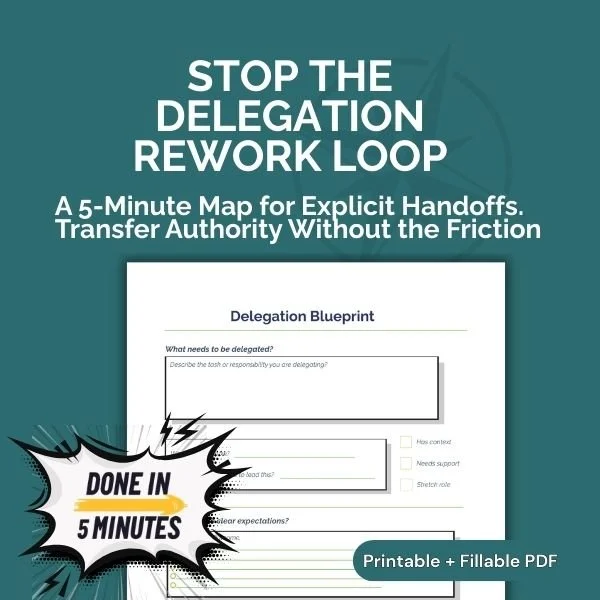
Get the Tool That Supports This Moment
If this pattern is showing up for you, the Delegation Script for Managers was designed to help you structure the handoff conversation so authority, context, and success criteria actually transfer. It gives you the language to make implicit standards explicit and close the gaps that create rework loops.
Not sure which pathway you're navigating? The Leadership Style Quiz helps you discover your leadership archetype and the terrain patterns that shape how you lead. Complete the quiz to receive Field Notes tailored to your map.