
The Vision Gap: Where Management Training Fails Purpose-Driven Leaders
The gap isn't your communication skills. It's the distance between where you are standing and where everyone else still is.

I spent years building a supply chain vision at a time when most people weren't thinking about supply chains at all. We were in the agricultural space, which meant the vision had to account for things that were slow, below the threshold of public attention, and not yet recognized as the crises they were becoming. Between 2012 and 2017, the U.S. lost nearly 80,000 farms — roughly 16,000 a year, according to the USDA Census of Agriculture. The American Farmland Trust put the land loss at 2,000 acres every single day, with projections showing more than 18 million acres gone by 2040, an area eight times the size of Yellowstone National Park. Soils were losing their ability to hold nutrients. Herbicide-tolerant corn and soybeans, grown primarily for animal feed and increasingly for seed oils, already covered more than 90 percent of U.S. acreage for those crops, according to the USDA Economic Research Service. Herbicide use, particularly glyphosate, had been rising steadily alongside that adoption, and off-target drift was documented damaging plant communities hundreds to thousands of feet from treated fields. The foundation the food system depended on was quietly eroding.
I could see the connections: between geography and supply, between today's sourcing decision and tomorrow's availability, between what we specified now and what would still be possible in a decade. I loved building a business case from historical pattern and future probability, the research hours, the interviews, the slow construction of a view that wasn't on anyone else's map. Every minute of it.
What I could not do was bring leadership along.
Getting alignment was difficult in a way I hadn't anticipated. The vision was sound. What filled the room instead was everything already present, already visible, already urgent. Competing realities were real. That is the thing about holding a big vision: everything that matters to people right now competes with it. You can be right about the future and still lose the room to the present.
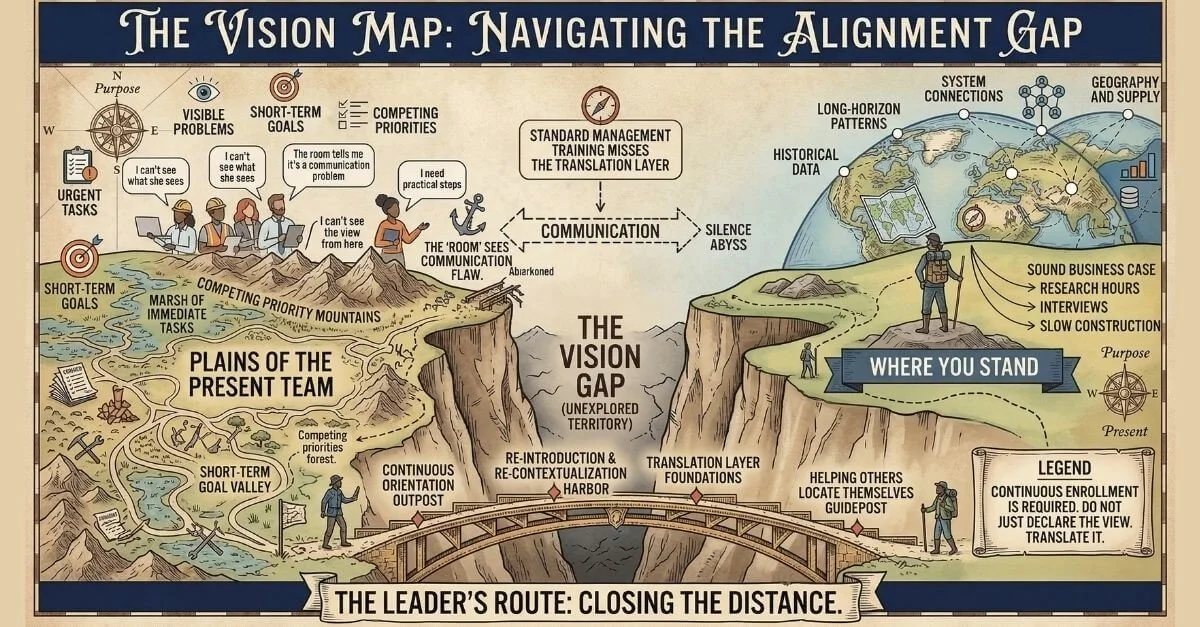
When a manager's vision fails to land, the common explanation is a communication problem: not specific enough, not practical enough, not broken down enough. What's actually present is a distance problem. The manager is standing on terrain the team hasn't reached yet, describing a view the team can't see from where they are standing. There is no standard playbook in management training for closing that distance. Vision communication gets treated as a one-time declaration when it is, at its core, continuous orientation work.
What Is the Vision Gap in Management?
There is a pattern that shows up in managers who carry a long or systemic vision: the picture they hold is clear and sound, and still it lands in silence. The team nods. The meeting ends. Things continue as before.
What the pattern reveals is not a communication failure. It reveals that standard management training never gave the visionary leader a translation playbook. Managers are taught to set goals, delegate tasks, run performance conversations, and deliver feedback. They are rarely taught that a long-range vision requires continuous enrollment, that it will need to be re-introduced, re-contextualized, and re-grounded every time the present reasserts itself. Which it always will. Vision communication is never one-and-done. The manager who discovers this tends to discover it alone.
What the pattern costs over time is enrollment confidence. The manager starts to wonder whether the vision is too big, too abstract, too early. They edit it down to something the room seems capable of holding. They build smaller. The original picture gets quieter. And the decision that required a longer view gets made with shorter sight.
Where Did the Vision Gap Come From?
The expectation that managers should communicate and enroll others in long-range vision is relatively recent. For most of the 20th century, vision at work moved through hierarchy. Senior leaders set the direction. Middle managers executed it. Direction traveled downward through mandate, policy, and chain of command. The manager's job was to translate the organization's vision into daily operations, not to originate it.
The shift came in the 1980s and 1990s, when the visionary leader became a dominant cultural model. Books on transformational leadership, the rise of the CEO as cultural figure, and the mythology of companies built on long-range ideas created an expectation that leaders at every level should carry and communicate a compelling vision. That expectation filtered into management development without the accompanying infrastructure. The translation playbook was never written. Middle managers inherited the expectation and were left to figure out the mechanics on their own.
What also didn't transfer down was recognition that building a business case for a long-horizon vision is real work: research hours, interview hours, the slow construction of a picture from historical pattern and future probability. That work is demanding and almost entirely invisible to the people who haven't been inside it. The manager who has done that work arrives at a meeting ready to share a direction they have been living with for months. The team encounters it fresh. That distance is real. Nothing in standard management development addresses it.
The Tool
If you're working with this pattern, The Vision Enrollment Guide is a two-part PDF framework built around the two problems this post names.
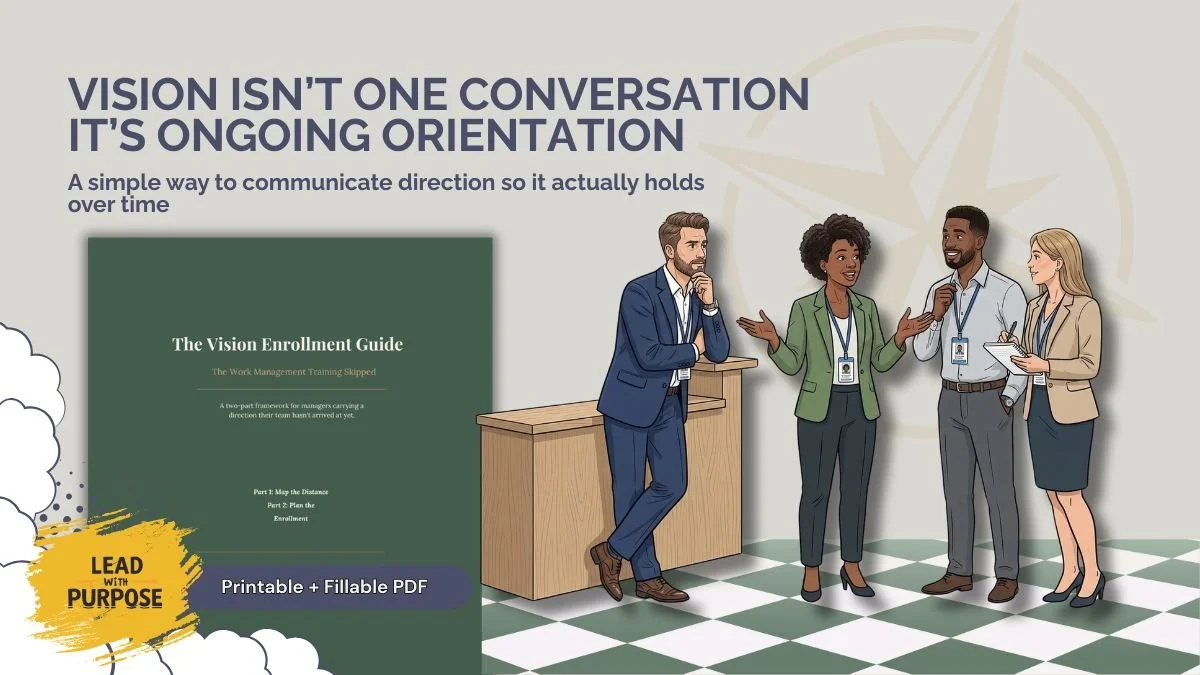
Part 1 helps you map the distance. It walks you through where you are standing, where your team is standing, and what kind of gap you're actually working with: a time horizon gap, a context gap, a competing pressure problem, or a trust gap. Most managers have never named the distance that precisely. Naming it changes what you do next.
Part 2 gives you the structure for the enrollment work itself. It includes a Vision Core section where you write the direction in plain language your team can hold, a Competing Realities section where you name what will pull the room back to the present every time you re-introduce it, and a Re-Grounding Rhythm section where you plan the repeated orientation work rather than leaving it to chance. The guide closes with a One Next Move prompt and a Mini-Map for any moment when the gap feels wide and you are not sure where to start.
[The Vision Enrollment Guide | The Work Management Training Skipped](ETSY LINK PLACEHOLDER)
How This Pattern Shows Up
This terrain doesn't feel the same for everyone who walks it.
If you lead with strong relational awareness, the enrollment gap tends to feel personal. When people you work closely with can't see what you're carrying, it can register as indifference to the relationship rather than unfamiliarity with the terrain.
If you lead primarily from vision and purpose, this pattern tends to be the most isolating. You are standing on terrain the team hasn't reached yet, and the view from there is clear. The gap isn't evidence that the vision is wrong. It's evidence that the bridge hasn't been built, and that building it is part of the work.
When a team can't see the vision, what looks like a communication problem is almost always a translation gap, and no one ever handed visionary managers the tools to close it.
What Leadership Cartography Names Here
Leadership Cartography treats vision as terrain, not as a declaration. A direction that exists only in the leader's internal clarity is not yet a map. It becomes a map when others can locate themselves on it, when the picture includes not just where things are going but also where people are starting from.
The Purpose pathway in Leadership Cartography is organized around exactly this terrain. The work of this pathway is rarely generating the vision. It is almost always the translation layer: the continuous re-grounding, the repeated orientation, the patient work of bringing others from where they are to where the vision requires them to stand. That work was never in the job description. Which is why so many visionary managers figure it out by carrying the vision alone until they either find a way through or quietly put it down.
This is also worth saying plainly: visionary leaders aren't making the work harder. They are the ones keeping the organization from depleting what it depends on. Every supply chain that still has something to source, every team that still has capacity to give, every institution that hasn't burned through its own foundation. Somewhere in that history is a leader who held a longer picture and found a way to get others to stand in it long enough to see what they saw. Without that, all an organization ever does is use, take, and extract until there is nothing left to draw from. The translation work was never optional. It was the work.
The question worth sitting with isn't whether others can see what you see. The question is what it would take for them to stand where you are standing, even briefly, and see the same view.
When a team can't see the vision, what looks like a communication problem is almost always a translation gap, and no one ever handed visionary managers the tools to close it.
Related Reading
Manager Hours vs. Maker Hours: Why You Can't Think Clearly Anymore — If you lead from vision and purpose, the rhythm mismatch between deep thinking and coordination work is part of why the enrollment gap stays open.
Why Manager Delegation Fails: Trust and Clarity — The same translation gap that shows up in handoffs shows up in vision communication. Both are structural, not personal.
Manager Overwhelm: Why Busywork Leads to Burnout — The competing realities this post names don't just compete with your vision. They compound over time. This post looks at where the load comes from.