
When Your Boss Is the Bottleneck: Why Managing Up Feels Impossible
What the system is doing when decisions stall above you

Have you ever been so stalled out by your boss that you began to question if this is the right place to work? I did.
We were pushing four major initiatives through the company at the same time. I was assigned to generate a system that would result in a playbook for operators, a lofty project that required significant observation in the field and careful mapping of the connections between what people actually did versus what policy told them to do. I had built the full system. I knew where every component connected, where the inputs and outputs lived, and where I still needed to research further before we could finalize the flow.
What I could not do was get the coordinator overseeing all four initiatives on the phone. His job was to connect with each of us regularly, ensure alignment with the mission, offer coaching if things stalled. I called. I left messages. I scheduled meetings and showed up for them. We never connected, no matter how hard I tried.
I had no moves. I did not have the authority to proceed without his input, and I did not have the power to compel his engagement. The project sat. And I sat with the belief that was easier to carry than the structural reality: that I must not be important enough to call back.
That belief stayed with me right up until I finally sat across from him and listened to him coach me about my attitude. He had never read my project. He never asked about the system I had built, where it was headed, or what I needed to move it forward. He coached my attitude. That was the whole conversation.
When a boss becomes a bottleneck, the most common working theory is that the manager isn't communicating clearly enough, hasn't built sufficient trust, or hasn't found the right way to frame the ask. This interpretation locates the problem in the approach. The more accurate location is structural. Organizations routinely position people as coordinators, coaches, and approvers without building any accountability for engagement into those roles. The manager below is left with full responsibility for the work and no authorized path forward when the person above stops showing up. The friction is real. The source of it is not the approach.
The following traces the structural dynamic that produces this pattern, what it costs the manager caught inside it, and how to read the terrain when the bottleneck above you has a different agenda entirely.
What Is the Bottleneck Pattern in Management?
The pattern has a specific shape. The authority to proceed sits above the manager. The accountability for outcomes sits with the manager. The person holding the authority is unreachable, disengaged, or operating on a different set of priorities entirely. And the manager, who has built the work and is ready to move, has no authorized alternative.
This is what it means to have no moves. It is not a communication failure. It is an absence of infrastructure. There is no documented threshold at which the manager can proceed without sign-off. There is no proxy. There is no sanctioned route around the blocked node. The only move available is to keep trying to reach someone who is not picking up.
The cost accumulates before it becomes visible. It is not only the stalled project. It is the credibility erosion with the team watching the work sit. It is the invisible labor of managing expectations in both directions while nothing moves. And it is the belief that fills the gap when the organization provides no structural explanation: that the silence means something about your worth, your importance, your standing in the room.
That belief is the most expensive part. Because it is wrong, and it is very hard to correct.
Why Does Decision-Making Stall in Organizations?
The bottleneck is not a personality trait. It is a product of specific organizational structures, and understanding those structures is what changes how you read the situation.
Gatekeeping without reciprocal accountability: Coordinator and coaching roles carry the authority to approve and align but rarely any matching obligation to be available.
Agenda misalignment with no surfacing mechanism: When the person above has a different investment in the project, there is typically no organizational mechanism to surface that before the work stops moving.
Asymmetric accountability: Managers are evaluated on outcomes that depend on inputs they cannot control when the approval chain is blocked.
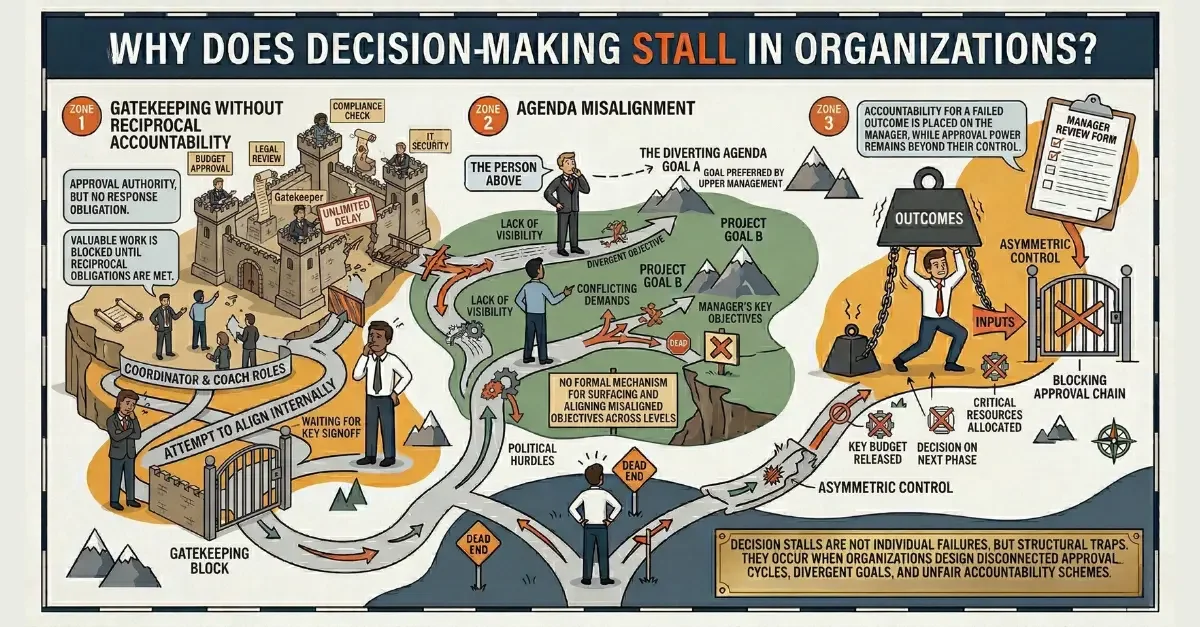
Taken together, these three structures produce a manager with nowhere to go. The friction is not about what is or is not happening in the relationship. It is about what the organization designed, or left undesigned, around the act of coordination.
Where Did This Approval Structure Come From?
The concentration of coordination authority at senior organizational levels has a specific origin. It did not emerge from a philosophy of leadership. It emerged from the factory floor.
Frederick Winslow Taylor's Principles of Scientific Management, published in 1911, formalized a distinction that would shape organizational design for more than a century: thinking belongs to management, doing belongs to workers. Taylor's time-motion studies produced a model in which efficiency required separating the people who analyzed and decided from the people who executed. The premise was that the person closest to the work was not positioned to make sound decisions about it. The manager thinks. The worker does. The worker needs the manager's input before moving.
That premise traveled upward over time. As organizations grew more complex and layers accumulated, the logic applied not only to workers but to frontline and middle managers as well. Senior leadership held the thinking. Everyone below held the doing. The coordinator role, the coach, the approver became the organizational mechanism by which the right level of thinking was supposed to be confirmed before action was taken. According to historian Alfred Chandler, whose Pulitzer Prize-winning work The Visible Hand: The Managerial Revolution in American Business (1977) documented the rise of modern corporate structure, the multi-layered hierarchical firm became the dominant organizational form by mid-century because it gave senior leaders coordinated control over decisions at scale. What Chandler documented as an efficiency structure became, over time, an inertia structure.
The manager navigating a bottleneck today is operating inside an approval architecture designed for a different era, one where decisions moved slowly by necessity, roles were clear, and the person in the coordinator seat was expected to stay in it. That architecture did not account for what happens when the coordinator stops showing up, has a different agenda, or was never actually invested in the project they were assigned to oversee.
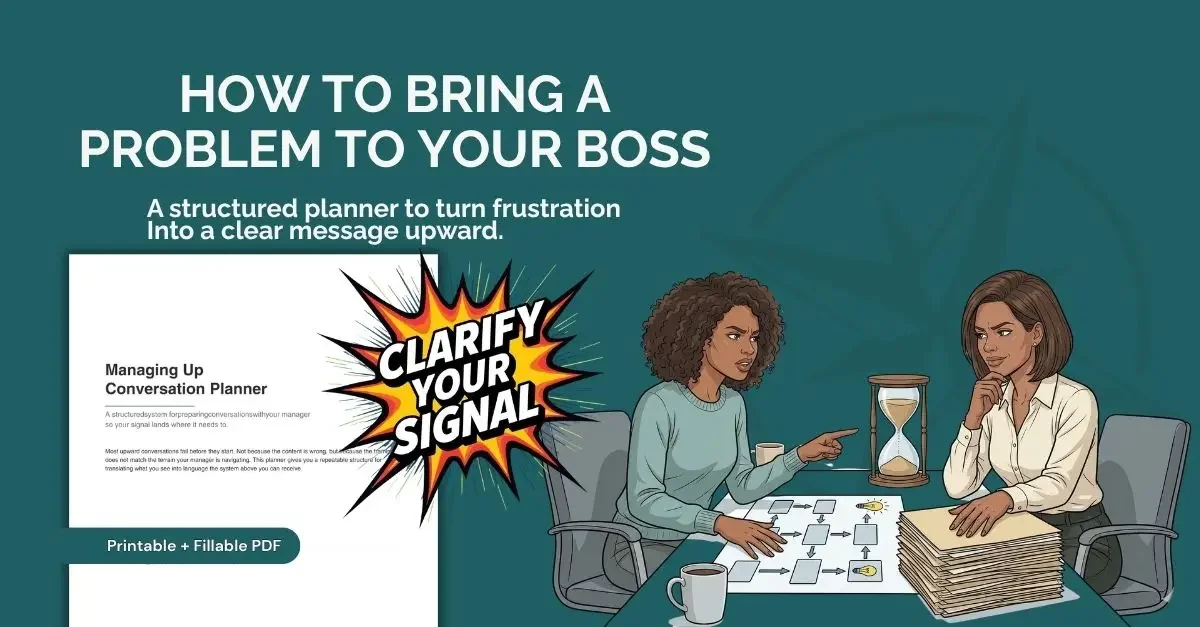
If you have recognized yourself in this pattern and you are ready to try again, the conversation still has to happen. The Managing Up Conversation Planner for Managers is a fillable PDF that helps you organize what you are carrying before you walk into the room, so the signal you see becomes something the person above you can actually receive.
Managing Up Conversation Planner for Managers
The Managing Up Conversation Planner for Managers helps you prepare clear, structured conversations with your boss when something important needs to be raised. Upward conversations can feel risky. You may see a problem, a bottleneck, or a signal leadership needs to understand, but the message does not always land the way you hope.
What this tool helps you do
Prepare important conversations with your manager so your message lands clearly.
Translate operational signals into language leadership understands.
Walk into upward conversations steady, structured, and confident.
This pattern tends to show up differently depending on how you are wired. If your instinct is to keep trying, to find the better framing, the earlier time slot, the shorter summary, you may have spent significant energy in motion that the structure above you was never going to reward. The effort was real. The ceiling was not about the effort.
If your instinct is to internalize the silence, you may have arrived at the same belief I did: that you were not important enough. That is the most common misread inside this pattern, and it is the one worth sitting with most carefully. The silence above you is data about the structure and the person in it. It is not data about your work or the value you bring to it.
When the person above you stops showing up, the question worth asking is not how to reach them better, but whether the role they occupy was ever designed to support what you are trying to build.
Managing up is one of the most misunderstood dynamics in organizational life, because it is almost always framed as a skill. Get better at it. Read the room. Find the right approach. That framing assumes the person above you is a neutral variable, someone who will engage if you communicate well enough. It does not account for agenda misalignment, for gatekeeping without accountability, for the coordinator who was never actually invested in your project and proved it by coaching your attitude instead of reading your work.
Leadership Cartography was built around this kind of misread, the moment when a manager absorbs a structural or relational failure as a personal verdict. The five pathways in the system describe different ways managers navigate organizational terrain, and the managing up pattern surfaces across all of them, often as one of the most quietly damaging dynamics a career encounters.
At some point, the cost stops equaling the benefit. That is not a failure. That is a checkpoint. If the person above you has a different agenda, is not engaged in your success, and has shown you that clearly enough times, the question is no longer how to manage up more effectively. The question is whether you want to keep paying the price of trying. Staying in a role where you are minimized or blocked from what you are capable of, because of someone else's bias or disinterest, is itself a decision. This post will not make that decision for you. But it can offer you the language to stop calling it a you problem.
Related Reading
How Managers Absorb Team Stress — The bottleneck above you and the pressure from below land in the same place: the manager in the middle who has to hold both.
Why Manager Delegation Fails: Trust and Clarity — When authority flows in only one direction, the conditions for delegation never fully form.
The Vision Gap: Where Management Training Fails Purpose-Driven Leaders — Management training rarely addresses what happens when the layer above you is not aligned with the work you are trying to move forward.