
How Do I Stop Disappearing Into My Work
How absorption quietly disconnects you from the work that matters most

You stopped asking how people were doing. Not intentionally. You just ran out of room for it.
Your days filled up with the work that kept coming back to you, the tasks that were easier to finish than to explain again, the decisions that needed to be made before someone else made them badly. You became very good at getting things done. And somewhere in that, you stopped being the person your team came to because they felt seen. You became the person they came to because you would just handle it.
This is how Support leaders lose the thread. Not through burnout. Not through poor boundaries. Through absorption. The doing takes over and the relating quietly disappears, and by the time you notice, the mission that once felt personal has become a list of things to get through before Friday.
The work did not change you. The system did. And the system will keep doing it until something interrupts the loop.
What follows names how that loop forms, what it costs the leader and the team, and how a follow-through structure gives care somewhere to land other than on your own desk.
The Pattern Under the Problem
When Doing Becomes a Distance
It starts as helpfulness. Someone needs something and you provide it. Someone gets stuck and you unstick them. Someone misses a deadline and you cover the gap. Each individual act makes sense. The pattern underneath it does not.
Over time, your calendar fills with problems. Your inbox fills with questions. Your attention fills with tasks that belong to other people. And the thing that made you good at this work — your ability to stay close to people, to notice when someone is struggling, to hold the thread of a relationship across weeks and months — that thing starts to atrophy.
You are not less caring. You are less present. There is a difference.
The emotional cost is not dramatic. It is quiet and cumulative. You finish the week having done a great deal and connected with almost no one. You know what everyone is working on and almost nothing about how they are actually doing. You have become efficient in a way that feels hollow, and you are not sure when that happened.
When a Support leader stops being relational, the team notices before the leader does. People stop bringing them the real things. They bring them tasks instead, because tasks are what get handled. The relationship that once made the team feel safe starts to feel transactional. And the leader, already buried in doing, does not have enough surface area left to notice the shift.

What the System Is Doing
1. The System Rewards Immediate Resolution
When work comes back to a manager and the manager finishes it, the immediate problem disappears. The deadline is met. The gap is closed. The system registers this as success. What the system does not register is what just happened to ownership, capability, or the relationship between the manager and the person who was supposed to carry the work.
Immediate resolution is visible. Capability building is slow and invisible. When a system does not measure whether people are growing, it will always optimize for getting things done, and the person most likely to carry that optimization is the one who cares most about the outcome.
2. The System Has No Structure for Verifying Who Is Carrying What
When delegation happens without a weekly rhythm that tracks follow-through, ownership becomes theoretical. The manager hands something off. The person receives it. And then nothing checks back in to see whether the transfer actually held.
Without that structure, responsibility drifts back to whoever is most likely to catch it. For Support leaders, that is almost always them. Not because they lack boundaries, but because the system has never built a container that holds someone else accountable for carrying the work.
3. The System Confuses Availability With Leadership
Support leaders are often evaluated, formally or informally, on how available they are. How quickly they respond. How reliably they show up when someone needs something. This is not wrong, but it creates a condition where being present and being productive become the same thing in the leader's mind.
When availability becomes the primary measure of value, a Support leader will fill every available hour with doing. Because doing feels like being there. And being there feels like the job. The relational work, the development conversations, the quiet check-ins that have no immediate output, those start to feel like luxuries. They are not. They are the job. The system just does not measure them.
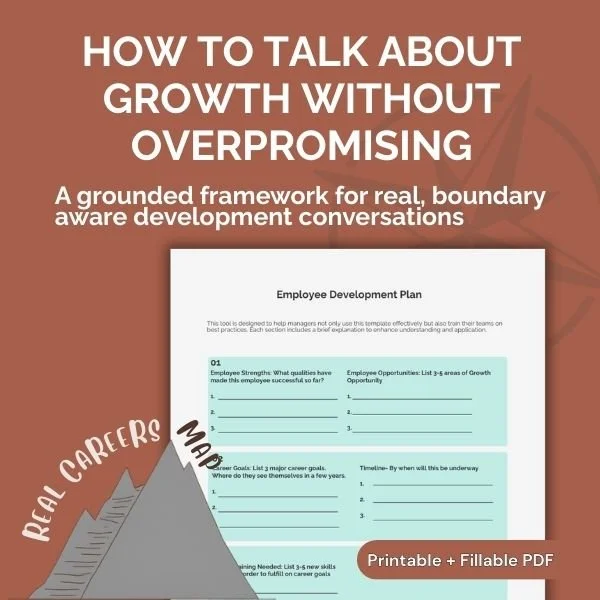
Employee Development Plan | Realistic, Boundaried Growth Conversation Framework
If this pattern is showing up, the Employee Development Plan was built for this moment. It gives you a structure for holding development conversations that keep ownership with the person, not with you. It tracks progress across time so you are not relying on your memory or your inbox to know whether someone is carrying what you handed them.
This is not a performance management tool. It is a relational one. It gives you a place to be a Support leader again, in conversation, with a person, about their growth. Not a task manager finishing work that came back to you.
If This Is Your Terrain
If this is the terrain you are standing in, a few things are probably true.
Your calendar is full and your relationships feel thin. You know what everyone is working on. You are less certain how they are actually doing. You are finishing things that were handed off weeks ago and telling yourself it is faster to just do it than to explain it again.
You may have noticed that people bring you tasks more than they bring you real conversations. You may have started to wonder whether you are managing or just executing. You may feel competent and disconnected at the same time, and not have language for why that feels wrong.
This is not a character flaw. This is a system that has no structure for verifying ownership, no rhythm for development conversations, and no way of measuring the relational work that is actually holding your team together. You have been doing that work yourself, invisibly, and the system has been slowly replacing it with tasks.
The question is not whether you care enough to change this. The question is whether the system you are working inside of has a structure that makes it possible.
The Reframe
Support leaders do not lose themselves by caring too much. They lose themselves when the system gives care nowhere to go except back onto their own desk.
If I Leave You With One Thing
If any of this landed, the Employee Development Plan is where to start. Not because it fixes the system, but because it gives you one structured place to be relational again. One conversation, one person, one rhythm that returns ownership to where it belongs.
That is not a small thing. For a Support leader who has been absorbed in doing, it is the first step back toward the work that actually matters.
Continue Your Leadership Journey

If you have been absorbed in the doing long enough that the relational part of your leadership feels distant, it helps to know where you are standing before you decide what to change. The Leadership Cartography quiz was designed to help you locate your natural navigation style so the path back to yourself is shorter.