
What happens when shame starts narrating the signal before you have fully returned to the larger terrain.

A little over a year into building Your Leadership Map, I created an assessment to help managers locate the way they tend to lead under pressure.
It was not built as a clinical instrument. It was built from twenty-three years of watching managers move through real work: the ones who cared deeply but lost the numbers, the ones who read the numbers but ran over people, the ones who held the system together until everything depended on them, the ones who waited too long for agreement, and the ones whose vision outran the people carrying the present.
For a while, the assessment lived where most early work lives. It sat on the website. It moved through Pinterest. It gathered responses. It helped people find their way into the larger body of work.
As it sold on Etsy, it became one of the clearest signals that people were willing to pay for this kind of reflection.
But the value of it did not fully land for me until a team leader bought it for her team and used it to think through how to develop them.
I charged her around eighty-five dollars for the whole thing, which now seems kind of low. At the time, I still did not fully understand what I had created.
Then it reached someone inside a highly respected institution.
That’s when something in me changed.
At first, it felt like momentum. The assessment had moved from a small public experiment into something more serious. What began as a tool I thought might be useful had started to gather evidence. People were finding it. People were paying for it. Someone had used it with a team. Now it had reached a room where leadership development, budget, authority, and institutional credibility were part of the conversation.
That is when everything came into question. Not the assessment on its own. Everything.
I started asking whether I was the right person to have built it. I questioned whether twenty-three years of watching managers move through real work counted as a legitimate form of knowing. I questioned whether pattern recognition from the field had any right to stand near assessments with deeper academic roots, formal research language, and psychological validation behind them.
The thought beneath all of it was blunt: What have I been thinking? That is how shame entered. It didn’t tell me the work needed refinement. That would have been useful. It told me I had no business bringing the work into a room where it might be taken seriously.
The work still mattered on its own. But somewhere along the way, its reception had started carrying more than information. It had started carrying a question about me.
Was I legitimate? Did I know enough? Did my experience count? Did I have any right to bring this forward? So, by the time it reached someone inside an academic institution, shame already had all the material it needed. That is what shame did to me when the work got close to visibility. It narrowed the field. It pulled every signal into the same limiting view.
A slow Etsy day no longer felt like a slow Etsy day. It felt like evidence. A quiet week on the website no longer felt like ordinary fluctuation. It felt like confirmation. The lack of an immediate institutional yes no longer felt like the normal pace of a larger buyer. It felt like proof that the work had been seen and dismissed.
It did not simply ask whether the work needed to improve. It asked whether the person who made it had the right to keep going. This is the part I mill over pretty regularly because it is the part that is sneaky. The realization itself is not the end of the pattern.
There is a space after you see what happened where your body has not yet caught up. You can recognize that shame has started narrating the signal and still feel the pull to obey it. You can name the pattern and still want to check again, fix something, rewrite the offer, replay the conversation, explain yourself better, produce more, or disappear before the world has a chance to decide.
Awareness returns before the attachment releases. That is the middle space. It is the place where I can see that the assessment has become too loaded, but still feel that old urge to make every result answer the question of whether I am safe, legitimate, or allowed to keep building.
It is the place where the work is still valuable, but my nervous system has started treating its reception as the measure of my value. The difference shows up in what becomes possible next. The work can be refined. The offer can be clarified. The assessment can be strengthened. The buyer path can be improved. The language can get sharper.
But shame does not start there.
Shame does not begin by asking what the work needs next. It begins by asking whether I should have brought the work forward at all.
Managers know this space too. It can happen when one employee's development starts to feel like a reflection of the manager's ability to lead. When one project gets executive attention and stops being a project in a broader body of work and becomes proof of whether the manager belongs in the next room. When one metric does not move, one client goes quiet, one team resists a decision, or one presentation does not land the way it was meant to.
The work still matters. The signal still deserves attention. But the same thing starts happening to you that happened to me. You are no longer only reading the work. You are reading the threat of what the work might mean about you.
That is when the field narrows..
The employee is no longer one employee inside a larger team system. The project is no longer one project inside a larger portfolio. The metric is no longer one metric inside a larger body of evidence. Everything collapses around the outcome that feels most capable of revealing something you would rather not see. From the outside, this can look like containment or commitment. Inside, it feels like survival. The middle space is uncomfortable because nothing has fully resolved yet.
You can see that the outcome has become too loaded, but your body may still respond as if the stakes are as high as shame says they are. You may know the employee’s development is not the sole measure of your worth as a leader and still feel exposed every time the employee struggles. You may know one project is not the entire story of your capability and still feel the need to overwork every detail because the project is now visible to people with more authority. You may know one metric is only one measure and still check it constantly because the number has started carrying more emotional meaning than it should.
This is why the middle space cannot be reduced to mindset.
The pattern is already in motion. Attention has narrowed. The outcome has become overcharged. The old survival strategy is trying to help by regaining control.
That strategy may look responsible from the outside.
Prepare more.
Check again.
Rewrite the plan.
Send another follow-up.
Rehearse the conversation.
Review what went wrong.
Try to close every gap before anyone else can see it.
Some of those actions may be useful. That is what makes the pattern harder to catch. The behavior is not always wrong. The question is what is leading it. Is the next move coming from a clear read of the terrain? Or is it coming from shame’s attempt to prevent exposure?
That is the difference.
The way back does not begin with certainty. It begins with noticing what has happened to the field. When I am inside the pattern, the first sign is not always the thought. It is the narrowing. Everything starts to organize around one outcome. The work gets smaller. The future gets smaller. The number of possible routes gets smaller.
That is when I know I am no longer reading the signal clearly.
I am reading it through threat. The first recalibration is not to dismiss the signal. The signal may still matter. The employee may still need support. The project may still need attention. The metric may still require a closer look. The buyer may still need a follow-up. The second recalibration is to remove the verdict. This is information. This is not a verdict. This may tell me something about the work. It does not get to tell me whether I have the right to keep going.
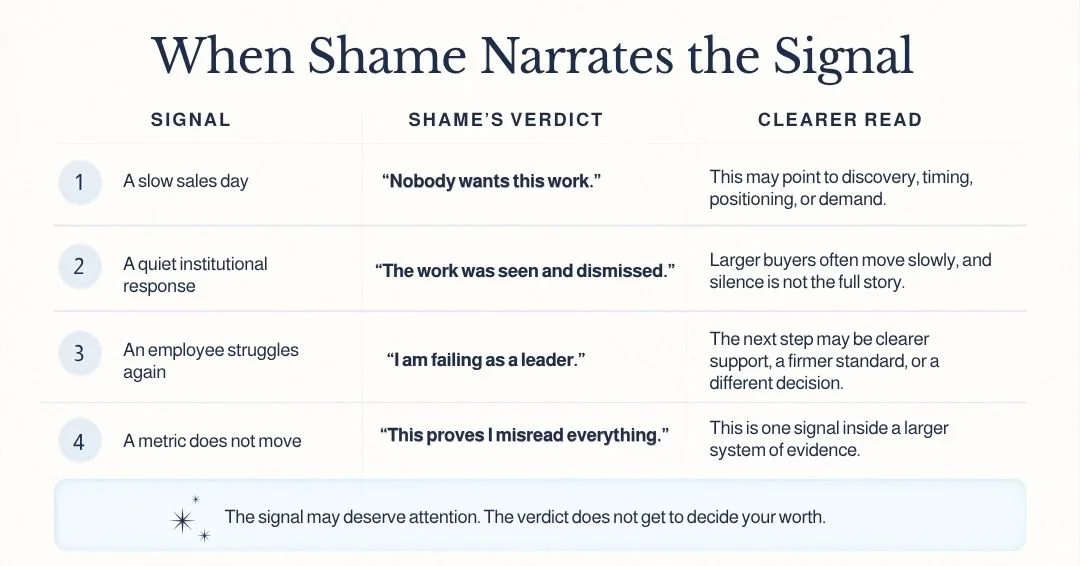
That is where the field starts to widen again.
Not all at once. Usually not dramatically. But enough to see one more route. Enough to remember one more piece of evidence. Enough to ask what the work needs next instead of what shame is trying to prove. For a manager, that may mean returning the employee to what is needed next. This is one person with a development need. This is not the final verdict on whether I can lead. It may mean seeing the project in proportion again. This is one visible body of work. This is not the entire story of my capability. It may mean seeing the metric for what it actually signals. This is one signal inside a larger system. This is not the only evidence that matters.
Recalibration is not pretending the outcome does not matter. It is refusing to let the outcome become the place where worth is decided. When the verdict is removed, the outcome becomes readable again.
That is the part I keep coming back to.
A signal can still matter without becoming the authority over everything else. A slow sales day can still tell me something about discovery, timing, positioning, or demand. A slow-moving institutional response can still tell me something about pace, budget cycles, buyer process, or the need for clearer follow-up. A low metric can still tell a manager something about capacity, conditions, clarity, or support.
But once the verdict is removed, the signal no longer has to answer for the whole future.
That is where attention begins to return. Not perfectly. Not permanently. But enough. Enough to remember that one result is not the whole map. Enough to see that silence is only part of the story. Enough to notice that one person’s development is not the final measure of a manager’s ability to lead.
When the field widens, the next move offers more freedom.
The question is no longer: What does this prove about me? The question becomes: What is this showing me about the terrain? That is a very different place to take the next step forward. It does not remove responsibility. It restores perspective.
From that place, I can look at the assessment and ask what actually needs strengthening. I can look at the offer and ask what needs to be clearer. I can look at the buyer path and ask where someone might need more context. I can look at the silence and remind myself that large rooms often move slowly.
You can do the same.
You can look at the employee and ask what support, clarity, standard, or decision is needed now. You can look at the project and ask what the visibility has changed, what the work requires, and what pressure has started to distort the path. You can look at the metric and ask what else belongs in the evidence.
The outcome remains important. It just stops being the thing everything else must prove.
I wish this all meant the pattern never returns. And yet, it does. The difference is that I can recognize it sooner now. I can feel when the field starts to narrow. I can hear when shame begins turning information into a verdict. I notice when my next move is being shaped by the fear of being exposed rather than by the work itself.
That does not make me instantly free. But it gives me a place to begin.
I can pause before I make the outcome larger than it is. I can ask what the signal is actually showing me. I can separate what needs attention from what shame is trying to prove. For a manager, that pause matters.
It can keep one employee from becoming the whole story of their leadership. It can keep one project from becoming the entire measure of their readiness. It can keep one metric from swallowing every other piece of evidence. It can keep the next move connected to the terrain instead of the threat. The space between seeing the pattern and being free of it is not failure.
It is where the pattern begins to loosen its grip. The outcome still matters, but it no longer gets to drive everything. I am still learning how to let the assessment be seen without asking its reception to decide my worth. That may be the real work now. To keep strengthening what needs to be strengthened. To keep clarifying what needs to be clarified. To keep listening to the signals without handing shame the microphone.
The work can grow. The system can mature. The buyer path can become clearer. The evidence can deepen. But none of that requires me to disappear from what I have made.
The assessment was built from what I have seen, carried, studied, noticed, and lived inside real management systems. It is allowed to keep becoming.
And so am I.