
Why a team that collaborates on everything can still decide nothing

There is a kind of team that looks healthy from the outside. Everyone gets heard. No one steamrolls anyone. Meetings are full of input, and the manager leaves each one feeling like the group is close to something. Then the next meeting opens the same decision again. And the one after that. The conversation is alive but, the decision is not moving.
This is a condition a lot of collaborative managers are living inside. The team agrees the topic matters. The team shares perspective generously. What never comes is the point where the decision ends and the work begins. Weeks pass and the same item sits open, gathering more input and less momentum.
When a team collaborates on everything and decides nothing, the common read is that you need to facilitate better, or that the team needs to be more decisive. The structural truth is simpler. Most collaborative teams have a clear process for gathering input and no rule for who closes the decision.
Why does a collaborative team struggle to make decisions?
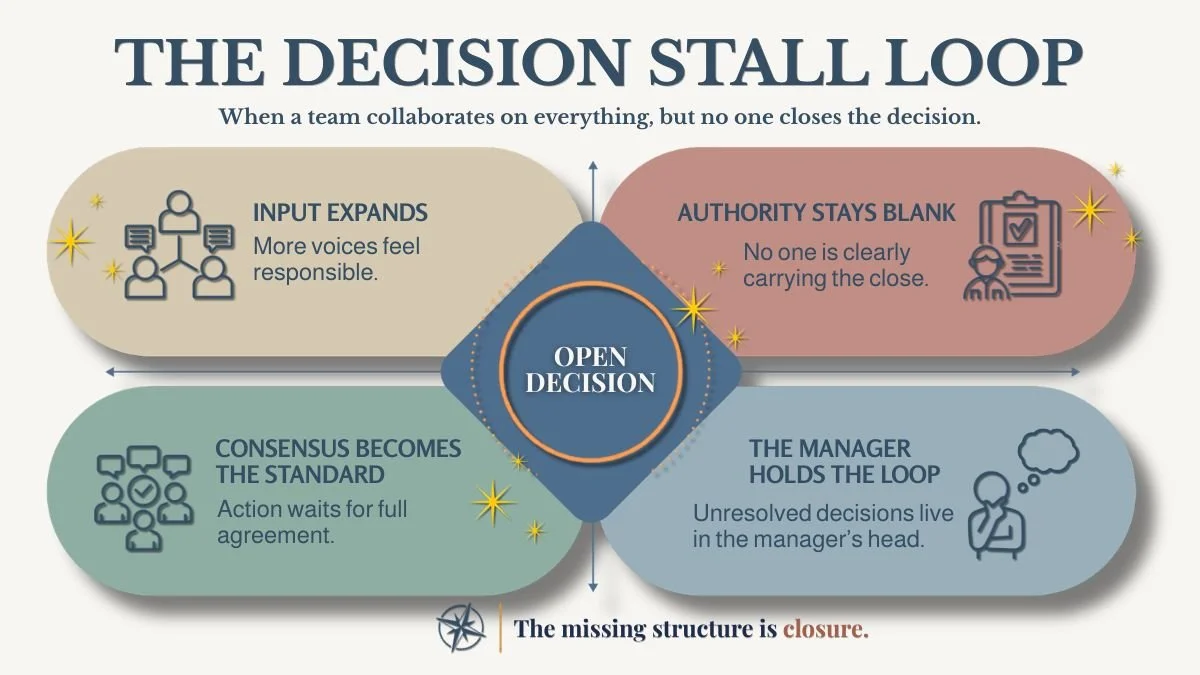
The pattern under the problem is a decision with input rights fully defined and decision rights left blank.
In a collaborative team, a leader builds a strong habit of widening the circle. More voices feels like more fairness and more buy-in, so the reflex is to keep gathering before closing. The trouble is that gathering input has a natural beginning and no natural end. There is always one more person who has not weighed in, one more angle worth a look, one more week to let it settle. When you value collaboration, it tends to read closing the decision as overriding the group, so the close keeps getting deferred in the name of doing right by everyone.
What this takes from you builds up over time. Every open decision lives somewhere, and in a team without a closing rule, it lives in your head. The list of unresolved items grows. You become the place every unfinished decision is stored. Momentum drains out of the team, and you carry the cost of that as personal stress, while still believing the inclusive approach is the responsible one.
The deeper barrier surfaces at this belief. The team is stuck because collaboration was built completely and closure was never built at all.
What is the system doing that keeps decisions open?
The organizational layer produces this condition in a few specific ways.
Most collaborative structures define how input gets gathered and never defines who holds the decision. According to Bain & Company, in a survey of more than 350 global organizations, only about 15 percent practice effective decision making. The capacity to discuss is widespread. The capacity to close is rare, and the rarity is structural.
Meeting culture rewards discussion over closure. Bain & Company research finds that two-thirds of meetings end before participants make the important decision on the table, and 85 percent of executives are dissatisfied with how effective their meetings are. A meeting that produces rich conversation and no decision still registers as a good meeting in most organizations, so the behavior that keeps loops open gets reinforced week after week.
Consensus gets treated as the fairness standard. When agreement becomes the requirement for action, closing a decision before everyone signs on reads as a violation of the team's values. When you close anyway, it risks looking like the person who abandoned the collaborative promise, so the safer move inside the culture is to wait, and waiting is what keeps the decision open.
There is no infrastructure in most teams that separates input rights from decision rights. When everyone with a perspective is treated as someone whose agreement is required, the number of people who can stall a decision equals the number of people in the room.
Where did decision-by-committee come from?
The collaborative org chart most managers work inside is an inheritance from a structure built to solve a different problem.
In the 1950s and 1960s, the United States aerospace industry faced projects too complex for any single department to run. NASA's programs and large defense contracts needed engineering, manufacturing, finance, and project leadership working the same problem at the same time. The answer was the matrix organization, a structure in which people report to two managers at once, a functional manager and a project manager, so authority is shared across the disciplines a complex project requires. Stanley Davis and Paul Lawrence formalized the model in their 1977 book Matrix and in a 1978 Harvard Business Review study that documented both its advantages and its characteristic failures.
The matrix solved a real problem by distributing authority. Distributing authority also removed the single point where a decision ends. When two managers share a decision by design, the design itself slows the close, because balance of power and speed of closure pull against each other. Davis and Lawrence documented this directly. The structure built to share power produced decisions that diffused until no one clearly owned the end of them.
What spread from that origin into general management culture was the collaborative half of the inheritance and not the discipline that was supposed to come with it. Organizations adopted shared input as a value. The matrix's hard-won lesson, that shared authority needs an explicit rule for who closes, did not travel with it. The modern team that collaborates on everything and decides nothing is running a 70-year-old structure with its input mechanism intact and its closing mechanism missing.
Related Tool
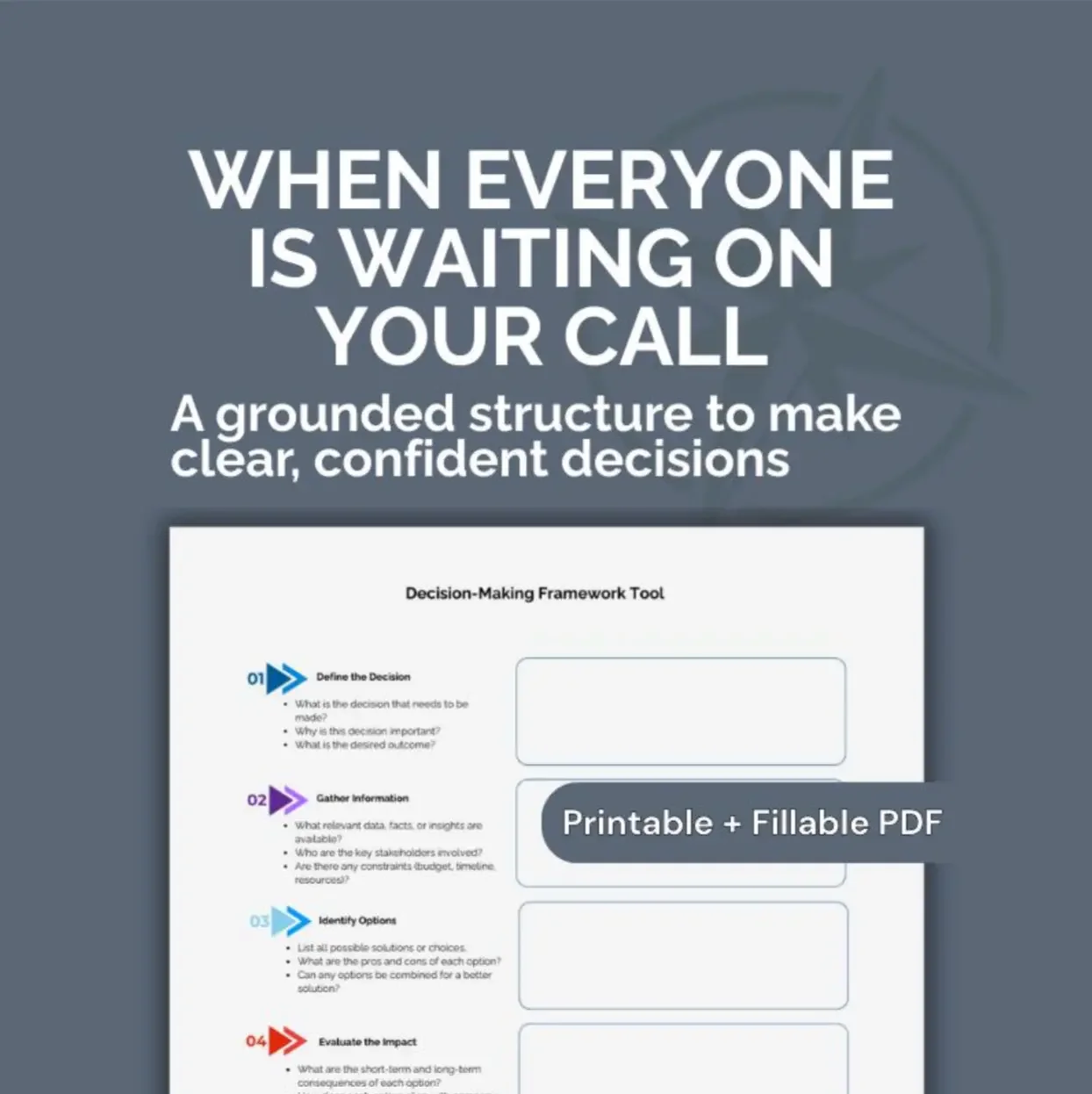
The Decision-Making Framework for Managers ($8.95) is built for this exact gap. It gives a team a structure for who decides and how, so input and authority stop being treated as the same thing. The framework walks a manager through separating the people whose perspective shapes a decision from the person who carries the close, and it sets a visible end point so a decision stops living in the manager's head.
How can a manager close decisions without losing collaboration?
The moves below keep the collaboration and add the part that was missing.
Locate the decision rule before the conversation opens. A decision tends to move when the group knows, going in, who carries the close. Deciding that first removes the question that otherwise hangs over the whole discussion.
Separate input from authority out loud. Collaboration holds when the group hears that their perspective shapes the decision and that one named person ends it. Saying both at the start keeps people from reading the eventual close as a surprise or a betrayal.
Set the closing point as deliberately as the opening one. A decision that has a time it begins and no time it ends will stay open. The conversation tends to land when there is a stated moment where input closes and the call gets made.
Close where everyone can see it. A decision shuts cleanly when the manager states the call, the owner, and the next step in front of the group. The visible close is what shifts the loop from open to done, and it is the move collaborative managers skip most often.
A team that collaborates on everything and decides nothing has built a complete process for gathering input and skipped the one for ending the conversation.
Leadership Cartography reads patterns like this one as terrain you are standing in. The strength of the Together pathway is real. Those who lead this way build trust, distribute ownership, and create teams where people actually want to contribute. The terrain risk that comes with that strength is closure, because the same instinct that keeps the circle open is the one that struggles to end the conversation.
The collaboration is the asset. What it needs alongside it is a rule for who ends the decision, so the team's input has somewhere to land. A manager who adds that one rule keeps everything that makes the team strong and loses the stall.
If your team talks through everything and finishes almost none of it, the question worth sitting with is whether anyone in the room knows who is allowed to say the conversation is over.
Sources:
Related Reading
If this resonated, these go further:
If the stall in this post felt familiar, it's part of a pattern you can read, and the quiz below shows you which one is yours. Discover Your Pattern.