
The Structural Reason Managers Burn Out in Secret
What Happens When One Outcome Absorbs the Weight of Everything

A little over a year ago I started selling digital management tools on a popular site as a test. I wanted to see if proof of concept existed before building out an entire company and website around my idea.
Somewhere in that stretch, I stopped treating the store as a test and started treating it as a viable sales channel. I didn’t even realize my original goal had changed.
Every morning, I checked the sales stats first. I developed more tools to meet what I thought was demand. Each sale seemed to confirm that the company could work. Each slow period began to carry more weight than it should have. Then the sales slumped.
My focus narrowed almost immediately. I spent every extra moment trying to figure out the algorithm. I changed titles, keywords and descriptions. I watched numbers. I searched for the reason sales had slowed down. Nearly all of my energy went into a platform I could influence only at the edges.
A good sales day gave me a brief moment of relief. Then the pressure would start up again. A slow day seemed to confirm every fear I was already carrying: this will not work, these tools are not wanted, I have built the wrong thing.
Nobody around me knew the storefront had become the measure of whether the business deserved to exist. Its irregular sales had become the official verdict on the whole idea. My life had narrowed around a $7 transaction on a platform I did not control.
Managers carry versions of this pattern all the time.
A project begins as one responsibility among several. A direct report begins as one development need on the team. A client account begins as one relationship in a broader body of work. A metric begins as one measure of progress.
Leaders who describe exhaustion that doesn't quite make sense on paper are often carrying a version of this pattern. Whether it’s a project, a direct report, a client relationship, or a performance metric getting reclassified away from its original intent. What started as one channel among several becomes the proof of value, the argument for the promotion, the thing that has to land.
The project has to prove they are ready for more. The employee has to improve or the manager has failed. The client has to stay or the year is ruined. The numbers have to move or all of the work required to reach them comes into question. Notice how narrow this gets.
Once that happens, exhaustion becomes difficult for other people to understand. They see stress, intensity, or over investment. What they don’t see is one unstable result has been carrying the weight of an entire future.
How does one result start carrying too much weight?
The shift can happen without a single decision being made.
The project was already important. The client relationship already needed attention. The team metric already mattered. Then something changes around it. A promotion feels dependent on the outcome. Financial security begins to feel tied to it. A manager’s confidence in their own judgment begins rising and falling with whether this one thing succeeds.
The responsibility remains the same on paper but the meaning of it changes privately.
Once that happens, the manager begins reading every result through the same question: is this working, or is this proof that everything is falling apart?
Good news produces relief for a few hours. Bad news produces a verdict. Ordinary fluctuation becomes difficult to tolerate because the outcome is carrying more than the work itself. It is carrying the manager’s sense of capability, security, and future direction.
That is what happened to me with the store. A slow sales week could no longer be a slow sales week. It became evidence about the company, the idea, and whether I had any business continuing to build it.
Managers can end up in the same position with work no one else sees in the same way.
A direct report becomes the employee who has to turn around because the manager needs to prove they can develop people. A struggling project becomes the promotion case. A client relationship becomes the revenue number the entire quarter depends on. A team’s performance becomes the manager’s argument that they belong in the role.
The work gets heavier because the outcome is now responsible for answering a much larger question.
What makes this pattern so exhausting?
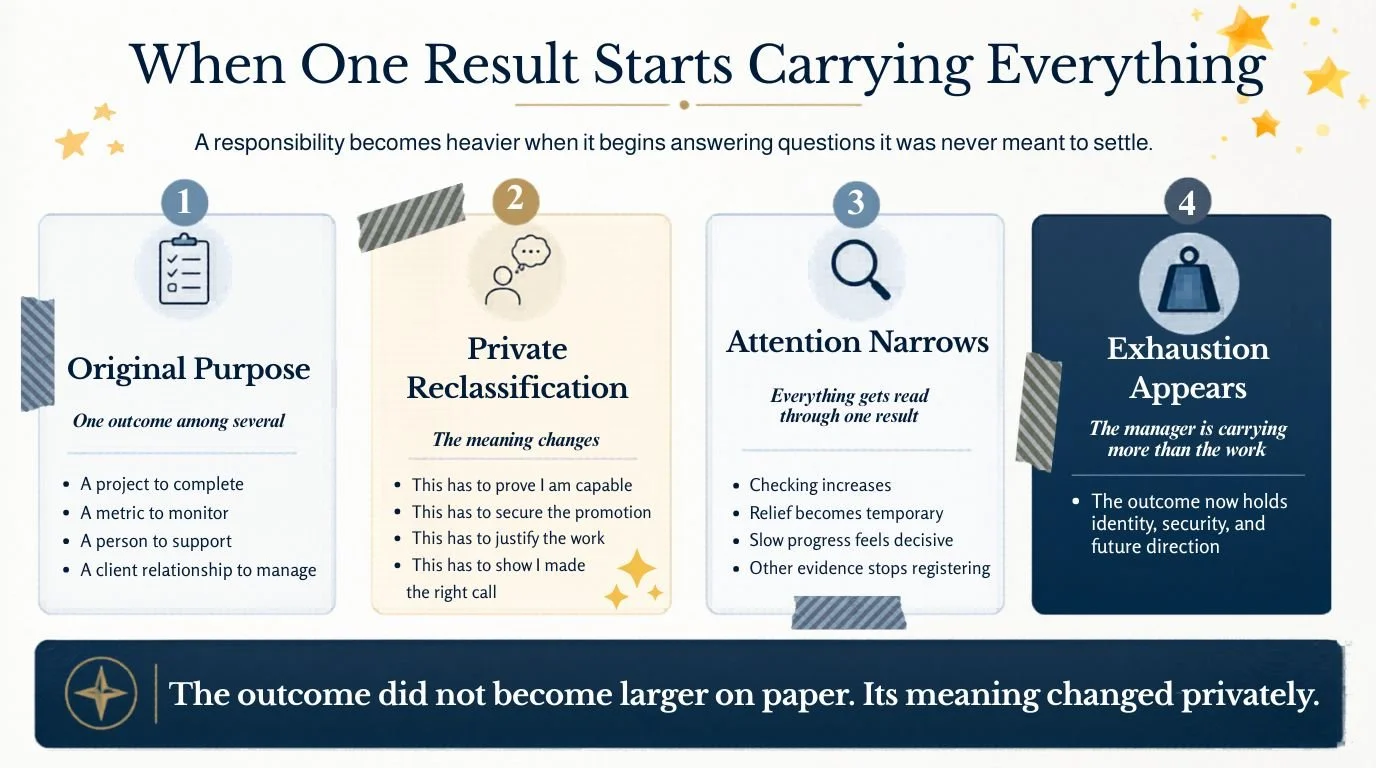
Private reclassification changes attention.
When one result begins carrying the weight of everything, the manager gives it more time, more thought, and more emotional space. They watch it more closely. They interfere more often. They have a harder time leaving it alone long enough to see what is happening clearly.
The result is a kind of professional tunnel vision. Other evidence loses force. Other routes receive less attention. Other measures of progress barely register because the manager is waiting for one outcome to settle the whole matter.
This is where exhaustion becomes hard to explain to other people.
The workload may not look impossible. The number of projects may not have increased. The manager may still be performing well. What has changed is the amount of meaning concentrated inside one unstable result.
The people around them often see someone who is deeply committed. They see focus, persistence, and high standards. They may even praise the manager for caring so much.
The manager experiences something harsher. They are carrying an outcome that can no longer simply succeed or fail on its own terms. It has become responsible for proving that their effort, judgment, or future still makes sense.
That kind of stress does not require a crisis to become draining. It only requires uncertainty and enough time.
Why can a workplace miss this completely?
Most workplaces track outcomes. They don’t track how much identity or security a manager has placed inside one of them.
A review can show whether a goal was met. A dashboard can show whether a metric moved. A status meeting can show whether a project is on schedule. None of those structures show when one result has become the private verdict on a manager’s value or future.
The pattern often remains invisible because it resembles commitment.
A manager who stays close to the work, checks every detail, thinks about the issue constantly, and keeps trying to improve the result can look exceptionally responsible. The organization receives the effort. It has little reason to question what that effort is costing until the manager’s capacity begins to break down.
The manager may not recognize it either. The additional checking feels justified because the outcome matters. The extra attention feels responsible because the stakes feel high. The narrowing happens slowly enough that it can be mistaken for discipline.
That is how one responsibility begins consuming far more of a manager’s interior life than anyone around them understands.
Why did work become so attached to measurable outcomes?
Modern management has spent decades treating individual outcomes as the clearest proof of performance.
In 1954, Peter Drucker introduced Management by Objectives in The Practice of Management. The model connected individual managerial objectives to organizational goals and measured performance by whether those objectives were met. The approach gave organizations a clearer way to assign responsibility and assess results. It also helped establish a lasting habit in management practice: locating accountability inside the individual manager and the outcomes assigned to them.
That logic is still familiar. Managers are evaluated through goals, targets, project delivery, retention numbers, revenue results, engagement scores, and performance outcomes. Those measures can tell an organization something useful. They rarely record the full set of conditions surrounding the result or the amount of personal weight a manager begins attaching to it.
W. Edwards Deming pushed directly against this form of management. In Out of the Crisis and his 14 Points for Management, he argued against numerical goals for management and against annual rating systems because they encouraged organizations to judge people through results without sufficient understanding of the system producing those results.His criticism was simple and severe: goals without knowledge of the working conditions can create fear, distortion, and misplaced judgment.
That history matters because managers still work inside structures that make results highly visible and the conditions surrounding those results much harder to record.
A target is easy to place in a review. A missed milestone is easy to discuss in a meeting. The moment a manager begins carrying one outcome as proof of their entire professional future has no standard place to be seen.
So the manager keeps carrying it.
Where might this be happening in your work?
Sometimes the pattern appears in a project you cannot stop checking, even after you have already done what the work requires. Sometimes it appears in a person whose performance has begun to feel like evidence in your ability to lead.
Sometimes it appears in a number that has gained the power to determine how you feel about your entire role.
Sometimes it appears in the thing you keep trying to repair because accepting uncertainty around it feels too dangerous. The outcome may deserve attention. The question is how much of your future it has been asked to carry.
For me, the storefront had stopped being a place where I tested whether people would buy digital management tools. It had become the place where I looked every morning for permission to believe the company could exist.
Once I could see that, the sales numbers changed meaning again. They were still information but, they no longer had the authority to answer every question I had about the business. My creativity became untethered once again and the stress to make a $7 sale disappeared.
One result can absorb the weight of an entire future when its meaning changes privately and no one recognizes that its original purpose has changed.
This pattern matters because it can sit inside capable, committed managers for a long time without looking like distress.
The manager keeps showing up. The work keeps moving. The attention they give the outcome can be rewarded as dedication, even while their sense of possibility grows smaller around it.
Somewhere in the life of the project, the employee, the client, or the metric, its role changed. It stopped being one result in a larger body of work and began carrying the answer to a question it could never fully settle.
Seeing that change does not immediately resolve the uncertainty. It does return the outcome to its proper size.
That may be enough to remember there was always more than one route forward.
Related Reading
If this resonated, these go further:
When one uncertain outcome begins carrying too much of your future, The Source Assessment shows where pressure and responsibility tend to collect in the way you lead. Take it below.