
5 Types of Burnout Managers Face Right Now
What the forums are saying, and what the pattern underneath it means

Across workplace forums right now, managers are asking the same questions in different words.
How do I protect recovery time when one message during PTO undoes it? How do I keep performance steady when I have no control over the conditions producing the strain? How do I catch burnout in a remote team before someone just stops showing up? How do I repair trust with a team that was already stretched before I got there?
The questions are descriptions of a condition. They are this specific because the pressure is this specific. And the pattern underneath all of them is the same: emotional labor that has no off switch, no structural accounting, and nowhere to go.
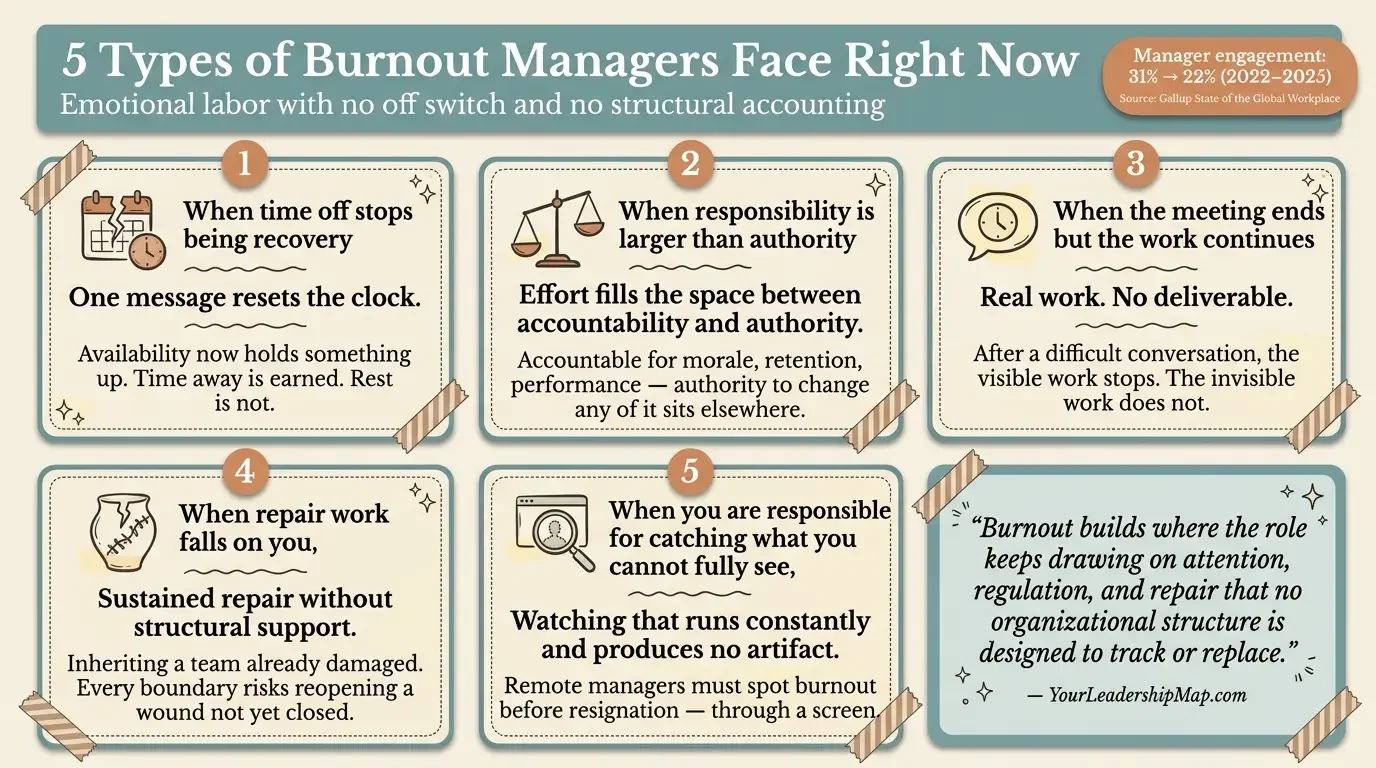
Manager burnout in 2026 is not primarily about hours. The Gallup State of the Global Workplace report found that manager engagement fell from 31% in 2022 to 22% in 2025, while manager stress remained higher than that of individual contributors. That gap is a pressure problem. The heaviest part of it has no infrastructure.
These five patterns show where it tends to collect.
When time off stops being recovery
The thread shows up in every forum variation. Someone took PTO. A message came in. They answered it because not answering felt riskier than answering. By the time they returned to the desk, they were not rested.
This pattern does not require a hostile culture to take hold. It requires only that availability is now holding something up, and that being unreachable creates more problems than it solves. When that condition is present, time off changes shape. The time away is earned. The rest doesn't seem to be. One message resets the clock.
The depletion continues through the break.
When responsibility is larger than authority
Managers are held accountable for morale, performance, retention, communication quality, and team behavior. The authority to change staffing levels, compensation, distribution of work, or executive decisions often sits somewhere else.
That gap produces a particular kind of exhaustion. When accountability exceeds authority, effort fills the space between them. Managers prepare more, check in more, absorb more, and try to keep the team steady through conditions they did not create and cannot fully change.
The forums name this as unfairness, and the description is accurate. The work may be hard. Hard work is expected. Being measured against conditions outside your control is a different kind of hard, and it compounds differently over time.
When the meeting ends but the work continues
After a difficult conversation, a performance concern, or a team conflict, the visible work stops. The invisible work does not.
What happened? Who seemed disengaged? Did the feedback land? Is there a follow-up coming, a resignation risk, a conversation that now needs to happen before the week is out? This processing is real work. It produces no deliverable and appears on no task list. It still draws from the same energy reserve that every other part of your job draws from.
This pattern is harder to carry for managers who read people well, because they catch the signals early: a shorter reply, a camera off, someone who used to raise issues and has gone quiet.
No organizational structure currently accounts for this as labor. It is treated as attentiveness, or judgment, or presence. Those words describe it. No one counts it.
When repair work falls on you
Some managers inherit a team that was already carrying damage from prior leadership. A high performer burned out. Trust eroded through a period of poor decisions. The work exceeded reasonable capacity for long enough that people stopped raising it.
The repair is real and it is possible. It also requires carrying the weight of conditions that were not yours to create. Every performance conversation has to be handled with extra care because someone has already been stretched past a reasonable limit. Every boundary the manager sets risks reopening a wound the team has not finished closing.
The care managers bring to this work is often genuine. The burnout comes from the sustained effort of trying to repair a broken experience through steadiness alone, without structural support, without backfill, and without anyone counting what that repair requires.
When you are responsible for catching what you cannot fully see
Remote and hybrid management added a specific pressure that the forums keep returning to: managers are expected to spot burnout before it becomes resignation, disengagement, or collapse, and they are doing that work through a screen.
The signals that used to be legible in a shared space have contracted. Shorter replies. Slower responses. Canceled one-on-ones. Less initiative. Someone who used to name problems and now only gives status updates. These are real signals. They are also incomplete ones.
Managers do not want to surveil. They also do not want to miss the moment when someone is close to done. So they watch communication patterns, response timing, participation, follow-through, and silence. That watching is its own form of labor. It runs constantly and produces no artifact.
The role asks managers to catch burnout early. It does not give them enough information, trust, staffing, or response time to do that consistently. And the pressure of trying still lands somewhere.
What these patterns have in common
These five patterns are expressions of the same condition: work that counts on managers to regulate, interpret, absorb, and repair keeps running past the end of the shift, and no organizational structure is designed to track what that costs.
When the depletion builds past a certain point, the symptoms look like personal failure. Shorter answers. Less context offered. A sharper tone that wasn't intended. Avoiding a conversation because there is not enough left to manage the reaction. Caring less because caring has become expensive.
That is the off-switch problem. The workday ends. The management does not.
Related tool: If this pattern is showing up in your own role, the Burnout Prevention Assessment for Managers looks at work volume, boundaries, emotional weight, recovery, role clarity, and support. Use it when you can feel depletion building but cannot yet tell which part of the role is driving it.
What this might mean for how you read your own role
If one of these patterns is familiar, Leadership Cartography offers a way to locate where the pressure is concentrating. The five pathways map different expressions of leadership, and they also map different vulnerabilities. Where the work keeps running after it should have stopped tends to match how a manager leads.
A manager who leads with Heart carries the emotional register of the team long past the end of the conversation. A manager who leads with Support stays responsible for conditions they cannot fully control. A manager who leads with Precision keeps tracking what is incomplete, off-rhythm, or unresolved.
The pattern is not a flaw. It is a terrain feature. Knowing where the pressure collects is the beginning of knowing what kind of recovery the role actually needs.
Burnout builds where your job keeps drawing on attention, regulation, and repair that no organizational structure is designed to track or replace.
Managers often keep going because people still need them. That is part of why this kind of burnout is hard to pin down. Performance can stay high. Care can stay real. The work still gets done. The cost builds inside all of that.
At some point, the question worth asking is where the role keeps asking for something that no one is counting, protecting, or replacing.
That is usually where burnout starts telling the truth.
Related Reading If this resonated, these go further:
Take the Source Assessment to discover your pattern and find your path back to operational clarity.