
Why Being The Steady One at Work is Draining You
There was a season in my COO role when I became the only steady person in the room
Being the calm one at work can feel exhausting because emotional steadiness is often treated as a personality trait instead of labor. Managers who absorb team stress, contain conflict, and stay composed under pressure are often carrying emotional weight the organization depends on but does not formally recognize. When that work stays invisible, the load builds until steadiness turns into burnout.

A serious organizational crisis had created a leadership vacuum almost overnight. Employees needed to be paid. Operational decisions needed to be made. I built a lean response plan to deal with it, brought in temps to cover what was a decimated finance team, and got to work alongside one contractor who had extensive finance capabilities and was willing to step in and support me.
The coaches wanted to sit with the grief of it, but their timing was catastrophic. Every morning, the remaining owners came to spill the tea and claim their innocence, state their case and then blame someone else. There were five of them. It was barely palatable.
I let them. I was steady for them. I held their feelings in one hand and the financial projections in the other and kept going. I didn't know what else to do.
What I could not see then was the mechanism I was already inside. My steadiness was the permission structure for their unsteadiness. The calmer I stayed, the more they could afford not to be. What I was actually holding was the space that made it possible for everyone else to fall apart justified or not.
And I must confess, they ate me for breakfast, every single morning.
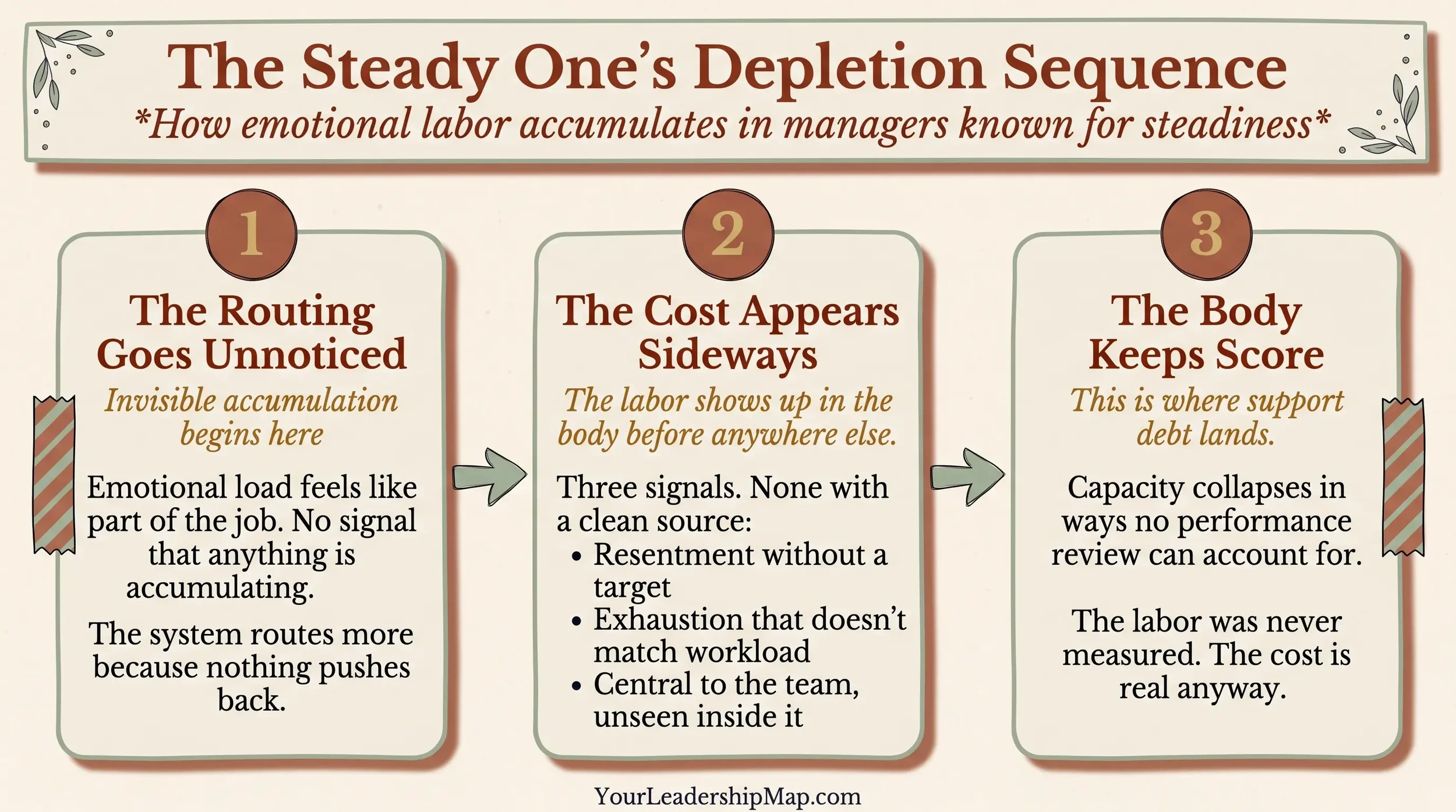
When a manager becomes known for emotional reliability, the system, the team, the employees respond by routing more emotional load in their direction. This is a structural consequence of how organizations handle what is difficult to measure. Emotional containment in management is treated as a character trait rather than as labor, which means it is expected without being resourced and extracted without being returned. Over time, steadiness without a structural return path produces depletion eventually leading to complete burnout.
Managers who carry the emotional climate of their teams are doing this kind of work. It rarely appears in job descriptions, almost never appears in performance reviews and it compounds.
Why Does Being Calm at Work Feel Like a Hidden Tax?
The manager who stays present during conflict, who fields team anxiety before it reaches escalation, who remains available when others withdraw, becomes the container where emotional weight fills to the top. The system routes more toward it, without any regard for capacity.
The manager's own emotional experience, the frustration, the uncertainty, the exhaustion that comes from doing the hard work, gets set aside to make room for what others can't seem to carry for themselves. The suppression is rarely conscious. It happens because the alternative feels like a breach of the role. A steady manager who shows the weight is suddenly less steady, and less steady reads as failure of function.
Sociologist Arlie Hochschild identified this dynamic way back in her 1983 work "The Managed Heart," which documented the management of feeling as a job requirement that produces specific long-term costs for the person performing it. Her research focused on flight attendants and bill collectors. The same mechanism runs through management, with almost no equivalent language in most organizations to account for it.
What this pattern takes, over time, is the manager's relationship to their own interior. What shows up in outward appearances vs. what they actually feel, stops lining up, and their own experience goes unattended to the point of where it stops registering.
What Is the Organization Producing That Makes This Pattern So Reliable?
The organizational structures that produce this pattern operate through a few consistent mechanisms.
1. Emotional volume gets routed toward the person most likely to contain it without incident.
Organizations measure for visible friction. A manager who de-escalates team conflict, fields personnel frustration, and contains complaint before it reaches formal escalation is producing measurable meaningful value.
Most organizations have no infrastructure for the emotional labor of management. The expectation to contain team anxiety, hold difficult conversations, and maintain emotional climate is a given. The manager with the most capacity and the least inclination to say otherwise takes it on.
2, Steadiness reads as competence.
Emotional containment in a manager gets coded as professional maturity, leadership presence, or resilience under pressure. This produces a feedback loop: the calmer the manager remains, the more pressure the system interprets them as capable of handling. The reward for reliable steadiness: more weight.
The people who benefit from a steady manager rarely experience the steadiness as something taken. They experience relief. No return mechanism exists for the steady manager.
Why Does This Pattern Hit Different Managers in Different Ways?
For a manager with a strong Support orientation, this pattern often does not register as a problem in the early years.
Holding space feels purposeful. Staying steady feels responsible. Being the person who can absorb the strain in the room and keep functioning often becomes part of how other people describe your value.
The cost usually appears much later.
It appears as resentment without a clean target.
As exhaustion that does not fully make sense on paper.
As the strange experience of being central to the functioning of a team and still feeling unseen inside it.
For a manager carrying the steady role by circumstance rather than by orientation, the strain lands differently.
The steadiness is more deliberate. It takes effort. Emotional containment becomes part of the performance of leadership, and the performance itself starts taking energy.
From the outside, this often reads as composure. Inside, it can feel like the constant suppression of pressure about to erupt.
Different managers absorb this pattern through different entry points, but the result is often similar. More of the burden keeps getting routed toward the person least likely to drop it in public.
What Happens When This Work Stays Invisible?
Invisible work accumulates.
You can look high functioning for a long time while carrying an emotional load that would be obvious if it showed up as a spreadsheet, a headcount gap, or a missed operational metric. When the labor stays this way, capacity planning ignores it. Performance conversations ignore it. Recovery ignores it.
Eventually your body does not and it is the only thing keeping score.
This is where emotional reliability turns into depletion. The team still experiences steadiness as relief. The organization still experiences steadiness as competence. You experiences the same steadiness as chronic wear.
What Does It Mean to Finally See the Work for What It Is?
The system learned to rely on your steadiness long before you understood what that reliance was costing you.
The first useful recognition, if this pattern is familiar, is about the emotional labor itself.
What you have been doing is work. Specific, significant, and largely uncredited work. Steadiness in the room. Space held for team anxiety. Emotional climate kept within range when conditions would otherwise produce rupture. These are central to what your role has been producing. The invisibility of that work in most organizational frameworks does not change its weight.
Realizing this changes how the exhaustion can read. It has weight and a source.
This pattern matters most in environments where instability keeps getting pushed downward and absorbed by the people closest to the consequences.
In those conditions, the question is whether the emotional load being routed through you is being treated as labor with weight, cost, and limits. Most systems still fail that test and you usually pay for it first.
If this resonated, these go further:
Discover Your Pattern and see which source pattern is driving how you carry pressure, responsibility, and strain at work.