
Difficult Conversations: 3 Scripts Managers Must Master
Difficult conversations feel hard to managers because the scripts they reach for were built for cooperation, and most hard conversations are not cooperative situations. A manager preparing feedback for someone who is underperforming, resistant, or defensive is preparing for a conversation where the system has already created friction long before the meeting starts. Without a script that accounts for the condition the person is in, the message lands wrong regardless of how carefully it was prepared. There are three conversation types that account for most of the difficult feedback terrain managers face: the accountability conversation, the development conversation, and the consequence conversation. Each one requires a different entry point because the person on the other side is in a different position.

I sat across from a manager I genuinely respected and delivered feedback I didn't believe.
He was a precision leader. Direct, thorough, exacting. He held high standards and communicated them clearly. He was doing the job. The problem was that the culture was moving in a different direction, and his way of showing up had started to read as cold to the people around him. Several people had said so. Leadership had taken note.
So the conversation got scheduled. I prepared it. I wrote out what I was going to say. I walked in.
He challenged me inside the first few minutes. Because he could feel that I didn't believe what I was saying. He looked at me and asked, essentially, whether I actually thought what he was doing was wrong. I didn't answer directly. I stayed with the script. He read right knew it.
That conversation went nowhere, because it couldn't. I was holding him accountable to a cultural expectation I wasn't sure I agreed with, using feedback I hadn't been honest about, in a role that required me to represent a direction I had real questions about. It didn't matter how carefully I'd prepared. There was no version of that script that was going to work, because the thing I was being asked to deliver wasn't really feedback. It was a cultural correction. And I hadn't said that out loud to either of us.
What I didn't understand at the time was that the conversation was about a mismatch between his leadership style and what the culture was rewarding in that moment. One is about a gap. The other is about terrain. I delivered the first one when I should have been honest enough to have the second.
You may have been in a version of this room. Tasked with a conversation that isn't quite what it's being called. Holding feedback you have questions about. Representing a direction that puts you at odds with your own read on the situation. The script usually falls apart because something underneath it isn't true. And the person across the table can feel that before the next sentence is finished.
Why does feedback conversation preparation so often miss the mark?
The script was designed to inform, not locate. Most feedback conversations are prepared as information transfers. The manager has an observation, draws a conclusion, and makes a plan to deliver it. What the script skips is the part where the person receiving the feedback needs to locate themselves in the same observation before the conclusion can land.
The accountability gap is structural. When a pattern of behavior becomes visible to a manager, it has usually been invisible to the organization for longer than the manager knows. The work culture doesn’t provide clear enough feedback signals early enough for the person to self-correct. By the time the manager is sitting down to have the conversation, the gap between what the person believes about their performance and what the system is measuring has widened behind the scenes. The script that doesn't acknowledge that gap creates the appearance of an ambush.
Development conversations get confused with accountability conversations. These two conversation types require fundamentally different entry points. A development conversation is about expanding capacity, holding the person as capable. An accountability conversation is about a gap between expectation and performance that is affecting the work.
Using a development frame for an accountability conversation signals that the stakes are lower than they are.
Using an accountability frame for a development conversation signals that the person is in trouble when they are not.
Consequence conversations collapse because the stakes aren't visible. When a pattern has reached the point where continued behavior will produce a formal outcome, most managers soften the message to make the conversation feel safer. The result is a conversation where the person leaves without understanding the actual weight of what was communicated.
The manager believes they delivered a clear message.
The person believes they received constructive feedback.
Both are describing different conversations.
The room is not neutral. Every difficult conversation happens inside a relationship that carries history. That history determines how the words are received. A manager who has been direct and consistent over time creates a different listening environment than a manager who tends to soften or delay. The script that works for one of those managers does not work for the other, because the person on the other side is filtering through different expectations.
The cost of mismatching the script to the situation is not just a bad conversation. It is a pattern of feedback that doesn't move anything, followed by an outcome that feels sudden to the person experiencing it.
The Feedback Forest — Terrain Survey
Before the script matters, the terrain matters. Most managers in a difficult feedback conversation are standing in one of four specific friction points. Each one produces a different kind of stuck.
Where are you standing in your feedback conversations?
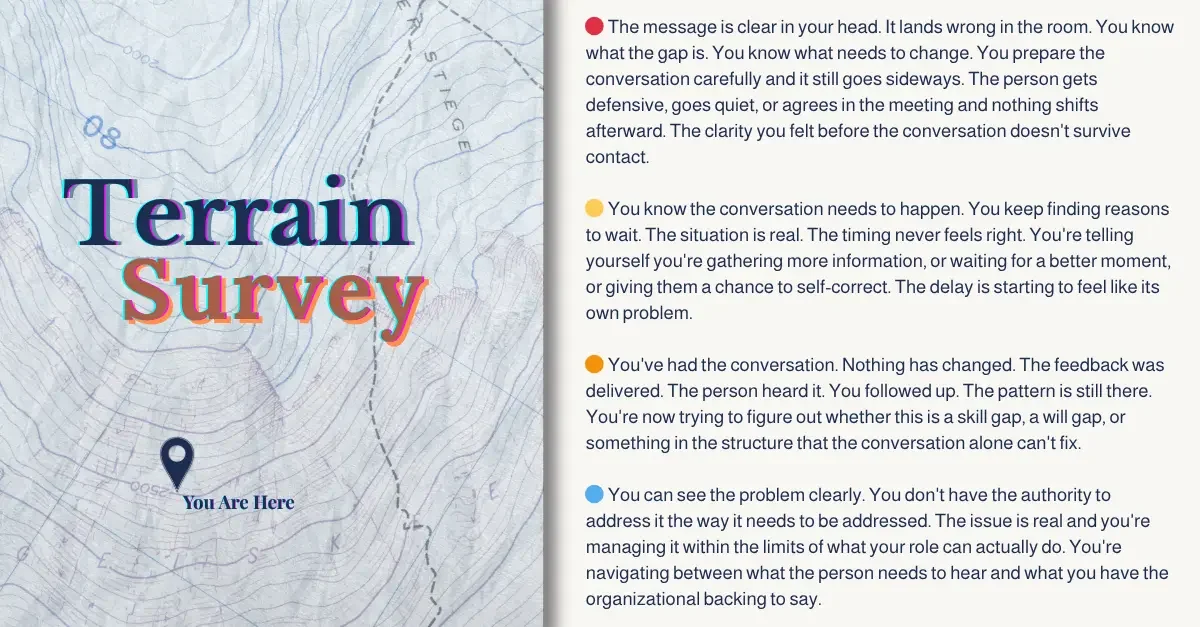
Which one of these is where you're standing right now?
What you are feeling is not a gap in your ability. It is a gap in the structure. The system that produced this pattern did not give you, or the other person, the visibility needed to prevent arriving here. The conversation is the late intervention, not the early one. The terrain has conditions. The conditions have names. And the first step is locating which one you are standing on.
What do the three feedback conversation scripts actually address?
There is a system underneath the difficult conversation, and that system has three distinct terrain types. Each one requires its own entry point.
The Accountability Script is for situations where a behavior pattern is affecting the work and the person needs to understand the gap between where their performance sits and where the role requires it to be. The entry point is shared observation, not delivered verdict. The conversation starts by describing what is visible, not by announcing the conclusion. When the person can see what the manager sees before the interpretation is offered, the defensive posture that ends most accountability conversations often doesn't appear.
The Development Script is for situations where capability is real and the ceiling is structural. The person is performing within the bounds of what they currently know how to do. The work is to extend the range. The entry point is specificity about what the next level of the work actually requires, so the person can locate the gap themselves rather than receiving it as a judgment.
The Consequence Script is the conversation where the stakes are real and need to be stated plainly. The entry point here is clarity about what the continued pattern produces. Not as threat. As fact. The conversation fails when the stakes are softened to the point where the person doesn't understand the weight of what they are being told. It also fails when the weight is delivered without the precision that makes the path forward visible.
The Difficult Conversations Guide includes structured frameworks for each of these three conversation types, with entry point language and what-to-watch-for notes for each terrain.
What managers get wrong about difficult conversations
What is the most common mistake managers make when preparing for a difficult conversation?
The most common mistake is preparing the message without locating the conversation type first. A feedback conversation where the stakes are high and the behavior pattern is well-established requires a different entry.
How do you give feedback when the person always gets defensive?
Defensiveness in a feedback conversation is usually a signal that the person has received the conclusion before they've had the chance to see the observation that leads to it.
What should you say in a consequence conversation when the situation is serious?
Consequence conversations require two things that most managers struggle to hold together: clarity about the stakes and precision about the path forward.
What if you've already had the feedback conversation and nothing has changed?
When a feedback conversation has been delivered and the pattern continues, the question shifts from what was said to what the structure around the person is reinforcing. Most people do not continue a pattern out of stubbornness.
Why the feedback conversation is a terrain question, not a skill question
Most training on difficult conversations frames the challenge as a skill to be developed. Get better at delivering hard messages. Practice the words. Learn the frameworks. Build the muscle.
The framing is not wrong. The skill matters. What the framing misses is that the conversation is not happening in a vacuum. It is happening inside a relationship, inside a team, inside an organizational culture that has been signaling things about performance, expectations, and consequence for longer than the conversation has been on the calendar.
Leadership Cartography exists for exactly this reason. Before the script comes the terrain. Before the message comes the position. A manager who can locate which feedback terrain they are standing in before the conversation starts is not using a better script. They are asking a better question.
The question is where this conversation fits in the pattern that produced the need for it. That question changes what the preparation looks like. It changes what the entry point is. It changes whether the conversation moves anything or adds another layer of stuck to a pattern that was already there.
The feedback conversation is not the intervention. It is the moment where the intervention is either possible or not, depending on how the terrain was read going in.
Your next steps
This week: Before the next feedback conversation, locate which of the three conversation types it is. Accountability, development, or consequence. The entry point follows from the type.
This month: Notice whether the difficult conversations you're having are early enough to allow course correction, or whether the pattern has already reached consequence territory before the conversation starts. That gap is a signal about what the structure around feedback is doing, not just about the individuals involved.
RELATED READING
How to Give Constructive Feedback That People Actually Listen To
How to Have a Difficult Conversation: The Framework
Locate the terrain before you write the script and discover your pathway.