
When Your One-on-Ones Are Full of Connection and Empty of Development
The relationship isn't the problem. The missing structure is.

One-on-ones that feel relationally solid but never produce development are often misread as a trust problem, a matter of deepening connection or asking more meaningful questions, when they are actually a structure problem. Relational warmth and developmental progress are not the same thing, and without a structure that tracks both, care tends to fill the meeting and accountability tends to disappear from it.
No shared record of what was promised, no developmental thread carried from one conversation to the next, no established frame that makes feedback land as a continuation rather than a surprise.
In those conditions, the difficult conversation that eventually becomes unavoidable arrives without context. The employee has no map for it because none was built.
What does it feel like when care becomes the whole meeting?
For a long time, I thought keeping things good between us was the most important thing I could do in a one-on-one. I wanted the person across from me to leave feeling supported, not burdened. I knew their job was already hard. I did not want to make it harder.
So I let the relational part fill the meeting.
I asked how they were doing, and I genuinely wanted to know. I listened. I checked in on what felt heavy. I made room for what was difficult. What I did not do was build any structure underneath that care.
I did not track a developmental thread from one meeting to the next. I did not return to what they had said they wanted to work on. I did not create a shared record of what we were noticing, practicing, or strengthening. I did not place the accountability back on them to deliver on their own development.
That felt like pressure I did not want to put on someone I was trying to support. Then performance entered the room.
I could not avoid the conversation anymore, and I walked into that one-on-one with something that needed to be said. But there was no context for it. There were no shared agreements. No developmental record. No established thread to pull from. The performance issue landed as if it had arrived out of nowhere. They left that meeting upset, and I understood why.
What I had done, in trying to protect them from difficulty, was remove the structure that would have made difficulty navigable. A relationship without a developmental record does not make feedback easier to receive. It makes feedback impossible to place.
The employee sitting across from me had no frame for what I was saying because I had never built one. I thought I was being considerate. What I was actually doing was making the hard conversation harder by waiting until it was the only conversation left to have.
If your one-on-ones feel caring and connected, but you still dread the day performance has to enter the room, this is usually what is underneath it. The relationship is real. The structure that makes both relationship and accountability possible was never built.
Why does this pattern continue even when managers try to change it?
This pattern holds because the conditions that produce it are still running. A manager can ask better questions. They can bring a new agenda. They can try to make the meeting feel more developmental.
But asking better questions inside a meeting that has no structural reason to go deeper will not change what the meeting produces. The meeting keeps returning to what it has been trained to do.
No structure exists for status outside the one-on-one: When there is no shared tracker, async update channel, team standup, or written check-in, the one-on-one becomes the only available place for operational information.
Status fills the meeting because there is nowhere else in the workflow designed to receive it. The meeting becomes operational not because the manager chose that outcome, but because no other structure has been built to take that job.
Organizations tend to measure execution, not development: In many workplaces, output is what gets counted. Projects. Deadlines. Deliverables. Metrics. Updates. Progress against visible work. A conversation about how someone is growing, what patterns they are noticing in themselves, where they feel uncertain, or what kind of judgment they are building can start to feel secondary.
Managers absorb that pressure.Development feels discretionary. Status feels necessary. So the one-on-one becomes one more place where execution gets checked instead of development getting tracked.
Direct reports bring what the pattern has trained them to bring: If a manager has opened six months of one-on-ones with “What’s the update on X?” the direct report arrives prepared to give an update on X. The pattern calibrates over time. The person does not know a different meeting is possible because a different meeting has never been established. Changing the question without changing the structure can create confusion rather than depth.
The direct report may wonder why the meeting suddenly feels different, whether something is wrong, or what answer the manager is really looking for.
Developmental conversation requires different conditions than operational conversation: Many managers are fluent in operational exchange. They can clarify priorities, remove blockers, check progress, communicate expectations, and keep work moving. Developmental conversation asks for a different kind of attention.
It requires the manager to notice patterns, stay with uncertainty, ask questions that do not resolve immediately, and connect the current conversation to a longer arc of growth.
That does not happen just because the calendar says “one-on-one.” It happens when the conditions around the meeting make that kind of conversation possible. The meeting is not failing to become developmental. The conditions for developmental conversation were not created.
That is where the map begins.
The Development Valley Terrain Survey
One-on-ones that stay relational without becoming developmental are not all stuck for the same reason. Which of these is closest to what you are standing in right now?
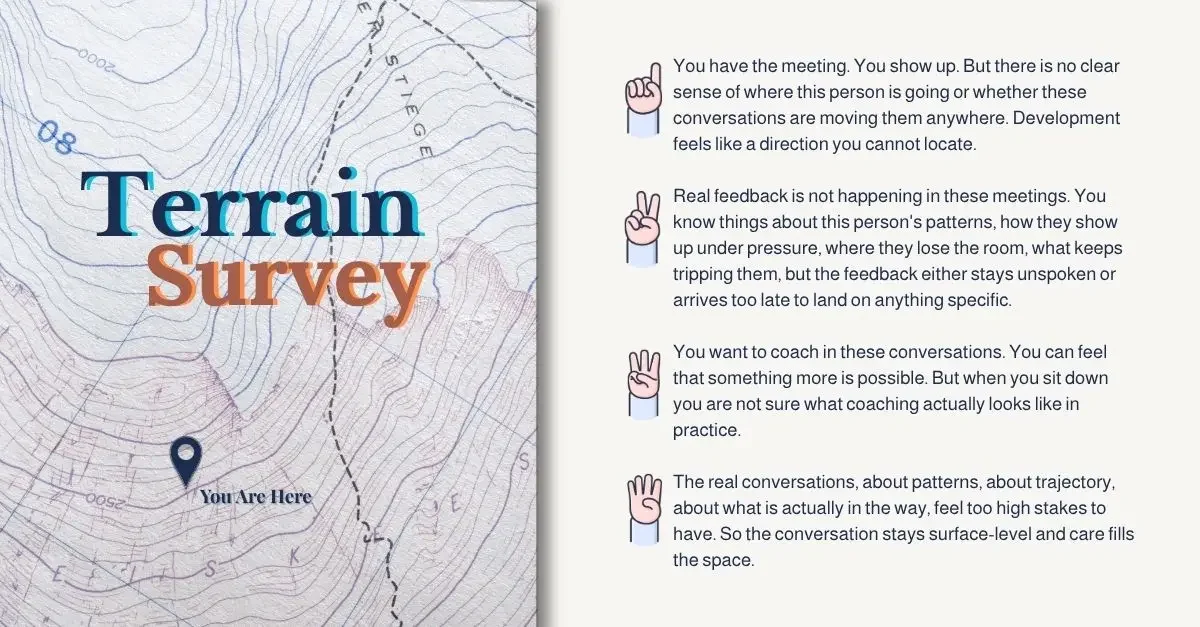
The friction point you are standing on shapes what the meeting actually needs. Choose the one that fits and find out where to begin.
Before you read the map
The one-on-one that stays relational without becoming developmental is not evidence of a skill gap. It is evidence of a structure gap. The meeting has been running on the conditions available. Different conditions were never built.
That is not a character observation. It is a conditions observation.
The manager who fills every meeting with care and connection is not failing to develop their people. They are responding to a situation where no developmental structure was established to make accountability feel like a natural part of the relationship. Once the structure exists, the conversation changes. The capacity was present. The conditions were not.
What does it actually look like to change a one-on-one?
The One-on-One Reframe Map works through four phases. Each one addresses a different layer of what is producing the relational-without-developmental default.
Signal Reading. This phase locates what the current one-on-one is actually doing, what job it has been given, what it is protecting, and what it costs to leave it unchanged. The goal is not to critique the meeting. It is to see it clearly.
Structural Redirect. Status needs a dedicated place outside the one-on-one before the meeting can be used differently. This phase builds the alternative structure, async updates, shared trackers, brief standing check-ins, so the developmental conversation has room to happen. The redirect is structural, not conversational.
Re-entry. With status relocated, the one-on-one gets a different job. This phase works with the language and posture the developmental conversation requires, the questions, the listening orientation, the comfort with staying in uncertainty rather than resolving it.
Depth as Default. The developmental conversation becomes consistent when it stops depending on the manager's effort to initiate it. This phase makes it structural, embedded in the rhythm of the relationship rather than something the manager has to remember to do.
Frequently asked questions about one-on-ones
What should a good one-on-one actually accomplish?
A developmental one-on-one does three things. It gives the manager a clear picture of how the person is doing, not what they are working on, but how they are moving through their work. It gives the direct report a space where their development is tracked by someone with authority over their growth. And it builds the kind of relational trust that makes hard conversations land as part of an ongoing relationship rather than as a sudden arrival. None of those things require a perfect agenda. They require a structure that persists between meetings.
What do you do when the direct report keeps bringing status updates even after you have tried to redirect?
The redirect has to happen upstream of the conversation, not inside it. If status has no dedicated place to go, the report brings it to the one-on-one because that is the only structure available. The most effective move is to create an alternative first, a brief async update channel, a shared project board, a five-minute standing check-in, and then let the one-on-one operate differently. The redirect without the alternative structure asks the report to suppress information that has no other place to go.
How long does it take before one-on-ones start to feel different?
The structural change is faster than the relational one. A new async update channel can be running in a week. The direct report learning to trust that the one-on-one is now a different kind of conversation takes longer. People recalibrate to new conditions gradually, based on accumulated evidence that the conditions are real and consistent. Managers who establish and maintain the new structure for six to eight weeks typically start to see the conversation shift.
What if my manager expects constant status updates on my team?
This is one of the most common structural traps for managers trying to change their one-on-ones. The pressure to be constantly informed flows downstream: the manager's manager needs updates, so the manager needs updates from their team, so the one-on-one becomes the extraction point. The most productive move is usually to make the alternative status channel visible to the manager's manager, to show them where the information lives rather than absorbing it personally first. Transparency replaces extraction.
Why the structure is the leadership work
Leadership Cartography is built on the idea that the conditions a manager creates are as important as the behaviors they model. The one-on-one is one of the most direct expressions of that principle. It is the meeting the manager controls most fully. What happens inside it reflects what the manager has decided, consciously or not, is worth protecting.
Different pathways arrive at this friction differently. Precision leaders often run the most operationally efficient one-on-ones. They are thorough, structured, and productive, and they can spend years without ever establishing a developmental thread, because the precision that makes them effective operationally also makes ambiguity feel like waste. Heart leaders feel the absence of developmental structure acutely but often read it as a relationship problem rather than a structural one. They sense something is off and turn toward the relationship for an answer that only structure can provide. Purpose leaders want the one-on-one to connect to something larger, and when it stays relational without direction, it produces a flatness that is hard to name but easy to feel.
Leadership Cartography does not prescribe what a one-on-one should look like. It gives the manager a way to see which conditions they have built, which they have inherited, and which ones they can actually change. The meeting is not the problem. The structure around it is. And structure, once visible, can be worked with.
Related Reading
How to write a development plan that actually drives growth