
Manager Overwhelm: Why Legacy Systems Do Not See Human Limits
Manager overwhelm is a structural condition that surfaces when an organization has no mechanism for treating the manager's time and attention as a finite resource. The role is designed as a compression point. It carries upward communication, downward execution, lateral coordination, and everything that does not fit cleanly into any of those directions. What the design rarely accounts for is a ceiling.
The result is a workload that keeps expanding without any organizational response to the expansion. The manager absorbs escalations, ambiguous projects, and access expectations that treat availability as unlimited. The pressure compounds regardless of how well the manager manages themselves. That is the condition manager overwhelm describes: a structural condition the system was never built to see.

Have you tried every system for managing the load and still ended up back in the same place?
I had a routine that worked for a while. Morning block for thinking work, inbox cleared before nine, Fridays structured loosely enough to catch what had fallen through the week. I was good at it.
And then the job shifted in ways I could not quite name. Not a single spike. A slow, steady addition. One more project with no owner. A standing expectation of faster response times. Meetings that multiplied until the thinking blocks were gone. Each individual change felt manageable. The accumulation was not.
I kept adjusting. Earlier starts, tighter blocks, more deliberate triage. Every system bought some relief and then disappeared into the same pressure that had produced the problem in the first place.
What I understand now is that I was applying personal solutions to an organizational condition. The system had not been designed with my capacity as a limiting factor. It treated my availability as a shared resource. No routine I built was ever going to close that gap, because the gap was not mine to close.
Structural overwhelm does not respond to better management. The gap was never yours to close.
Why doesn't better time management solve the overwhelm?
The middle manager role is, by design, a holding position. It carries the weight from above and the weight from below, plus everything lateral that has no clearer place to land. The person in that role is accountable for execution they did not set in motion and communication they did not originate.
What organizations rarely build into this design is any recognition that there are limits to what a person can hold. The manager's availability is treated as a standard, not a resource. Response time becomes a performance metric. Capacity is assumed. When volume increases, there is no organizational mechanism that recalibrates the design to match. The system simply continues.
Gallup's 2026 State of the Global Workplace report found that manager engagement dropped nine points since 2022, reaching 22% in 2025. Gallup DHR Global's 2026 Workforce Trends Report identified overwhelming workloads as the top burnout driver across all regions, cited by 48% of respondents, with burnout's drag on engagement growing from 34% to 52% year over year. DHR Global These numbers reflect a structural condition in which the people doing the most compressive work in the organization are not being protected by the organizational design.
A personal productivity system improves what a person can control. It does not address what the organization has not designed. The gap between what the system sends and what the manager can absorb is structural. Closing it requires a different kind of intervention than another morning routine.
Terrain Survey: The Overwhelm Gully
Before you try to fix this, locate where you are in it. Manager overwhelm is not one thing. It arrives through a specific structural opening, and that opening determines what actually helps.
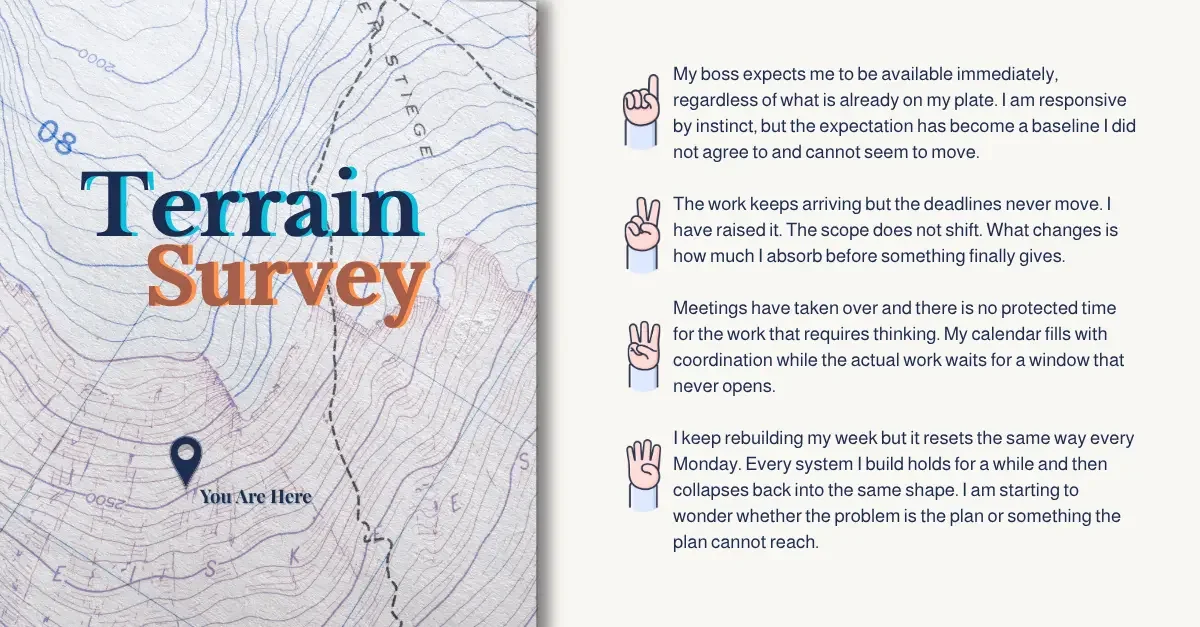
How does a manager navigate a system that was designed for their throughput but not their capacity?
Most managers carry overwhelm as a private condition. What feels like poor prioritization or an inability to keep up is usually a breakdown in how the organization accounts for its own compression points. When the system treats the manager's availability as unlimited, the manager absorbs what the structure cannot hold. The issue is not effort. The design never included a ceiling.
What does structural manager overwhelm look like as a pattern?
The Overwhelm Type Map identifies four conditions that produce compressive workload.
Always-on access produces overwhelm when availability is treated as a performance standard rather than a resource. The manager is accessible not because the situation requires it but because not being accessible carries a cost they cannot afford.
Workload without timeline relief produces overwhelm when volume compounds without any corresponding adjustment to scope or deadline. The work gets more. The time does not.
Meeting proliferation produces overwhelm when coordination demands consume the protected time required for judgment-heavy work. The calendar fills. The work does not move.
Toxic project entrapment produces overwhelm when the manager is embedded in a failing project with no viable exit and no clear authority to surface what is not working. They manage damage, not outcomes.
These four conditions can arrive together. They each have a different pressure source, which means they do not respond to the same intervention.
What kind of leader are you under pressure?

Structural overwhelm lands differently depending on how you lead. The Support leader absorbs until the weight becomes invisible. The Heart leader carries the relational load on top of everything else the system sends. Knowing which one you are changes where you start.
The Leadership Map Quiz takes about four minutes. It places you on the map and names the terrain you are most likely navigating.
What actually helps when the load is structural?
What tends to help
Locating the type of overwhelm before trying to solve it. The entry point determines what an effective response looks like. A week with no protected thinking time calls for a different intervention than a week dominated by a project with no exit.
Separating what is a capacity problem from what is a signal problem. Some overwhelm is volume. Some is a communication or relationship condition that keeps regenerating pressure regardless of how well the week is managed.
Treating protected time as a structural necessity rather than a goodwill arrangement. Goodwill gets overridden by urgency. Structure holds longer.
Surfacing constraint upward before it reaches crisis. The organizational levels above cannot see what they have not been shown. What is absorbed silently is also managed silently, indefinitely.
What tends to make it worse
Applying harder personal optimization to a structural condition. This delays the pressure but does not address its source. The conditions regenerate.
Absorbing ambiguous projects without naming the absorption. What a manager takes on without acknowledgment, they also carry without acknowledgment.
Treating the overwhelm as temporary. Structural conditions do not self-correct without a change to the structure. They stabilize at the level of compression the system has normalized.
Waiting for the organization to recognize the problem. Organizations that have no mechanism for seeing the ceiling also have no mechanism for seeing when it is being reached.
How does your leadership style shape the way this lands?
The Support pathway leader is particularly vulnerable to structural overwhelm because the instinct to absorb is part of how they lead. They take on what they perceive team cannot handle. They stay available because someone has to be. They hesitate to surface constraint upward because doing so can feel like exposing the team or failing the role.
The overwhelm a Support leader carries often looks, from the outside, like someone who has it handled. They are responsive, dependable, present. What is not visible is the compression beneath that presence: the accumulation of what was taken on without acknowledgment, the projects managed silently, the early starts that happened because the day was already full before it began.
The Heart pathway leader navigates a version of this that carries relational weight alongside structural weight. The pressure is not only volume. It is the emotional availability the role requires, stacked on top of everything else the system sends. When the structure generates more need than the leader can meet, the gap tends to read as personal failure. It is never that.
What Leadership Cartography offers here is a way to separate the condition from the character. The overwhelm is structural. The instinct to absorb it is a strength that a particular kind of system has learned to depend on. Understanding which one you are navigating changes what the first move looks like.